The Story of St Brendan’s Oratory and Its Medieval Frescoes
Along the western edge of the Iveragh Peninsula, stone buildings carry memories that reach back beyond written records. St Brendan’s Oratory belongs to that landscape of early Christian devotion, coastal travel and monastic settlement, where a small structure could serve as a place of prayer, refuge and local gathering.
Its story is closely connected with Brendan the Navigator, the Kerry-born saint whose legendary voyages helped shape Ireland’s medieval imagination. The surviving fabric is quieter than the stories told about him, yet its walls and fragments of painted decoration offer a valuable glimpse into how faith was experienced in a remote Atlantic community.
For visitors from Australia, the site can be understood as part of a wider heritage journey rather than a single stop. It sits within the cultural geography of the Skellig Coast, where ancient buildings, fishing settlements, island traditions and dramatic sea crossings are all linked.
A Saint Shaped By The Atlantic
Brendan is traditionally associated with the western coast of Ireland and with voyages into the unknown. Medieval texts describe his sea journey in spiritual and symbolic terms, blending geography, biblical imagery and the imagination of an island society accustomed to uncertain waters.
The saint’s reputation travelled widely. Churches, wells and settlements were named for him across Ireland, and his feast day remains an important part of local religious heritage. Along the Kerry coast, his name also reflects the practical reality of early Christian life: communities relied on boats, sheltered coves and knowledge of tides to remain connected.
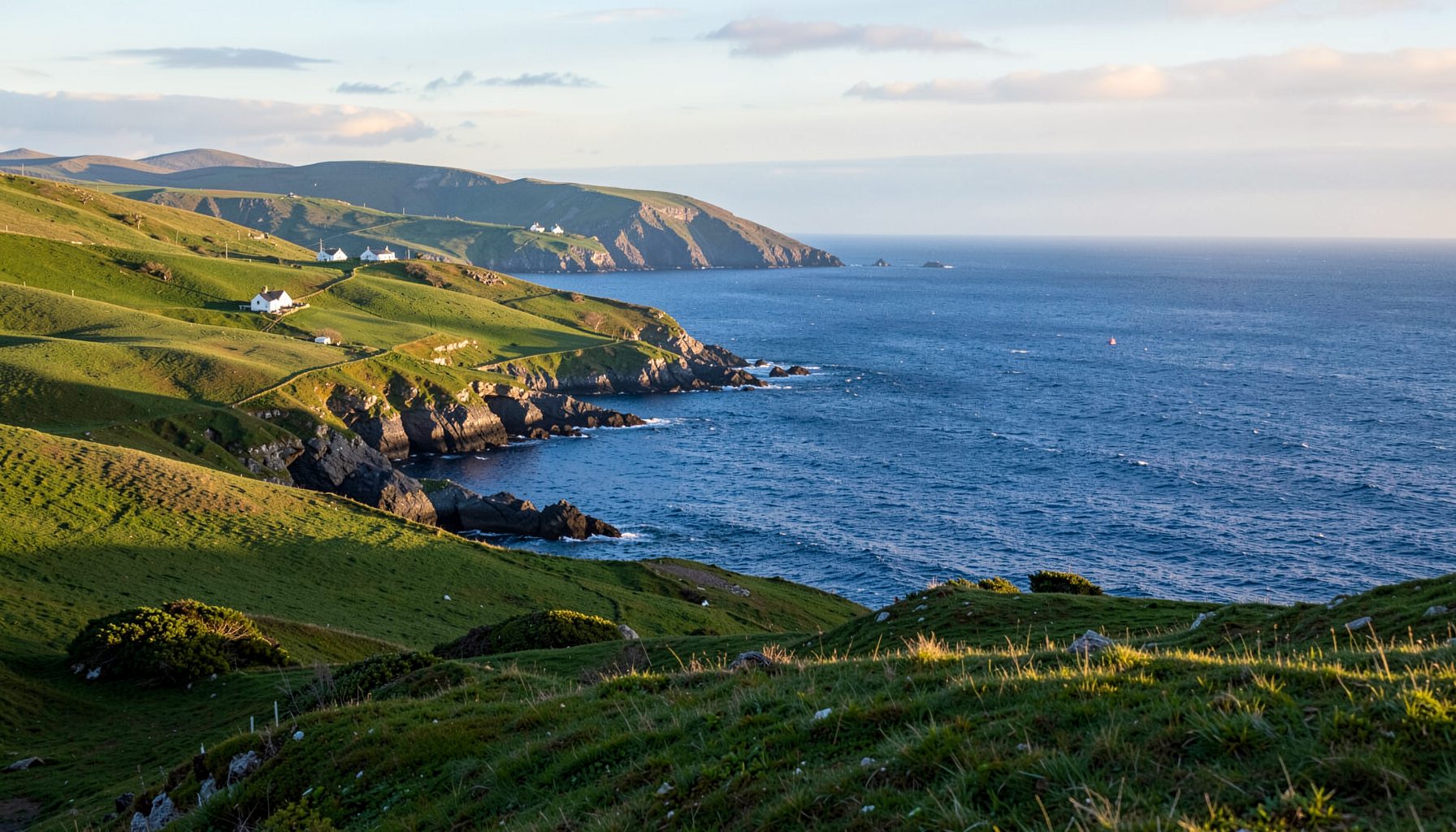
That maritime setting matters when reading the oratory’s history. This was not an isolated monument in an empty landscape. It belonged to a network of settlements, tracks, fields and landing places, each shaped by the Atlantic weather and by movement between the mainland and offshore islands.
The Oratory In Its Kerry Setting
St Brendan’s Oratory is best approached as part of a wider medieval landscape rather than as a building that can be separated from its surroundings. Small oratories were places of worship, but they could also mark a saint’s association with a locality and provide a focus for seasonal devotion.
The surviving structure has the simplicity often associated with early Irish ecclesiastical architecture: thick masonry, a compact interior and an emphasis on durability. Such buildings were made for a demanding climate. Wind-driven rain, salt air and repeated repairs have affected the stonework, while later changes in land use have altered the setting around it.
Visitors should allow time to notice details that are easy to miss. Doorways, joints in the masonry, fragments of plaster and the relationship between the building and nearby ground can reveal as much as a dramatic view. The site rewards a slower pace, especially when approached as a heritage place rather than a photo stop.
What The Frescoes Reveal
The medieval frescoes are important because painted interiors were once far more common than the surviving remains suggest. Churches and oratories were not necessarily bare stone spaces. Colour, figures and decorative borders helped worshippers understand sacred stories, particularly in communities where access to books was limited.
Only fragments or traces may survive, and their condition can vary according to moisture, exposure and conservation history. Even a small patch of pigment can indicate that the interior once held a richer visual programme. Red and ochre tones, outlines of figures or traces of ornamental pattern may have helped divide the walls into scenes and symbols.
It is useful to avoid treating the paintings as if they were a complete gallery. Time, damp and rebuilding have interrupted the original sequence. Their value lies partly in what remains and partly in the evidence they provide about medieval religious culture along Ireland’s western seaboard.
Reading A Medieval Sacred Space
A fresco was more than decoration. Images could guide prayer, reinforce the stories of saints and make the meaning of a service more accessible. In a small oratory, the scale of the room would have brought the painted figures close to the people gathered inside, creating an intimate setting for worship.
The imagery associated with medieval churches often included saints, biblical episodes, angels, crosses and symbolic motifs. Interpretation should be cautious where only fragments remain, since a partial outline can be difficult to identify with certainty. Archaeologists and conservators compare pigment, style, plaster layers and related sites before assigning a date or subject.
This layered approach is especially useful for Australian visitors accustomed to reading Aboriginal rock art, convict sites or gold-rush buildings through evidence and cultural context. Every heritage place has its own protocols, but the shared principle is clear: the visible remains are part of a larger story, and gaps in the evidence should be acknowledged rather than filled with confident invention.
Weather, Conservation And Respect
The Atlantic climate is one of the greatest forces shaping the oratory today. Rain can enter through vulnerable sections, salt carried by sea air can affect surfaces, and cycles of damp and drying can weaken plaster. Conservation therefore involves careful monitoring rather than simply repairing the building once and leaving it alone.
Painted surfaces are particularly fragile. Touching a wall, leaning equipment against it or using flash in a confined space can cause damage over time. Visitors should follow local access instructions, remain on appropriate paths and avoid entering restricted areas, even when the building appears empty or unmanaged.
The same care applies across the Skellig Coast. Offshore wildlife sites, including seabird colonies, can be sensitive to disturbance. Planning a visit alongside reliable local information about puffin colonies helps connect the oratory’s cultural story with the living coastal environment around it.
Following The Story From Australia
For Australians, the most practical comparison may be with a heritage drive through regional Victoria or along the Great Ocean Road. The distances can look modest on a map, yet narrow lanes, weather changes and limited services can make a short Irish route take longer than expected. A flexible itinerary is more useful than trying to tick off every location.
The Skellig Coast also suits travellers who enjoy local interpretation. Community museums, village noticeboards, walking routes and small cultural initiatives often provide context that a major attraction cannot. In Ireland, phrases such as “grand” or “a bit fresh” may describe conditions that visitors from Brisbane or Perth would consider genuinely cold, particularly near exposed headlands.
Australian school-holiday timing and the European summer season can overlap, creating pressure at popular coastal sites. Booking any required boat trip well ahead, checking road conditions and carrying a waterproof layer are sensible habits. Travellers from Sydney or Melbourne may recognise the rhythm of a regional destination where cafés, galleries and visitor services operate with shorter hours outside the main season.
A Useful Heritage Visit
The oratory works well as part of a day centred on local history rather than as an isolated attraction. Combine it with nearby archaeological sites, village heritage, coastal walks or a visit to a learning hub, allowing enough time for weather and conversation. The broader setting helps explain why a small religious building mattered to people living on the edge of Europe.
Interpretive material may distinguish between established evidence, local tradition and later legend. That distinction strengthens the experience. Brendan’s voyages are powerful stories, but the archaeological value of the oratory rests in its physical remains, its setting and the traces of medieval devotion preserved in the walls.
| Feature | What It Helps Explain | Visitor Value |
|---|---|---|
| Saint Brendan tradition | Kerry’s maritime religious history | Connects legend with the Atlantic landscape |
| Compact stone structure | Early and medieval worship practices | Shows how modest buildings served local communities |
| Fresco fragments | Medieval colour, storytelling and devotion | Reveals a lost interior world |
| Coastal setting | Weather, travel and settlement patterns | Places the oratory within its living environment |
| Conservation needs | The fragility of plaster and stone | Encourages responsible visitation |
A visit is most rewarding when approached with patience. Look closely, listen to local interpretation and remember that the surviving fragments are vulnerable. The oratory’s quietness is part of its character; it does not need the scale of a cathedral to communicate the depth of Kerry’s religious and maritime past.
Explore the Skellig Coast’s heritage stories, villages and community initiatives before setting out, and make St Brendan’s Oratory part of a respectful journey through the peninsula’s layered history.