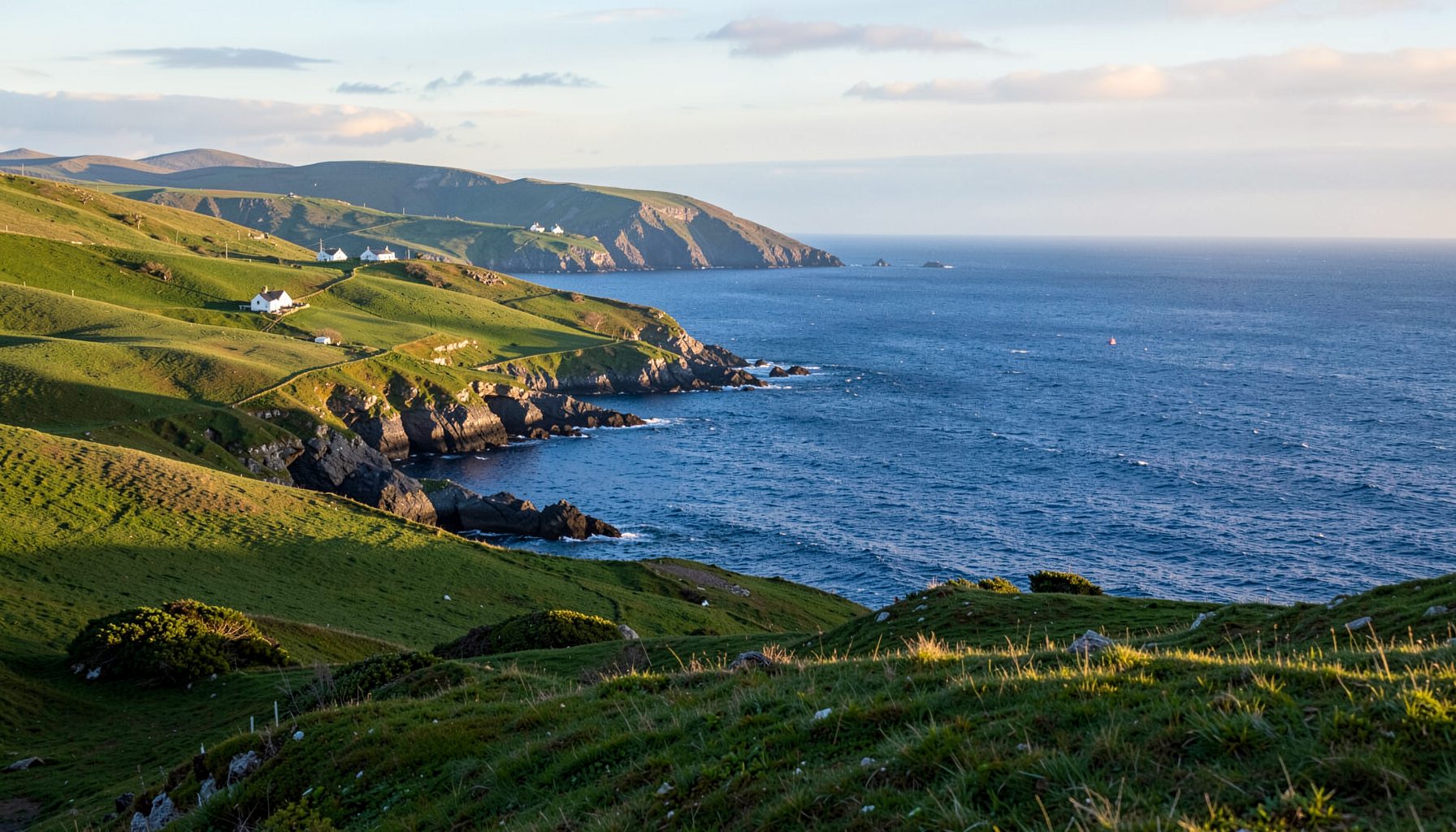
Abbey Island And Its Medieval Ruins
Abbey Island lies just off Derrynane Beach on the southern edge of the Iveragh Peninsula, where the Atlantic reaches into a sheltered curve of coast. At low tide, a sandy and rocky route connects the mainland to the island, leading visitors towards the weathered remains of a medieval church, an old burial ground and fragments of a much older Christian story.
For Australians, the place offers a very different kind of coastal heritage experience from Port Arthur, Fremantle Prison or the historic villages along the Great Ocean Road. There are no grand visitor buildings or neatly staged interiors here. Abbey Island is an open archaeological site, shaped by salt air, grazing land, tides and the continuing life of the Derrynane community.
A Sacred Place Before The Ruins
Tradition links Abbey Island with St Finan, an early Irish saint associated with Christian settlement in the region. The island’s religious history may reach back to the sixth century, when small monastic communities were often established in remote coastal locations. These sites were places of prayer, study, farming and burial, rather than isolated churches in the modern sense.
The surviving structure belongs to a later period. Its rough stone walls and recognisable medieval church form give visitors a tangible sense of the building that replaced or developed around the earlier settlement. Much of the early monastic site has disappeared, yet the landscape still communicates why this location mattered: it was close to the sea, sheltered from the worst Atlantic exposure and connected to the mainland by a tidal crossing.
Early Irish monasteries were frequently modest in scale. Their importance came from continuity, local devotion and the people who gathered around them. Abbey Island should therefore be read as part of a wider network of religious sites across Kerry, rather than as a single monument standing apart from its surroundings.
Reading The Medieval Church
The ruined church is built in the restrained style associated with medieval Irish religious architecture. Its stonework is practical and sturdy, while the remaining openings and wall lines hint at the original interior. Weathering has softened many details, but the surviving masonry still allows careful visitors to imagine a nave, a sanctuary and a place where generations came to worship.
The ruins are especially powerful because they have not been separated from the burial ground around them. Gravestones and memorials make the site feel less like an abandoned building and more like a continuing place of memory. Some markers are difficult to read, and uneven ground means that the cemetery rewards patience rather than a quick walk-through.
Abbey Island is also connected with the O’Connell family and the heritage of Derrynane House, the home of Daniel O’Connell, the nineteenth-century campaigner for Catholic Emancipation. The churchyard adds a local dimension to that national story. It shows how political history, family remembrance and older religious traditions overlap in one small coastal setting.
What To Notice On A Visit
The tidal crossing determines the entire experience. Conditions can change quickly, and a route that looks straightforward on the way out may become unsafe when the tide turns. Visitors should check reliable local tide information, allow plenty of time and avoid treating the crossing as a casual shortcut. In Ireland, asking locally before setting off is often the wisest approach.
| Feature | What It Offers | Practical Consideration |
|---|---|---|
| Tidal access | A memorable approach across the shore | Cross only during a suitable low-tide window |
| Medieval church ruins | Stone walls, architectural traces and atmosphere | Uneven surfaces require sensible footwear |
| Burial ground | Local family history and older memorials | Treat graves and stones with respect |
| Atlantic setting | Views towards Derrynane Bay and surrounding hills | Wind and rain can arrive quickly |
| Nearby Derrynane heritage | Links to the O’Connell family and estate | Allow time to explore beyond the island |
For an Australian visitor, the rhythm may feel familiar in one respect: it resembles the need to understand beach conditions before heading out, whether at a remote stretch near Broome, a reef access point in Queensland or a rock platform outside Sydney. The difference is that Abbey Island combines coastal safety with an archaeological boundary that is not always obvious on the ground.
Wear shoes with a firm grip, carry a waterproof layer and keep phones protected from spray. A sunny morning in Caherdaniel can become a damp, windy arvo on the shore. The island is best approached slowly, with attention to the tide, the surface underfoot and the people who still regard the area as part of their home landscape.
The Island In Its Wider Landscape
Abbey Island makes greater sense when seen alongside Derrynane Beach, Derrynane House and the coastal roads leading towards Castlecove and Waterville. The surrounding scenery is not merely a backdrop. The church, burial ground, pasture, shore and nearby settlements form a connected cultural landscape that has been used and reshaped over many centuries.
The hedgerows and field boundaries around the Skellig Coast are part of that story. They reflect farming practices, property lines and local knowledge passed between generations. A closer look at hedge-layer's work helps explain why these apparently ordinary boundaries remain important to the character of the Ring of Kerry.
From the island, the view extends across Derrynane Bay towards hills and headlands that have guided boats, walkers and farming families for generations. The setting can encourage a grand historical imagination, but the details are often small: a gate, a field wall, a worn path, a patch of sheltering grass or a name remembered by local families.
A Different Heritage Experience For Australians
Australian travellers are often accustomed to heritage places with timed entry, paid interpretation, marked paths and clear signage. Abbey Island works differently. Its value comes through observation, prior reading and a willingness to accept that the site is part of an active rural and coastal environment. The lack of a formal attraction layout is part of its character, though it also makes responsible preparation essential.
The Australian tourism market has a strong appetite for self-drive regional itineraries. Visitors may be combining the Skellig Coast with a longer Ring of Kerry circuit, much as they might link Hobart, Port Arthur and the Tasman Peninsula or travel between Melbourne and the Twelve Apostles. Abbey Island suits that style of journey, provided it is treated as one carefully timed stop rather than a guaranteed quick detour.
A few local words can also help visitors settle into the place. Someone may describe a short walk as “grand”, meaning perfectly fine, or advise you to wait until the tide is “right”. The relaxed pace should not be mistaken for a lack of knowledge. Local people understand the shore in practical terms, and their advice can be more useful than a rushed online itinerary.
For Australian families travelling during school holidays, weather and tide planning matter as much as driving time. A site that is accessible on one morning may be unsuitable later in the day. Building flexibility into the itinerary is sensible, especially when the wider region includes narrow roads, changing weather and attractions whose opening hours vary by season.
Protecting A Fragile Coastal Heritage Site
The ruins and cemetery are vulnerable to the same forces that created the island’s atmosphere. Salt, wind, rain, frost and plant growth gradually wear down the stone. Increased foot traffic can damage fragile ground, disturb graves or widen informal paths. Visitors should keep to durable surfaces where possible and avoid climbing on walls.
Respectful behaviour is particularly important in the burial ground. Do not move stones, rub inscriptions to make them clearer or use memorials as seats. Photography is welcome when handled thoughtfully, but people visiting family graves should be given privacy. A quiet approach is appropriate even when the island is being enjoyed as part of a sightseeing day.
The site also benefits from the wider principle of leaving no trace. Take rubbish away, keep dogs under control and avoid collecting stones or shells. Abbey Island is not a theme park reconstruction; its character depends on the survival of original fabric and the continued relationship between the ruins and the local community.
Learning about the church before arriving can make a short visit much richer. Notice the relationship between the building and the shore, look for changes in masonry and consider how the site may have functioned when the surrounding landscape was more difficult to cross. These details turn a photograph stop into a genuine encounter with medieval Kerry.
Making Abbey Island Part Of A Skellig Coast Journey
A visit can begin at Derrynane Beach, continue across the tidal route and then extend to Derrynane House or another nearby heritage and landscape site. The pace should remain unhurried. Allow time for weather delays, tide restrictions and the possibility that the crossing will not be appropriate at the moment you arrive.
The wider Skellig Coast offers many ways to deepen the story. Community initiatives, local learning hubs, walking programmes and village events show how heritage remains connected to present-day life. Medieval ruins are valuable, but they become more meaningful when visitors also understand the people who maintain fields, guide visitors, organise activities and care for local history.
Abbey Island’s significance lies in its layers: early Christian tradition, medieval worship, family burial, national political history and the everyday life of a tidal shore. Those layers cannot be reduced to a single date or famous name. They are encountered gradually, through the ruined walls and through the landscape that continues around them.
Add Abbey Island to a respectful Skellig Coast itinerary, check the tide before travelling and give the site the time it deserves. Explore the nearby villages, heritage places and community stories as well, so your visit supports a deeper connection with the people and landscapes of Ireland’s Iveragh Peninsula.