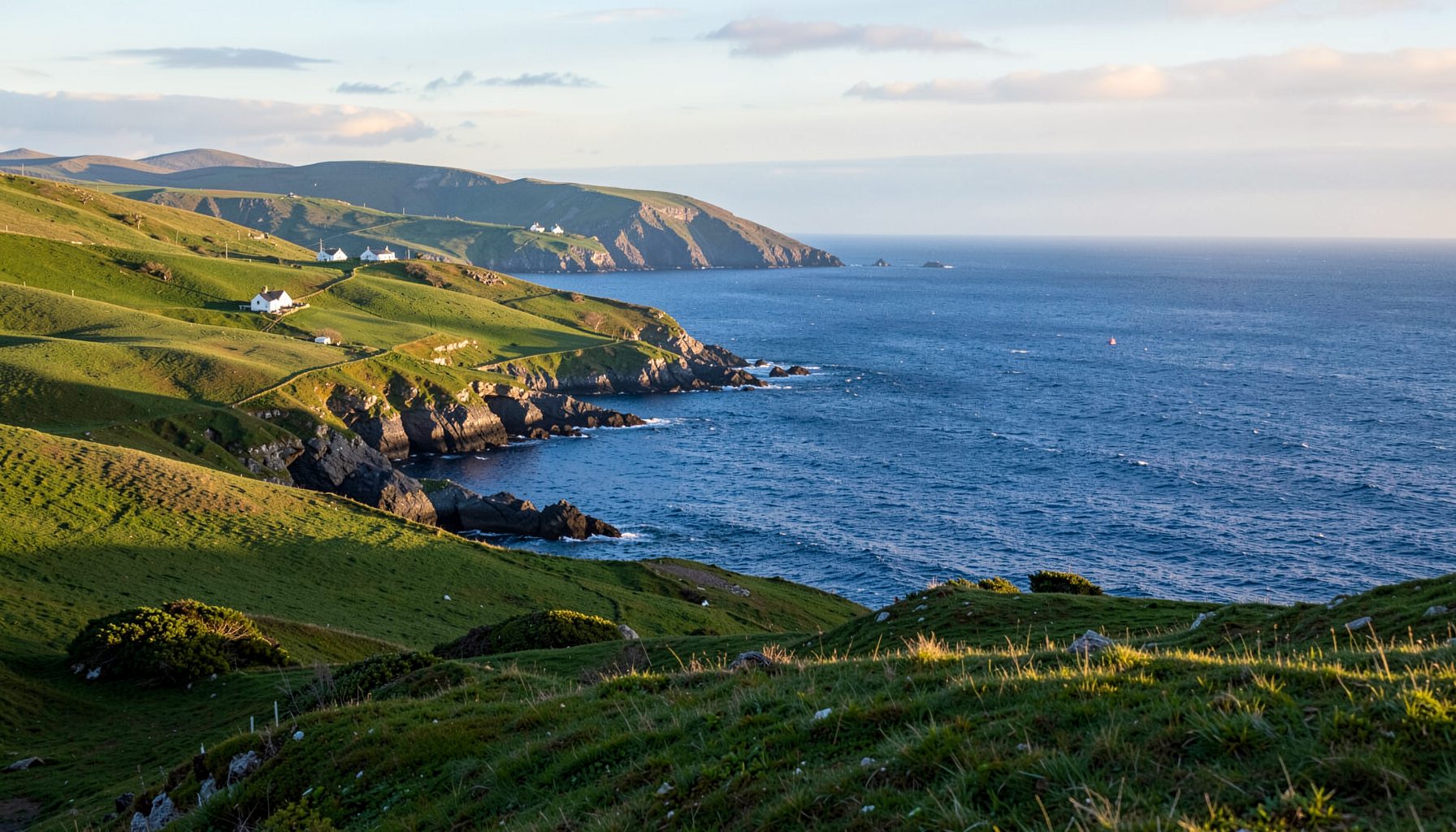
A Day Behind Kerry’s Traditional Stone Walls
The life of a traditional stone wall builder in Kerry begins with an understanding of place. Along the Skellig Coast, from Kells to Castlecove, walls divide fields, shelter livestock and trace the contours of hills shaped by wind, rain and generations of farming. They are practical structures, yet they also form one of the region’s most recognisable cultural landscapes.
A dry-stone wall is made without cement or mortar. Its strength comes from careful selection, weight, friction and the slight inward lean built into each course. Every stone has a likely position, whether it is a broad foundation block, a small piece of hearting or a long coping stone set across the top.
For an Australian reader, the work may recall dry-stone walls around Tasmania, South Australia or Victoria, though Kerry’s wet Atlantic climate creates its own demands. The craft is physical, patient and deeply local. It calls for knowledge of geology, weather, livestock and the quiet habits of rural communities.
Reading The Land Before Lifting A Stone
A wall builder does not arrive and start stacking immediately. The first task is to read the ground: where water gathers, how a slope moves after heavy rain, which direction cattle are likely to push and whether an older wall has settled into a stable line. On the Iveragh Peninsula, shallow soil and exposed rock often make the foundation both visible and challenging.
Stone may come from a collapsed section, a nearby field or a local clearance project. Granite, sandstone and other rocks each behave differently under a hammer. Some split cleanly; others fracture unpredictably. The builder learns to recognise a stone’s grain, weight and balance before deciding whether it belongs at the base, in the middle or along the crest.
This knowledge is especially valuable around coastal roads and upland fields, where salt-laden wind and persistent rain test every repair. A wall that looks sound in summer may reveal loose packing after a winter of saturated ground and repeated frost.
The Working Day In Kerry
The day often starts early, particularly when a wall stands in an exposed field with little shelter. Tools are simple: gloves, a stone hammer, a shovel, a line, a bar and sometimes a small lifting aid. The builder may work alone or with an experienced partner, using a trailer or farm vehicle to move stone close to the job.
Much of the labour is sorting. Large foundation stones are placed first, with their broadest faces settled firmly into the ground. Smaller stones fill gaps inside the wall, creating hearting that prevents movement. Each layer is checked by eye and hand, because a wall can look straight while carrying hidden instability.
A traditional builder develops a steady rhythm rather than rushing. Lift, turn, test, settle and step back: these repeated actions protect the wall and the worker. A short break for a cuppa is part of the working culture, particularly when rain comes across the hills and everyone needs a moment to warm their hands.
How A Dry-Stone Wall Holds Together
The visible face of a wall is only part of its structure. Good foundations spread weight over firm ground, while the wall’s sides taper slightly towards the top. Through-stones may run across the width to tie both faces together. The upper coping course adds weight and helps finish the line, often with stones carefully placed like small architectural features.
Builders do not rely on identical dimensions. The character of a Kerry wall comes from variation: rounded beach-worn pieces beside rough field stone, pale surfaces against dark moss and irregular courses following the land. The wall must be orderly enough to stand, but flexible enough to belong to its setting.
Repair work requires restraint. Rebuilding an entire section may be unnecessary if only a few stones have shifted. The builder removes unstable material, checks the older courses and reconnects the damaged area. Preserving an established wall’s profile matters, especially near older farmsteads, walking routes and heritage sites.
Weather, Muscle And Patience
Rain changes the pace of the work. Wet stones are slippery, clay becomes heavy and visibility can fall quickly in coastal mist. A builder must know when to continue and when a temporary cover or an early finish will prevent injury. Strong winds also make it difficult to handle broad stones safely on open ground.
The physical strain is cumulative. Repeated lifting affects the back, shoulders and hands, while kneeling and crouching place pressure on the legs. Experienced builders use body position carefully, keeping loads close and avoiding unnecessary twists. The craft rewards fitness, but technique is what allows it to continue over decades.
Kerry’s weather also explains why maintenance never really ends. Rainwater finds small weaknesses, sheep lean against convenient gaps and vegetation takes root in joints. A wall builder may return to the same farm several times over many years, becoming familiar with its trouble spots and seasonal patterns.
Work, Tourism And Community Memory
A stone wall is part of a working landscape, not a decorative backdrop. It can mark a townland boundary, guide animals, protect a patch of crops or define an old route between settlements. Builders often hear local stories while working: who built a wall, when a field changed hands, or which stones came from a long-vanished house.
The walls also shape visitor experiences. People travelling through the Skellig Coast may notice how field boundaries frame views towards the sea or create narrow passages beside rural roads. Those interested in seeing the countryside at a slower pace can connect the wall craft with pony trekking routes, where landscape, animals and local access come together.
Tourism brings useful attention, yet the builder’s primary responsibility remains the community that lives with the wall. Repairs must respect farm access, road safety and land management. A picturesque structure that blocks a gate or collapses onto a public lane is still a practical problem.
Kerry Craft Through An Australian Lens
Australian landscapes offer useful comparisons, though the conditions are different. Around Hobart and parts of Tasmania, old stone walls reflect agricultural settlement and local volcanic or sedimentary rock. In South Australia, dry-stone features may appear in vineyard country or historic rural districts. Victoria’s older pastoral areas also show how stone can define a property without mortar.
The following comparison highlights the shared principles and the differences a builder would notice.
| Feature | Kerry stone wall building | Australian comparison |
|---|---|---|
| Climate | Cool, wet and windy, with frequent Atlantic rain | Often drier, with intense sun, heat or seasonal storms |
| Main pressure | Saturated ground, livestock and plant growth | Soil movement, heat, drought, fire exposure or heavy rain |
| Materials | Local field stone, sandstone, granite and cleared rock | Basalt, granite, sandstone and locally quarried stone |
| Work culture | Farm-based repairs shaped by community knowledge | Tradie, landscaping and heritage-restoration markets |
| Finishing style | Strong taper, tight hearting and prominent coping | Varies from heritage reconstruction to garden walls |
| Maintenance | Regular attention after wet winters | Inspection after storms, drought movement and ground shifts |
In Melbourne, a heritage-minded landscaper may need to balance traditional appearance with urban regulations and limited access. A builder working near Sydney may contend with a busy residential market where stone walls are commissioned for gardens, boundaries and architectural projects. In Adelaide, local stone and dry conditions can produce a different rhythm of weathering from the Atlantic coast.
The Australian market also values visible craftsmanship. Clients may discover a wall builder through a Saturday farmers’ market, a heritage fair or a local landscaping network, then arrange transport in a ute and discuss stone availability by the load. That commercial setting differs from a Kerry farm repair, but the core skill remains the same: placing each stone so the whole structure works.
Passing The Skill Forward
Traditional wall building is learned through observation and repetition. An apprentice watches how an experienced builder tests a foundation stone, hears the difference between a solid placement and a hollow one, and gradually takes responsibility for a section. Written instructions help, but the hands must learn weight, balance and resistance.
Community workshops, heritage programmes and practical demonstrations can support this process. They also give younger people a reason to see rural skills as valuable work rather than a fading curiosity. On the Skellig Coast, such knowledge links everyday farming with the wider story of the peninsula’s settlements, roads and field systems.
The craft has a quiet environmental benefit as well. Reusing stone from a collapsed wall avoids unnecessary transport and preserves local character. A well-maintained boundary can support insects, small plants and sheltering wildlife, while keeping livestock and visitors safely separated.
The Meaning Of A Finished Wall
When the last coping stone is set, the builder checks the line from several angles. The wall should appear settled rather than overly polished. Its base must sit naturally on the ground, its faces should lean with purpose and its top should resist the first push of weather or livestock.
Then the builder walks away from the work, often leaving little sign of the labour involved. Visitors may see an attractive boundary; farmers see a dependable part of the holding; local families may see a feature that has been present for as long as anyone remembers. Each viewpoint adds to the wall’s meaning.
That is why the craft remains relevant across Kerry. It joins practical repair with landscape identity, using nearby materials and inherited judgement. For Australians interested in rural heritage, dry-stone walls offer a strong reminder that durable construction can be modest, local and carefully adapted to its environment.
Explore the Skellig Coast’s villages, heritage stories and community life with the same attention a wall builder gives to the land. Look closely at field boundaries, notice how stone meets weather and share the value of these living traditions with others travelling through the region.