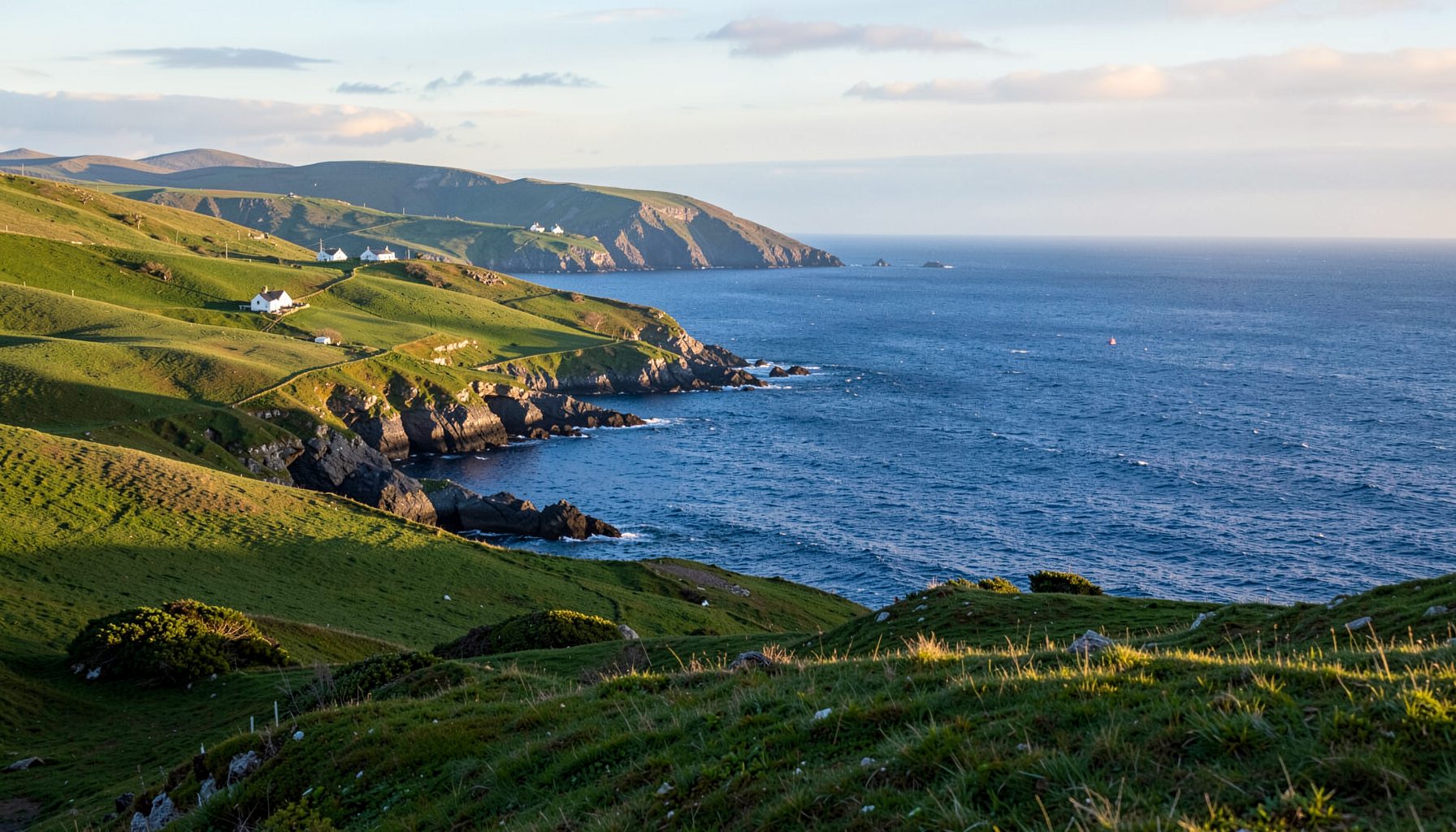
Listening Across the Skellig Coast
A local historian recording oral histories of the villages works close to the ground. The work may begin with a conversation at a kitchen table, a notebook opened beside a cup of tea, or a walk along a boreen where an older resident remembers the names once used for fields, lanes and shorelines. On the Skellig Coast, these accounts connect the communities from Kells to Castlecove with the wider story of Ireland’s Iveragh Peninsula.
The landscape is often the first archive. Stone walls, abandoned cottages, piers, holy wells and schoolhouses carry clues, while memory gives them meaning. A place that appears quiet to a visitor may hold stories of seasonal work, crowded dances, fishing trips, emigration, local rivalries and the practical knowledge required to live with Atlantic weather.
For people in Australia, where family history often stretches across oceans, this kind of community storytelling has a familiar pull. A listener in Melbourne, Sydney or Perth may recognise the way one remembered name can lead to a chain of relatives, photographs and half-forgotten customs. The distance between Ireland and Australia becomes part of the story rather than a barrier to it.
The Skellig Coast’s history also sits beside its present life. Villages welcome visitors drawn by Skellig Michael, a UNESCO World Heritage Site and Star Wars filming location, yet the region remains a living network of farms, schools, community groups and local events. Oral history helps ensure that residents’ voices remain central to how the coast is understood.
The historian begins with trust
Oral history is built through relationships rather than quick interviews. A historian may meet someone several times before turning on a recorder, allowing conversation to develop naturally. A recollection about a first job or a childhood game can eventually open into a detailed account of a townland, a family business or a period of social change.
Trust matters because memories are personal and sometimes difficult. People may speak about poverty, bereavement, migration, land disputes or the decline of a fishing tradition. The historian must explain how the recording will be stored, who may hear it and whether the speaker can withdraw or restrict material. Consent is a continuing process, not a form signed once and forgotten.
The most useful interviews do not treat residents as sources to be mined. They recognise them as interpreters of their own experience. A farmer, shopkeeper, teacher or retired boat owner may notice details that a formal written record has missed, including local pronunciation, humour and the unwritten rules that shaped village life.
Listening for the shape of a village
A village history is rarely a simple sequence of dates. It is held in ordinary routines: who opened the post office, where people gathered after Mass, which road flooded first, how children travelled to school and when the turf was cut. These details reveal how the community functioned and how its residents depended on one another.
Names are especially valuable. A field name may preserve a reference to an old craft, a vanished family or an event remembered only by a few people. The pronunciation of a place can also point to Irish-language roots and local identity. Recording these words carefully protects a layer of cultural knowledge that can disappear when older speakers are gone.
The historian listens for connections between places. A story from Castlecove may illuminate work patterns in Caherdaniel; a recollection from near Waterville may explain why families moved along the coast. The result is a networked history rather than a collection of isolated village profiles.
Work, land and the changing coast
Much of the region’s social history is tied to land and labour. Small farms required flexibility, with households combining livestock, seasonal work, fishing, building, teaching or employment elsewhere. Weather determined more than the success of a harvest; it influenced travel, school attendance, ferry crossings and whether neighbours could reach one another.
A detailed account of rural work can be found in a hill farmer’s story, which shows how practical knowledge is passed between generations. Such testimony helps readers understand the effort behind familiar landscapes. Green fields and stone boundaries are not simply scenic features; they are evidence of labour, adaptation and decisions made over decades.
Changes in agriculture, tourism and transport create further layers of memory. Older residents may compare a quiet winter road with a busy summer route, or recall when supplies arrived differently and neighbours relied on local shops for news as much as for groceries. A historian records these transitions without presenting the past as perfect or the present as a loss.
Recording voices with care
Fieldwork requires patience and good technical preparation. A portable recorder, spare batteries and a quiet setting are useful, but equipment is secondary to attention. The best recording can be made in a familiar room where the speaker feels at ease, provided background noise does not obscure the voice.
After an interview, the historian may create a transcript, identify place names, check dates and add descriptive information. This work takes time. Local spelling can vary, memories may conflict, and a name that sounds clear in conversation may require consultation with maps, parish records or other residents. Responsible editing preserves the character of the speaker without turning informal speech into something artificial.
Archives also need care. Digital files should be stored in more than one location, with clear metadata describing the speaker, date, place and permissions. Community access matters as much as long-term preservation. A recording kept in an inaccessible private folder cannot serve school groups, researchers or families searching for their connections to the coast.
Memory, migration and an Australian audience
The Skellig Coast has long been shaped by departures and returns. Families moved to cities, crossed the Irish Sea or travelled further abroad, carrying place names and habits with them. For Australians tracing Irish ancestry, an oral history can provide a richer connection than a list of birth and marriage dates. It may explain how a relative earned a living, what neighbours thought of them and why a family left.
There are familiar points of comparison with Australia. A community hall on the Iveragh Peninsula can evoke the social importance of a country town hall in regional Victoria, while a coastal gathering may recall the role of surf clubs or volunteer brigades in Australian towns. In both places, practical cooperation often becomes most visible when weather, distance or limited services test a community.
The contrast in scale is important too. Someone accustomed to the spread between Sydney and regional New South Wales may understand how distance shapes access to work, healthcare and education. On the Skellig Coast, a smaller population does not remove those concerns. It makes personal networks, local knowledge and community initiatives especially significant.
Local markets provide another point of connection. An Australian reader may picture a Saturday farmers’ market in Adelaide or Brisbane, where growers, bakers and makers exchange news as well as goods. On the Skellig Coast, seasonal produce, craft stalls and fundraising events can serve a similar social purpose, giving oral historians opportunities to meet residents informally and hear stories that may never emerge in a formal appointment.
From private memories to shared heritage
A recorded interview becomes part of public heritage only when it is presented with context. A short audio clip might accompany a map of a townland, photographs of a pier or a timeline of local industries. A school project could compare a grandparent’s account with current observations, helping younger residents see history as something made by people they know.
The historian must also acknowledge gaps and disagreement. One family’s version of an event may differ from another’s, and silence can be meaningful. Some subjects should remain private, while some stories may need a delay before publication. Respect for confidentiality protects both individuals and the credibility of the archive.
Community storytelling can strengthen the relationship between residents and visitors. People arriving to see Skellig Michael or explore the Ring of Kerry gain a deeper understanding when they encounter the voices of those who live with the landscape year-round. Heritage then becomes more than a backdrop for tourism; it becomes a conversation between place, memory and present-day life.
For local residents, the process offers recognition. A person who spent decades caring for animals, teaching children, running a shop or maintaining a boat may never have considered that experience historically important. An attentive historian shows that daily knowledge belongs in the record, alongside famous buildings, political events and celebrated landmarks.
The living archive of the Skellig Coast grows through small acts: an invitation to talk, a carefully labelled photograph, a remembered expression, a corrected place name. Visit Skellig Coast’s stories, share the memories held in your own family, and support the local groups and learning hubs that keep community history available to the next generation.