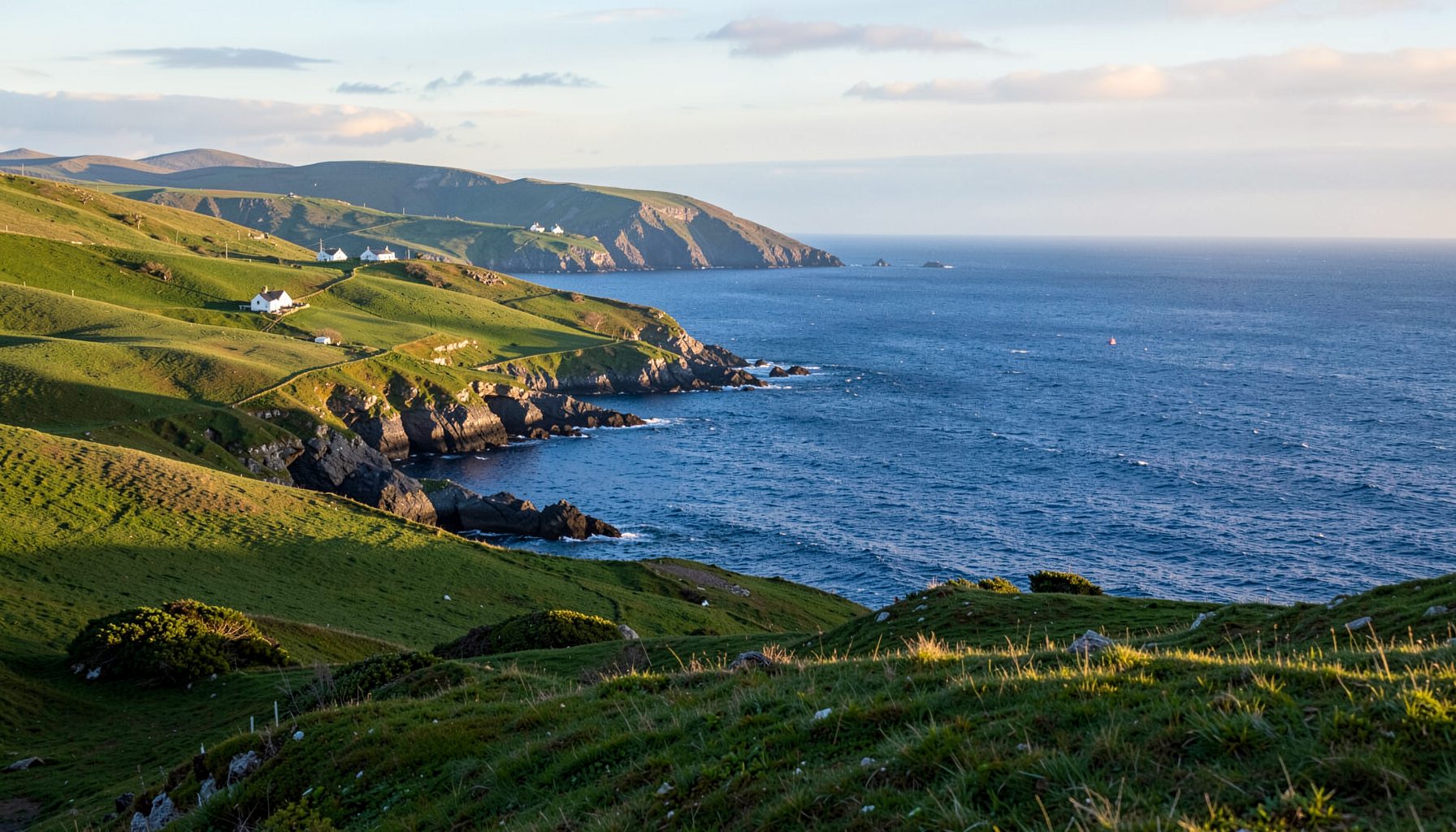
The history of mechanised turf cutting on the boglands
For centuries the boglands of the Iveragh Peninsula have supplied the households of Kerry with a steady, smoky fuel. Long before any diesel engine rumbled across a wet turf bank, families relied on the spade and the slean to slice rectangles of peat that were then stacked, footed and left to dry through the long Atlantic summer. The rhythm of the cutting season shaped the social calendar: schoolchildren were given weeks off to help in the bog, neighbours swapped labour in matched pairs, and the first dry July evening was marked by the unmistakable smell of newly lit turf fires drifting from cottage chimneys. That deeply embedded tradition would, in the space of a single generation, be transformed by machines that could do the work of twenty men.
The shift from hand to horsepower was not unique to Ireland. In places as far apart as the Scottish Highlands and the river flats of New South Wales, communities that depended on hand-cut peat or surface coal watched their landscapes redrawn by industrial extraction in the twentieth century. Visitors from Melbourne who know the brown coal fields of the Latrobe Valley, or travellers from Sydney familiar with the legacy of small coastal collieries, often recognise something familiar in the story of the Kerry bog. A fuel is a fuel, and once it becomes economically attractive, machines move in.
What makes the Kerry case distinctive is the combination of an unusually remote terrain, a population with deep emotional ties to the bog, and a global market that briefly turned local sod into a commodity worth shipping abroad. The story of mechanised turf cutting is therefore not simply a story of technology. It is a story of labour migration, of household budgets, of rural modernisation, and of a fragile wetland that has since become the centre of one of Ireland's most ambitious habitat restoration projects.
The hand-cut era and the roots of a working landscape
Until the early years of the twentieth century, every sod of fuel used on the Skellig Coast came from human effort. The standard tool was the slean, a narrow spade with a wing on one side that cut a vertical face and a flat lip that levered the slab loose. A skilled cutter could produce between three and five hundred sods in a working day when conditions were right, and the cutting season ran from late April until mid-July, when the surface peat was dry enough to grip but still soft enough to slice. The cut sods were spread flat, then turned, then "footed" into small stacks of five or six, before being gathered into larger clamps and finally carted home.
A hand-cutting crew worked in pairs or in a loose relay, and the work carried its own social etiquette. Families claimed their traditional banks by inheritance, and the boundaries were respected across generations. When a turf bank was exhausted, the surface was left bare and waterlogged, gradually returning to a wet peat mat that another generation might reclaim decades later. The cycle was slow, sustainable in its way, and intimately tied to local knowledge of weather, soil and water.
The pressures that broke this system came from two directions at once. Inside the peninsula, rural housing density was rising and the traditional bank rotations were producing less fuel per acre as the most accessible peat had already been taken. Outside, a wider economy was offering wage labour, emigration and a ready demand for cheap solid fuel in urban Ireland and beyond. Something had to give, and for a brief moment the answer was a machine.
The first machines reach the bogs
The earliest mechanical experiments on Irish bogs date from the 1920s and 1930s, when engineers began adapting potato diggers, horse-drawn ploughs and the first crawler tractors to the awkward work of slicing wet peat. A typical early rig mounted a frame on wide tracks to spread the weight, drove a rotating blade or share from the tractor power take-off, and either left the loosened peat to fall behind in a windrow or fed it by conveyor into a trailed hopper. Reliability was poor in the wettest conditions, and the early adopters were often the larger farmers or the local co-operatives who could absorb the cost of breakdowns.
By the late 1940s a handful of small Irish and British manufacturers were offering purpose-built turf harvesters, and the Irish Sugar Company's experiments with peat harvesting had demonstrated on a much larger scale what a mechanised bog could look like. On the Iveragh Peninsula the harvest remained in private and small co-operative hands for most of the mechanised era. A typical mid-1960s rig used a small crawler tractor pulling a single-row harvester with two or three workers following behind to stack the sods by hand.
Key milestones in the mechanisation of the Kerry bogs:
- 1920s – first tractor-drawn peat slicers tested on the midland bogs
- Late 1940s – purpose-built harvesters appear in small-batch production
- 1960s – crawler tractor and single-row harvester become the standard private rig
- 1970s – bagger harvesters arrive and small-scale export trials begin
| Method | Output per day | Labour required | Capital cost | Environmental impact |
|---|---|---|---|---|
| Hand-cutting with slean | 0.3 – 0.5 t | 2 – 4 people | Low | Low; slow bank rotation |
| Early tractor harvester | 2 – 4 t | 3 – 5 people | Moderate | Moderate; visible drainage |
| Modern industrial milling | 20 – 40 t | 1 – 2 operators | High | High; deep drainage and dust |
| Restored hand-cut bank | 0.2 – 0.4 t | 2 people | Very low | Minimal; supports habitat |
What changed most noticeably was the daily rhythm. Where a hand cutter might expect to take home a small cartload of sods, a single machine crew could fill several lorries in a working day. The seasonal labour shortage eased, and the wages paid to machine crews became an important supplement to small-farm incomes. For households balancing the rising cost of groceries in towns like Cahersiveen and Waterville, the turf money often made the difference between staying on the land and joining the steady stream of emigrants bound for Boston, London or, occasionally, Sydney.
The bagger era, export and the domestic fuel market
The decisive shift came in the 1970s with the spread of the "bagger" harvester. A bagger scooped loose milled peat, extruded it through a shaped nozzle and dropped neat sausages of sod onto the bog surface to dry. The cleaned, regular shape dried faster than hand-cut sods, looked tidier in the clamp, and crucially could be picked up by mechanical handlers and loaded directly onto trucks. Output per hectare rose sharply, and small contractors on the Iveragh Peninsula found that they could compete with the larger midland operations for the first time.
Most of the mechanised cut was still consumed within Ireland, particularly by households that had converted from coal to turf during the oil shocks of the 1970s. Domestic turf prices in cities such as Dublin and Cork rose steeply when oil imports spiked, and rural producers benefited. There were also modest export trials of dried, pressed turf briquettes to the United Kingdom and to a small but loyal market in continental Europe, where the fuel was sometimes marketed as a renewable alternative to coal for household stoves. Compared with the price of heating oil paid by an ordinary household in Brisbane or Adelaide during the same period, an Irish sod of turf was remarkably cheap, and that affordability kept the trade alive through difficult years.
The social impact was mixed. Mechanisation brought cash into the peninsula, but it also reduced the number of seasonal jobs that had traditionally drawn young people back from Dublin for the summer. A bog that once needed twenty cutters and stackers could now be managed by three or four machine operators and a driver. The men who had spent their teenage summers footing sods found themselves redundant on their own land, and the migration pattern that had long pointed east across the Atlantic began to turn south, towards Australia, with new arrivals settling around Melbourne, Perth and Hobart where Irish community networks remained strong.
Carbon, controversy and the turn towards conservation
By the 1990s the mood had begun to shift. Researchers in Ireland, the Netherlands and Scandinavia had documented the role of drained and actively harvested peatlands as significant sources of carbon dioxide, and the climate costs of industrial turf cutting were increasingly discussed in policy circles. A peat-fired power station at Edenderry had briefly made peat part of Ireland's electricity mix, but rising carbon prices and stricter emissions rules made the fuel uneconomic compared with imported gas and wind generation. On the Skellig Coast, smaller operators felt the squeeze through licensing rules, fuel quality standards and, eventually, restrictions on new drainage.
Community attitudes also changed. The bog was no longer seen simply as a fuel store but as a habitat worth protecting in its own right. Rare plants, breeding waders and the fascinating marine life of Valentia that depends on clean Atlantic inflows all became arguments for leaving more of the wetland intact. Conservation groups partnered with farmers to block drainage channels, raise the water table and re-wet cutaway bog. The Irish government, the EU LIFE programme and local co-operatives funded restoration on a scale that would have seemed unthinkable in the years when every dry ridge was a candidate for the next harvest.
For an Australian reader the parallels are striking. The restoration of sphagnum peatlands in the Tasmanian highlands and the rehabilitation of wetland edges around Wilsons Promontory show a similar swing from extraction to conservation, and Aboriginal firestick farming traditions are now cited as models of low-impact land management that worked with, rather than against, the bog. What the Kerry boglands share with those landscapes is the slow recognition that a wet, spongy ground once thought useless was in fact storing carbon, filtering water and sheltering life.
Heritage, living bogs and the future of a skill
Mechanisation did not erase hand cutting. Even at the height of the industrial era, older householders kept a small slean and a bank near the cottage, cutting enough sod for the kitchen fire and the sitting room grate. That household tradition continues, quietly, into the present. A handful of families on the peninsula still cut a bank by hand each spring, and the skill is taught to schoolchildren through outdoor heritage programmes that link the bog to local history, archaeology and ecology. The cut, the spread, the foot and the clamp are taught as a single sequence, much as a dry-stone waller might teach the laying of a stone.
The machines themselves are also being remembered. A small number of vintage harvesters and baggers have been restored by enthusiasts, and they appear at country fairs, vintage working days and at events such as the annual Iveragh agricultural show. For visitors who grew up around the diesel machinery of a wheat harvest near Horsham or a cane field outside Cairns, the sight of a small tracked harvester pulling itself across a black, wet bog is an oddly familiar echo of a wider story of rural mechanisation that ran through most twentieth-century farming communities.
The future of the Skellig Coast bogs is unlikely to involve many more harvests on the old scale. Restoration funding, climate commitments and the falling demand for smoky solid fuel in modern housing all point towards a wetter, quieter landscape. What remains, and what the heritage programmes now protect, is the knowledge, the tools and the social memory of a working bog. A walk along a restored blanket bog in late summer, with skylarks rising over a wet mat of cotton grass and the smell of a distant turf fire drifting from a cottage chimney, is a reminder that the mechanised era was only a chapter, and that the bog has many more stories left to tell.
Activities that keep the bog heritage alive on the Skellig Coast today:
- Cutting a family turf bank by slean each May and June
- Restoring and showing vintage turf machines at summer heritage days
- Joining guided bog walks led by community heritage groups
- Taking part in school programmes that teach ecology through turf cutting
Visit the Skellig Coast to walk a restored blanket bog, see a working vintage turf harvester at a local heritage day, or explore the marine wildlife of Valentia Island and the wider Iveragh Peninsula. Plan your journey, find community events, and discover how the people of Kerry have shaped, and are now carefully restoring, one of Europe's most distinctive wetland landscapes.