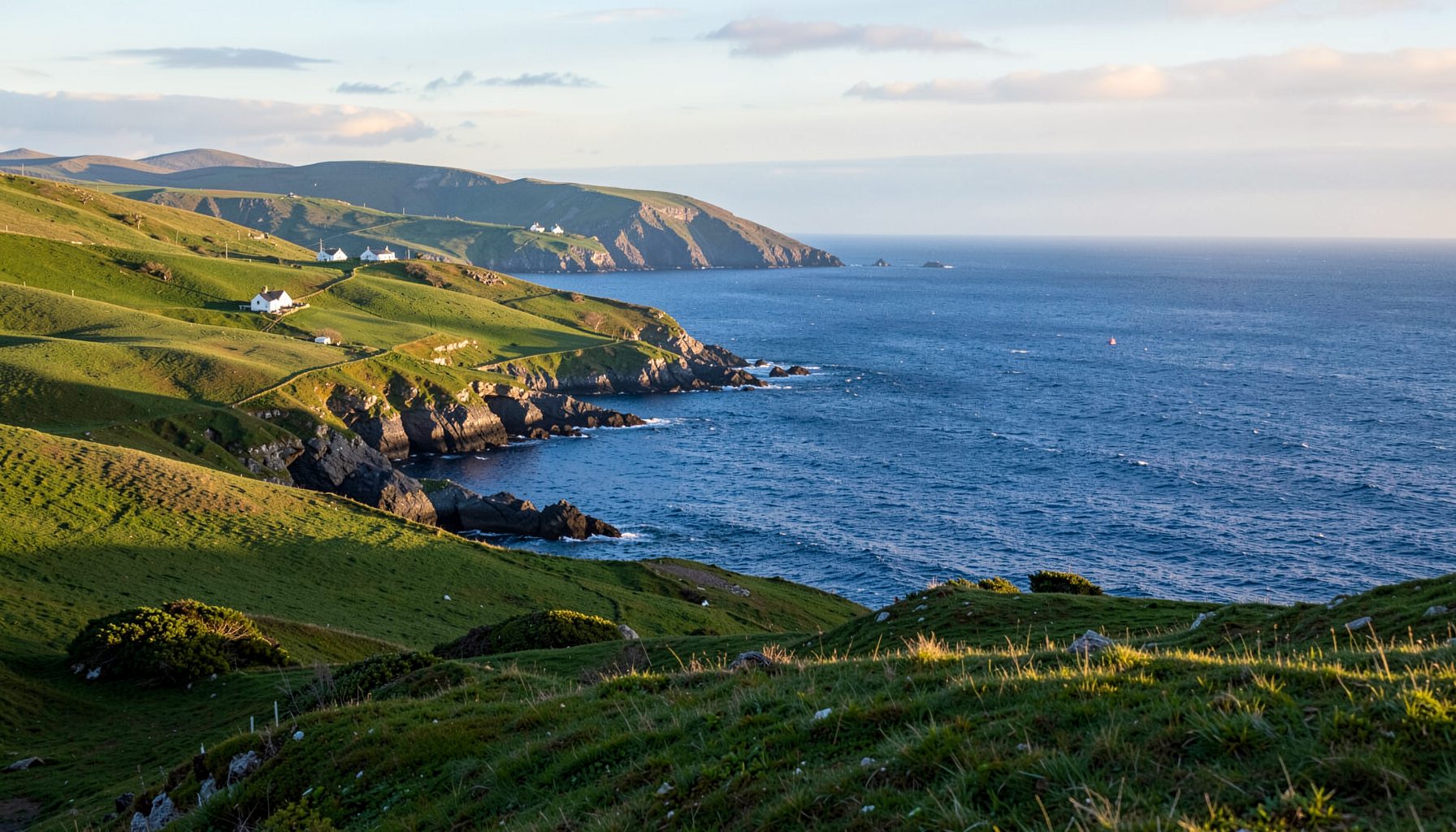
The History of the Knight of Kerry and the Valencia Estate
The story of the Knight of Kerry and the Valencia Estate connects one of Ireland’s most distinctive hereditary titles with the changing fortunes of Valentia Island on the Iveragh Peninsula. It brings together Gaelic and Norman lineages, landed estates, Atlantic trade, scientific discovery and the practical lives of island communities.
For visitors from Australia, the history can feel both grand and familiar. Like an old pastoral property, a colonial homestead or a National Trust garden, the estate is best understood through its landscape, working buildings and relationships with surrounding communities. The difference lies in the Atlantic setting: stone walls, slate, sea roads and weather shaped every part of life.
| Period | Development | Significance |
|---|---|---|
| Medieval period | The FitzGerald family established its influence in south-west Kerry | The foundations of the Knight of Kerry title |
| Seventeenth century | Landholding and political authority changed after the Tudor and Cromwellian periods | Estates became tied to English administration and Protestant ownership |
| Eighteenth century | A formal residence and designed landscape developed on Valentia Island | The estate became a visible centre of local power |
| Nineteenth century | Slate quarrying, fishing, agriculture and communications expanded | The island became linked to international commerce and science |
| Modern era | Estate history became part of community heritage and regional tourism | Visitors encounter a living landscape rather than a preserved relic |
The Origins Of The Hereditary Knight
The Knight of Kerry belongs to a small group of hereditary Irish knights associated with the FitzGerald family. These titles emerged from the influence of the Geraldines, descendants of Norman settlers who became deeply embedded in Irish society. Over generations, the family adopted local customs, intermarried with Gaelic families and developed strong territorial connections in Munster.
The title is often described as one of the three surviving hereditary knighthoods of Ireland, alongside the Knight of Glin and the White Knight. Its origins reach back to the medieval period, although the exact early succession is difficult to separate from family tradition, legal records and later genealogical interpretation. The title was less like a military rank in the modern sense and more like a hereditary recognition of status, landholding and service.
The Knight of Kerry was connected with lands around the Iveragh Peninsula, including Valentia Island. That connection gave the title a geographical identity. It was not simply a name carried by a distant aristocratic family; it was associated with a particular coastline, estate and network of tenants, workers, merchants and neighbours.
Valentia Island And The Estate
Valentia Island is often written as “Valencia” in older references, maps and estate discussions, while Valentia is the modern spelling generally used for the island. Lying off the coast near Portmagee and Cahersiveen, it occupies an important position at the western edge of the peninsula. Its sheltered waters, access to the mainland and proximity to the Skelligs made it valuable long before heritage tourism developed.
The estate should be viewed within the complicated history of Irish landownership. Medieval lordship gave way to Tudor and Stuart administration, followed by further upheaval during the seventeenth century. Ownership, leases and political loyalty could change rapidly, while local families continued to work the land and sea through periods of uncertainty.
By the eighteenth century, the estate linked the Knight of Kerry with a more formal landed residence and managed demesne. The house, gardens, fields and shoreline were part of a single system. The owner’s authority was expressed through architecture and landscaping, but the estate’s success depended on labour carried out by gardeners, quarrymen, boatmen, farm workers and domestic staff.
The House Gardens And Demesne
The estate landscape reflected the interests of an eighteenth-century landowning family. A demesne was more than an ornamental garden: it could include woodland, pasture, walled gardens, avenues, farm buildings, ponds and views carefully arranged around a principal house. On Valentia, the mild maritime climate allowed unusual planting possibilities, even though salt air, wind and poor soils made gardening demanding.
The gardens also displayed status. Imported plants and designed walks suggested connections with wider networks of trade and fashion. At the same time, estate planting could have a practical purpose, providing shelter, timber, fruit and vegetables. The boundary between pleasure ground and working landscape was often less distinct than it appears in modern heritage gardens.
For Australians, the comparison with a historic property such as Rippon Lea in Melbourne or Vaucluse House in Sydney is useful, provided the climate and social history are kept in mind. Valentia’s garden is Atlantic rather than subtropical or continental, and its character comes from exposure, stonework and views across coastal water. A visitor used to an Australian arvo in a formal garden may find the island’s light and wind surprisingly changeable within minutes.
Land, Labour And Local Power
The Knight’s position rested on land, but landownership did not mean that the estate operated in isolation. Tenants cultivated small holdings, livestock moved through shared landscapes and local people supplied skills that the household could not function without. The estate economy was tied to nearby villages and harbours, where goods, news and employment circulated.
Valentia’s slate quarry became an important part of the island’s story. Its stone was used locally and exported, and quarrying created specialised work in cutting, hauling and shipping. Slate from the island reached building projects beyond Kerry, adding an industrial dimension to a place often imagined only as rural and scenic.
The nineteenth century brought severe pressure across Ireland. The Great Famine, emigration, rent difficulties and changing agricultural markets affected estate communities deeply. A grand house could continue to present order while families nearby faced hunger or departure. Reading the history responsibly means holding both realities together: the architectural legacy of the estate and the unequal conditions that supported it.
Science, Communication And The Atlantic Edge
Valentia Island played a major role in the history of communications. In 1866, the successful transatlantic telegraph cable connection between Valentia and Heart’s Content in Newfoundland helped transform long-distance communication. Messages that once took weeks by ship could travel across the Atlantic in minutes, creating a powerful link between Europe and North America.
That achievement placed the island in a global story of engineering, finance and empire. It also depended on local geography and local labour. Cable stations, landing places and support services altered the island’s relationship with the outside world. Valentia was no longer simply a remote corner of Kerry; it had become part of a technological route crossing the ocean.
This is one reason the estate’s history cannot be treated as a self-contained country-house tale. The island’s landed families, quarry workers, fishermen, engineers and signal staff all belonged to overlapping systems. Today, a walk near the telegraph heritage sites can reveal how a remote landscape became an important node in international communications.
From Estate History To Community Heritage
The memory of the Knight of Kerry survives through buildings, family records, place names and stories attached to the landscape. Some features have changed use or disappeared, while others remain part of the visual identity of Valentia. Heritage work therefore involves interpreting fragments rather than presenting a perfectly complete picture.
Local history also sits alongside the wider attractions of the Skellig Coast. The Skellig islands, Skellig Michael, Portmagee, Cahersiveen and the villages of the Iveragh Peninsula form a connected cultural region. Visitors who arrive for scenery often discover that the coast is shaped by fishing, farming, faith, migration, geology and community activity as much as by famous viewpoints.
Food is another useful way to understand that living connection. Exploring regional seafood can link the modern visitor economy with older maritime traditions, from boats and landing places to seasonal work and local markets. For Australian travellers accustomed to buying prawns at a fish market, ordering oysters on the coast or calling a café “a good little spot”, the emphasis on freshness and provenance will feel familiar.
Reading The Landscape With Care
The estate is easiest to understand when the landscape is read at several scales. At close range, look for stone walls, planting patterns, entrances, outbuildings and changes in ground level. From a higher viewpoint, the relationship between house, fields, harbour and open sea becomes clearer. The setting explains why residence, industry and communication developed together.
Weather remains part of the experience. Australian visitors planning a self-drive itinerary from Dublin, Cork or Killarney should allow extra time for narrow roads, ferry schedules and sudden Atlantic rain. “No worries” is a useful attitude, but the practical version is carrying waterproof layers, checking opening times and avoiding a tightly packed timetable.
A regional visit also works best outside the busiest summer weeks. Shoulder-season travel can support local businesses when demand is lower, while giving visitors more time to appreciate community museums, walking routes and heritage sites. As with regional tourism in Tasmania or western Victoria, the local economy benefits when people stay longer, eat locally and spread their spending across several small communities.
Practical Ways To Explore The Story
The history becomes more meaningful when a visit combines formal interpretation with observation. A house or garden may provide the central narrative, but the surrounding roads, shorelines, quarry remains and villages show how that narrative affected everyday life.
Use these approaches to make the most of a heritage-focused visit:
- Begin with the FitzGerald family and the three hereditary Irish knightly titles.
- Distinguish Valentia Island’s estate history from the wider political history of County Kerry.
- Look for evidence of both ornamental design and practical estate production.
- Include the slate quarry and transatlantic telegraph story in your itinerary.
- Allow time for local villages, community museums and coastal walking routes.
- Treat the landscape as a working environment, not simply a backdrop for photographs.
The most rewarding interpretation avoids romanticising the past. The Knight of Kerry represents continuity, prestige and family memory, while the estate also reflects rent, labour, migration and unequal access to land. Those tensions make the story relevant today, especially in a region where heritage, farming, fishing and tourism continue to meet.
Trace the estate’s story through the Skellig Coast, then connect it with the villages, heritage sites and community initiatives that keep Valentia and the wider Iveragh Peninsula active. Use Skellig Coast as your regional guide before setting out, and allow the landscape to reveal the history at its own pace.