The History of Copper Mining on the Beara Peninsula
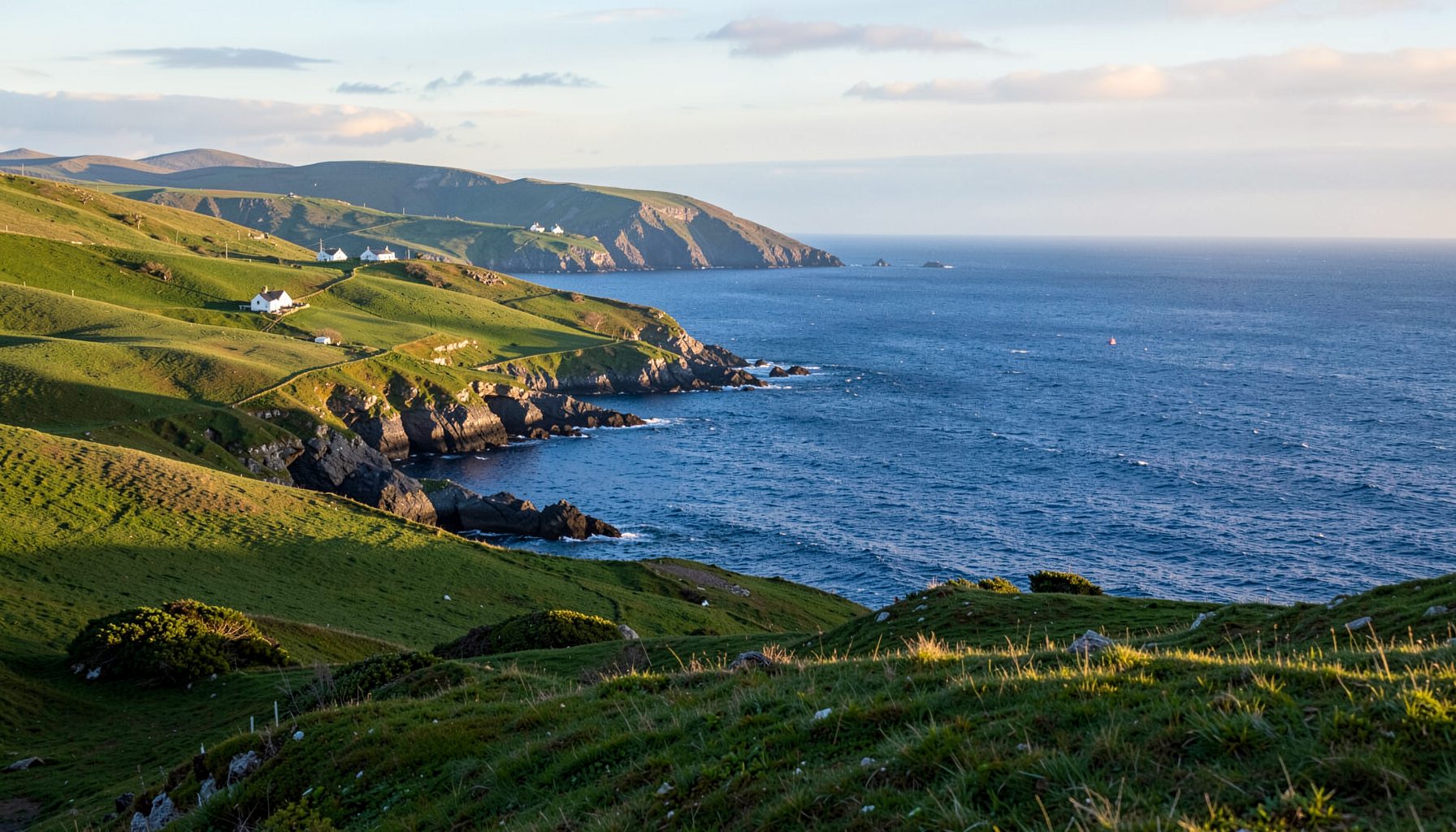
The Beara Peninsula is often associated with dramatic coastlines, stone circles, mountain passes and fishing villages, yet its modern landscape was also shaped by an ambitious industrial venture. Around Allihies, copper mining transformed a remote Atlantic district into a place connected to international markets, new technologies and migrant communities.
The remains of that industry are still visible across the hills: ruined engine houses, spoil slopes, adits, tracks and harbour works. They form a scattered industrial archive, where geology and social history meet. Understanding the mines means looking beyond abandoned buildings to the people who worked underground, transported ore, ran businesses and adapted to a rapidly changing economy.
A Mineral-Rich Landscape Before Industrial Mining
Copper occurs naturally in the rocks of western Cork, and the Beara Peninsula contains a complex geological mixture formed through ancient volcanic and sedimentary processes. The mineral veins around Allihies were especially valuable because they could produce copper ore close to the surface in some locations. The exposed terrain made traces of mineralisation easier to identify, although extracting ore from deeper levels demanded considerable investment.
Small-scale metalworking may have taken place in Ireland long before the great industrial expansion of the nineteenth century, but the Allihies mines became significant when commercial operators began organising systematic extraction. Local knowledge of the hills and mineral-bearing ground was important, while outside capital supplied the machinery, engineers and labour needed to develop the workings.
The peninsula’s position was both an advantage and a difficulty. Its coastline offered access to shipping, but roads were poor and the mountains made inland transport slow. Every load of ore, coal, timber, machinery and food had to move through a demanding landscape. The same isolation that preserved the area’s rural character also raised the cost of industrial activity.
The Puxley Enterprise And The Rise Of Allihies
The major phase of copper mining began in the early nineteenth century under the Puxley family, who developed leases around Allihies from about 1812. Their enterprise brought a more organised form of mining to the district. Shafts were sunk, drainage systems expanded and ore was carried from scattered workings towards processing and shipping points.
Mining operations extended across several sites, including the Mountain Mine and other workings on the slopes above the village. The names of individual mines could change over time as leases, partnerships and management arrangements shifted. What remained constant was the search for profitable veins in difficult ground, supported by an evolving combination of manual labour, mechanical pumping and transport infrastructure.
Copper from the Beara mines entered commercial networks that reached well beyond County Cork. Ore could be sent to smelters elsewhere, while equipment and fuel arrived by sea. Ballydonegan Bay and the coastal landing places became essential to the operation, linking the mines to the wider industrial economy of Britain and Ireland.
This growth altered Allihies itself. Shops, workshops, housing and public buildings developed around the mining population, giving the village a more varied social character than a purely agricultural settlement. Mining wealth was unevenly distributed, but the industry created employment and encouraged services that would have been difficult to sustain in a remote rural community.
Cornish Skill, Steam Power And Underground Work
The Beara mines relied heavily on expertise from Cornwall, a region with a long-established copper and tin industry. Cornish miners and engineers brought practical knowledge of shaft construction, blasting, drainage and ore dressing. Their influence can be seen in the distinctive engine houses and in the technical vocabulary associated with nineteenth-century mining.
Steam engines were introduced to help pump water from deep workings and operate equipment. In a mine beneath the water table, drainage was vital: without it, shafts could become unusable and production would stop. Engine houses were built to shelter large beam engines and related machinery, leaving substantial stone structures that now stand as some of the most recognisable monuments of the Beara mining district.
| Feature | Purpose in the mining system | What may remain today |
|---|---|---|
| Engine house | Housed steam-powered pumping or winding machinery | Tall masonry ruins and chimney bases |
| Shaft | Provided access to underground workings | Fenced openings, spoil heaps or depressions |
| Adit | Allowed access or drainage from a hillside | Dark entrances, collapsed passages and stonework |
| Ore dressing area | Separated valuable mineral from waste rock | Level platforms, broken stone and channels |
| Track or tramway | Moved ore and supplies across difficult ground | Embankments, cuttings and aligned stones |
| Harbour or landing place | Connected the mine with coastal shipping | Quays, stone walls and altered shorelines |
Underground work was physically demanding and dangerous. Miners used hand tools, drills and explosives to break rock, then hauled material through confined passages. Water, poor ventilation, falls and misfires were constant hazards. The surviving industrial remains reveal the scale of the enterprise, but they cannot fully convey the noise, darkness and exhaustion of daily labour.
A Mining Community On The Atlantic Edge
The copper mines changed the population of Allihies and surrounding townlands. Workers arrived from Cornwall and other mining districts, while local families found employment underground, at the surface, in transport and in associated trades. The community therefore combined established Irish rural traditions with customs and skills brought by newcomers.
Employment was often divided by gender and age. Men generally took on underground and heavy industrial work, while women and children could be involved in ore dressing, domestic service, shopkeeping, food production and other activities that supported the mining economy. Wages from the mines circulated through local businesses, though employment remained vulnerable to falling prices, poor ore quality and interruptions in shipping.
Mining also existed alongside religious, political and cultural tensions in nineteenth-century Ireland. The period after the 1798 rebellion remained part of local memory, and the role of parish networks in public life could be significant; accounts of the local clergy’s role help place Beara communities within that broader historical setting. Industrial change did not erase older loyalties or identities. Instead, it added new social divisions and relationships to an already complex rural society.
Living conditions varied. Some workers occupied planned or semi-planned housing, while others lived in older cottages or crowded accommodation. Access to clean water, sanitation and medical care was not always reliable. A mining settlement could appear prosperous when production was high, yet a closure or wage reduction quickly affected nearly every household.
Decline, Closures And The Changing Economy
Copper mining in Allihies faced several long-term problems. The richest and most accessible deposits became harder to reach, while deeper extraction required greater expenditure on pumps, labour and transport. International metal prices also fluctuated, and mines in other parts of the world could produce copper more cheaply on a larger scale.
The main nineteenth-century phase gradually weakened and came to an end in the late 1800s. Some attempts were made to revive or reorganise mining in later periods, but none restored the industry to its former importance. As employment disappeared, families moved away or returned to farming, fishing and other forms of work. The population decline associated with rural Ireland affected the peninsula alongside the specific consequences of mine closure.
The end of production did not remove the mines from local life. Abandoned shafts remained dangerous features on the hills, and ruined buildings were reused as landmarks, storage spaces or sources of building stone. Over time, vegetation covered spoil heaps and softened the outlines of tracks, making the industrial landscape less obvious to visitors unfamiliar with its history.
The mines also left a strong legacy of migration. Families connected to Allihies and the wider Beara Peninsula carried memories of mining to cities and overseas communities. Oral histories, family photographs, place names and surviving documents help preserve experiences that are absent from official company records.
Reading The Mining Heritage Today
The Allihies Copper Mine Trail offers a way to understand the district as a connected system rather than a collection of isolated ruins. A walk can reveal how shafts related to engine houses, how ore moved towards the coast and how industrial buildings were fitted into steep upland terrain. The landscape is uneven and exposed, so appropriate footwear and care around unstable ground are important.
Several features deserve particular attention:
- The ruined engine houses, which show the scale of steam-powered drainage and winding operations.
- The spoil heaps, where waste rock records the effort required to reach narrow mineral veins.
- Old tracks and tramway lines, which illustrate the importance of transport in a mountainous district.
- Coastal landing places, where mining was linked to ships, fuel supplies and overseas markets.
- The relationship between the mine sites, Allihies village, nearby farms and the Atlantic shoreline.
The heritage of Beara’s copper industry is valuable because it connects environmental history with human experience. The mountains were shaped by geological forces over immense periods, then altered within a few generations by shafts, roads, engines and waste ground. Present-day visitors can see how industrial decisions affected settlement patterns, employment and the appearance of the peninsula.
Preservation requires care. Ruined masonry can be unstable, shafts may be hidden by vegetation and some paths cross open ground exposed to changing weather. Keeping to marked routes, respecting private land and avoiding the removal of stones or artefacts helps protect the site for future research and community interpretation.
The copper mines of the Beara Peninsula tell a story of ambition, expertise and adaptation. Their history reaches from local mineral knowledge to Cornish engineering, from underground labour to Atlantic commerce, and from nineteenth-century expansion to the quieter economy that followed closure. Explore the Allihies mining landscape with time to examine its buildings, paths and viewpoints, and let the surviving remains reveal how deeply industry became part of Beara’s rural identity.