The story of the Skellig Experience Visitor Centre
The Skellig Experience Visitor Centre in Portmagee, County Kerry, is a place for understanding a landscape that cannot be fully appreciated from a map. Its exhibitions introduce Skellig Michael, the nearby islands, the stories of the Skellig Coast and the forces of Atlantic weather. Visitors can gather context here before choosing a coastal walk, harbour trip or island excursion.
More than a viewpoint over Portmagee harbour, the centre connects archaeology, natural history, film and local memory. Models, audiovisual material and carefully selected objects make monastic remains and island wildlife tangible. The story reaches beyond the famous offshore outpost; it also follows the communities, livelihoods and cultural activities of the mainland that sustained relationships with the islands.
For Australians from Melbourne, Sydney or Adelaide, timing can be a welcome advantage. Ireland’s summer from June to August overlaps with Australia’s winter school holidays, while Irish evenings are long and often mild. Visitors arriving during a hot Australian January will, however, meet a different seasonal rhythm. Accommodation and island excursions can be in greater demand during July and August, making early planning sensible.
A gateway on the Kerry coast
The centre’s mainland setting is significant. Portmagee is a working harbour community where boats, fishing traditions, pubs and local trade form the everyday backdrop to the UNESCO-listed island across the water. This grounding matters because Skellig Michael’s isolation depends on a network of ferry operators, pilots, landowners and neighbouring settlements. The exhibitions therefore treat the harbour as a doorway to the islands rather than as a separate attraction.
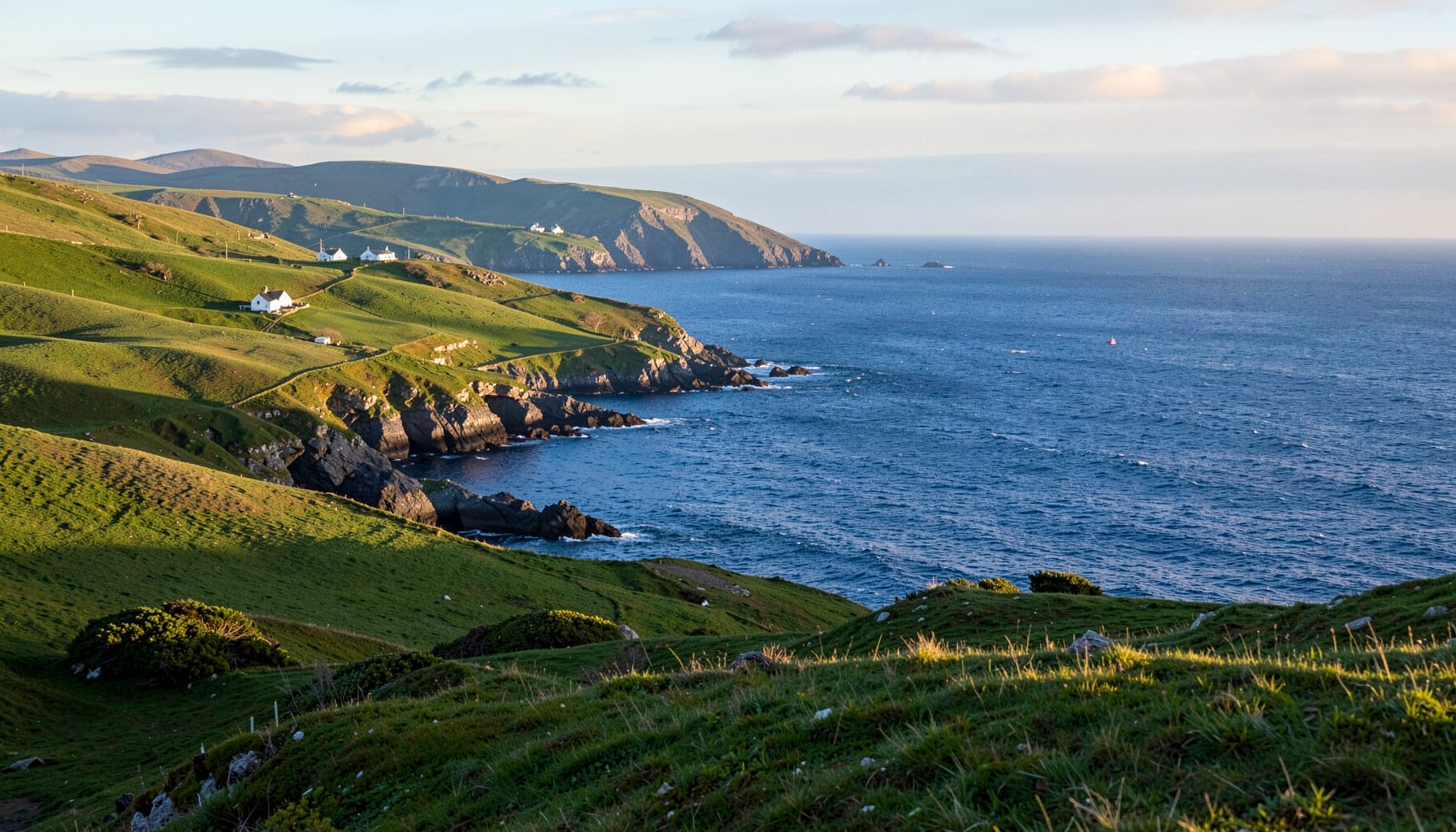
Interpretation begins with the island’s geography, including the dramatic cliffs, narrow landing places and exposed position in the Atlantic. Visitors are encouraged to understand why distance and weather shaped everything that happened on Skellig Michael. A detailed model helps translate maps into a three-dimensional landscape, showing how the monastic settlement occupies a sloping shelf above the sea. Its position becomes clearer when viewed from the harbour, where the scale of the cliffs can be deceptive.
The centre’s value lies in providing context before travellers explore independently. That balance is familiar from exploring historic Cebu on foot: a little background makes unfamiliar streets far more rewarding. Here, maps and displays help explain why a particular landing, path or stretch of coast matters.
Australian travellers will recognise the interest in provenance behind a well-made coffee in Melbourne or a stall at Queen Victoria Market or Paddy’s Markets. The centre applies that curiosity to different subjects: local stone, timber, food, boats, wildlife and the people who developed close relationships with the islands.
Skellig Michael’s monastic world
Skellig Michael’s monastic story begins with an early Christian settlement traditionally dated to the sixth century. Hermits established a religious community on a rocky summit with almost no level ground. Their austere way of life became part of the island’s identity, although the settlement later developed into a substantial medieval community with its own buildings, routines and challenges.
The interpretive displays explain how inhabitants adapted to their surroundings. Stone cells, oratories and the distinctive beehive-shaped clocháns were constructed from local materials. Sheltered areas provided space for storage, while the oratory served as a focus for worship. Visitors can consider the daily realities behind the surviving ruins: obtaining water, preparing food, maintaining buildings, coping with isolation and following a shared religious discipline.
The physical journey adds another dimension. Access involves a boat trip followed by a demanding climb of hundreds of steps to the monastery, commonly described as roughly 600. Conditions can change quickly, and access is arranged through authorised landing excursions rather than independent boat journeys. Skellig Michael, also known as Great Skellig, has held UNESCO World Heritage Site status since 1999. Its importance lies in the survival of an early monastic settlement and its exceptional setting, not simply in the presence of dramatic ruins.
Exhibits that reveal island life
At the heart of the visitor experience are models, images and audiovisual displays that make the island’s story accessible. The presentation links the settlement to its geology, sea climate and wildlife. Visitors can see how the monks’ buildings relate to the contours of the slope and why the island’s exposed position demanded careful choices about shelter, movement and resource management.
Interpretive material also brings the landscape to life through sound and narration. The noise of wind and waves helps communicate the environment surrounding the monastery, while information on seabirds, marine life and coastal habitats places the human settlement within a larger ecological system. Little Skellig, the smaller island nearby, is particularly important as a seabird sanctuary, with immense colonies nesting on cliffs that are difficult for people to reach.
Film forms another layer of the story. Star Wars: The Last Jedi and The Force Awakens used locations on Skellig Michael, introducing the island to international audiences. The centre places this modern cinematic connection alongside the monastic site without allowing it to become the entire story. For visitors who know the films, the filming locations become recognisable; for others, they offer an unexpected way into the island’s history. In both cases, the rugged terrain visible on screen becomes a real and demanding maritime landscape.
Living heritage of the Skellig Coast
The story is also a story of neighbouring communities. Kells, Portmagee, Waterville, Castlecove and other settlements along the Iveragh Peninsula and Ring of Kerry have traditions shaped by farming, fishing, seafaring, faith and careful use of a difficult environment. Coastal heritage survives not only in monuments but also in place names, local knowledge, food traditions and the continuing importance of the sea.
The centre provides a starting point for exploring those connections. Information about regional history can lead visitors towards churches, graveyards, harbour buildings and cultural activities that reveal how Kerry’s communities have understood their own landscape. An outdoor programme may offer a different perspective from an indoor exhibition, allowing weather, geology and local stories to become part of the experience directly.
Community initiatives and cultural events give the exhibition a contemporary dimension. Rather than presenting the past as closed and fixed, the centre can connect heritage with current efforts in local learning, craft, conservation and cultural activity. Visitors travelling with children may find that interpretation becomes more approachable when the questions of everyday life are given as much attention as dates and famous names. The story of Skellig Michael remains strongest when the island and the people of the surrounding coast are understood as parts of one connected place.
Practical recommendations for a rewarding visit
For many Australians, a trip centred on local food might begin with a barbecue featuring lamb or sausages and a long conversation over the side dishes. Ireland offers its own social version in a pub lunch, but the details differ: menus are often fixed, a service charge may appear on the bill and takeaway rules vary. Listening to how Kerry’s communities discuss their own food and working lives can be as revealing as any formal exhibition.
Before travelling, consider these practical ways to get more from the centre and its surrounding area:
- Check current opening hours and exhibition information, as access arrangements and displays can change.
- Treat an island landing as a separate, weather-dependent excursion, with appropriate footwear, clothing and transport arranged in advance.
- Allow time in Portmagee to explore the harbour and local surroundings rather than rushing directly towards a departure point.
- Dress for persistent wind, rain and rapid changes in conditions, keeping a waterproof outer layer close at hand.
- Use the centre’s information to connect the monastic site with coastal walks, heritage places and community activities elsewhere on the peninsula.
- Support local guides, boat operators and businesses, whose knowledge of tides, weather and landing conditions is essential.
Make the Skellig Experience Visitor Centre your first stop in Portmagee. Spend time with its models, sounds, stories and explanations, then carry that understanding towards the islands and surrounding communities. The experience is at its best when the centre is treated not as an isolated display, but as the beginning of a deeper encounter with the Skellig Coast.