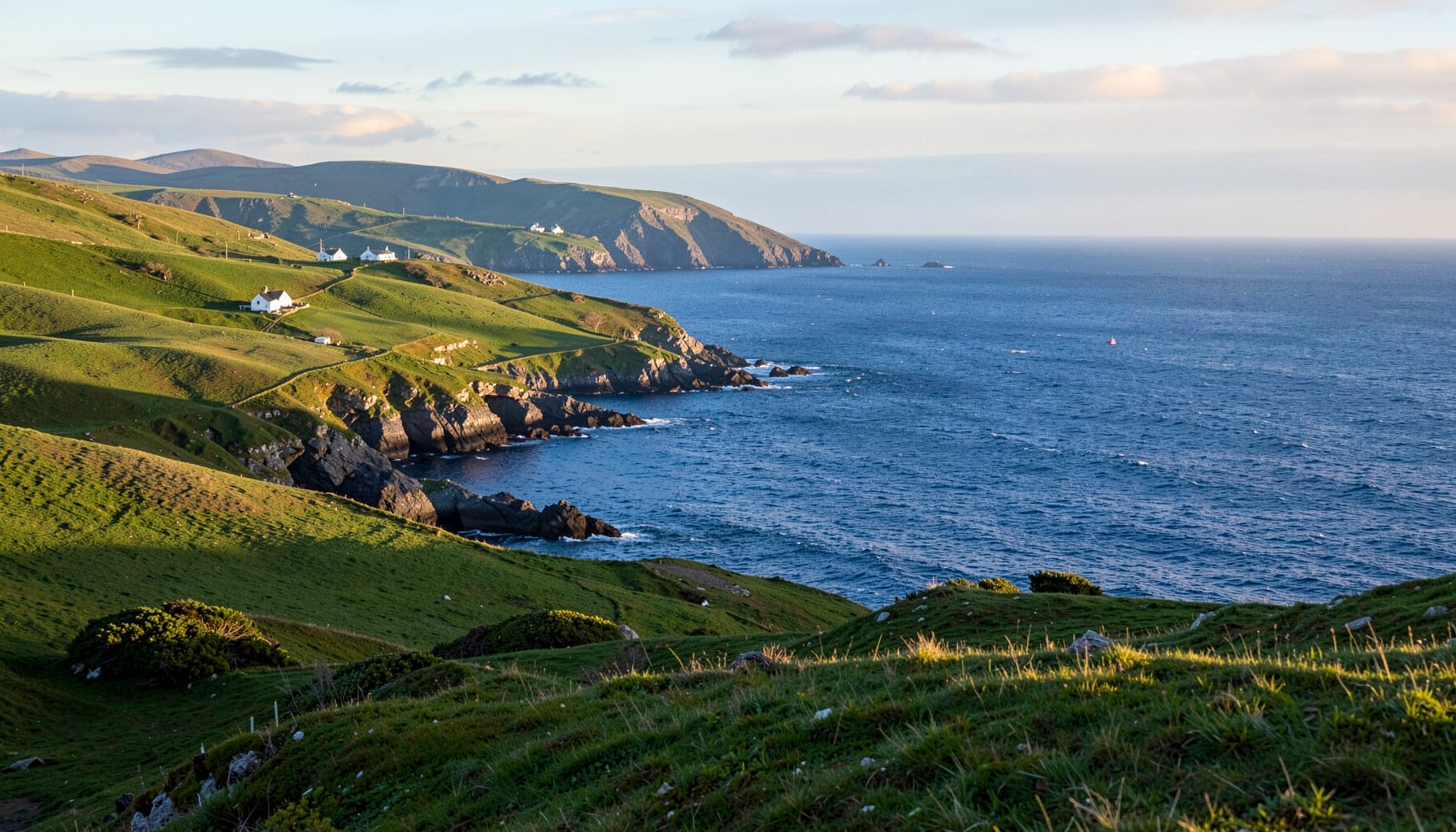
Dolphin and whale watching sites off the Iveragh Coast
The Atlantic edge of the Iveragh Peninsula offers several ways to look for marine wildlife, from sheltered bays around Sneem to exposed points near Kells and Castlecove. The area is best known for the UNESCO-listed Skellig Michael and the seabird colonies of the Skelligs, but cetaceans also visit the surrounding water. A rewarding visit depends on realistic expectations, an eye for currents and tides, and sensitivity to the animals using these waters.
The watching sites are not interchangeable. Some are village viewpoints, some are island landing places, and others are departure points for boat trips. From shore, sightings can be quiet and unpredictable; from a boat, the viewing angle is broader but entirely dependent on the sea state. Harbour offices, local skippers and community guides can provide current information about recent sightings, access and suitable conditions.
Choosing a base for coastal sightings
Begin with the geography that suits your expectations. Portmagee and Sneem are convenient for boat departures and access to the deeper waters of Kenmare Bay, while the shoreline around Kells, Cahersiveen, Valentia Island and Castlecove rewards patient land-based watching. The east-facing coast can feel very different from the western cliffs, with shelter, swell and prevailing wind playing major parts in what appears from land.
Shore watching offers flexibility. You can walk from a village, pause over coffee and remain alert for a dorsal fin, then continue along the coast without committing to a fixed cruise. It also places less pressure on wildlife than a crowded vessel. The trade-off is distance: a blow can be visible for several kilometres, yet details such as species markings or tail patterns may remain indistinct.
For visitors from Sydney or Melbourne, the easiest rhythm is usually to collect a left-hand-drive car at Dublin Airport and treat Kerry’s lanes as a different kind of road trip. Australian drivers are comfortable with long distances, but the narrow boreens, stone walls and blind bends require slower speeds. Many travellers base themselves in one village, visit the local pubs for an evening meal and make short coastal excursions rather than attempting to cover the whole peninsula.
Portmagee, Sneem and the Skellig approaches
Portmagee harbour is one of the best-known starting points for marine excursions. Trips from the village travel towards the Skelligs, with the towering sea stacks of Skellig Michael and the smaller island of Little Skellig often visible on a calm crossing. Seabird activity dominates in the breeding season, although pilots may also encounter dolphins feeding offshore or whales moving along the shelf edge. Puffin Island provides another coastal destination, subject to access and weather conditions.
At Sneem, the sheltered mouth of Kenmare Bay is particularly associated with bottlenose dolphins. They are resident around parts of the bay and may appear close to shore, where deep water meets rocky channels. Groups sometimes travel in company, but they can vanish quickly behind islands or in rougher water. The village also provides easy access to coastal walks and places to watch the entrance to the bay without adding another boat journey.
Wildlife viewing does not need to occupy an entire day. When the boats are not running, the traditional Irish music sessions in Portmagee pubs offer a way to experience the region’s community culture and give the sea conditions time to settle. A later return to the harbour may reward patience, while a windy afternoon might be better spent exploring the village and its surrounding footpaths.
Kells, Cahersiveen and the island shoreline
Around Kells and Ballinskelligs, the open Atlantic produces a different kind of spectacle. Humpback whales are sometimes seen passing close to the south coast, particularly during their southward migrations, while offshore dolphin groups can be identified by their dorsal fins cutting through swell. The beaches and headlands also offer views towards Valentia Island and the open water leading towards the Atlantic.
Cahersiveen is useful as a base for exploring several environments in one day. The River Shannon and sheltered inlets support varied birdlife, while the open coast south of the town can provide whale and dolphin sightings in suitable conditions. Around Castlecove, rocky coves, islands and the low-tide area near Little Jinji create excellent landfall scenery. Here, observation skills matter because seals, dolphins and seabirds can share the same stretch of water.
Local speech adds colour without requiring deep knowledge of dialect. Australians may use terms such as “arvo” and “brekkie”, while Kerry speakers might favour expressions including “wee” for a small quantity or “now” meaning “presently”. These differences usually become clear in conversation, and friendly repetition is often welcomed. The same applies to directions: “up the road” may cover several kilometres, whereas “just down the road” might still take a worthwhile walk.
Recognising whales and dolphins at sea
Bottlenose dolphins are the most immediately recognisable visitors around the western bays. Look for a rounded forehead, a dark back and a distinctively curved dorsal fin. Common dolphins are slimmer and may show a darker cap, while Risso’s dolphins can appear pale, scarred or barnacle-covered at close range. Groups often behave differently: bottlenose dolphins may hunt cooperatively near the surface, while smaller dolphins frequently porpoise through choppy water.
Humpback whales are known for long pectoral fins, knobbly heads and broad tail flukes. Fin whales are more streamlined and often show a pale jaw or flipper markings. Minke whales can be surprisingly small beside a boat, whereas sei whales are slimmer and less commonly encountered. Killer whales, pilot whales and sperm whales also visit Irish waters, but rarity and distance make a firm identification from shore uncommon even when a large blow is visible.
Distance changes what can be identified. A fluke can resemble the tail of several species, and a fin may be confused with a wave or a piece of driftwood. Binoculars help, but a long lens is less necessary for beginners. Record the time, position and shape of the sighting rather than assigning a species with certainty. In poor light, describing a “large whale with a tall blow” can be more useful than an inaccurate name.
Timing the trip around tides and weather
Whale and dolphin movement follows food, temperature and currents rather than a fixed timetable. Humpbacks are often most noticeable off Kerry from late summer into autumn, while fin whales and other feeding visitors can appear from spring onwards. Dolphins may be present throughout the year in sheltered western waters. Winter offers dramatic seas and occasional impressive sightings, but small-group access can be limited when harbours close or swell prevents safe departures.
Tides affect access to coves, beaches and islands, and wind can make a seemingly calm bay rough within an hour. Check Irish beach warnings and local marine forecasts rather than assuming they work exactly like Australian flag systems. Bring warm layers, waterproof footwear and a wind-resistant jacket. Sun protection still matters during long summer spells, particularly on exposed headlands where there may be little shade.
Australian coastal travellers are often used to combining a self-drive route with separately booked wildlife cruises, so that structure works well here too. Operators can fill cancelled places at short notice, but a flexible booking does not guarantee a sighting. Australian readers who browse international gaming pages may already know that a flexible slot multiplier changes a feature’s return without removing uncertainty. A sea watch has no guaranteed multiplier, and no booking system can manufacture a breach.
Respect for wildlife should shape every outing. Choose an operator that follows recognised cetacean guidelines, reduce speed when instructed and avoid positioning a vessel between a group and its calves. Never attempt to swim with or feed wild dolphins and seals. On land, keep clear of resting animals and stay on marked paths near sensitive nesting areas. Drones should remain grounded around colonies and marine mammals.
Choose one or two bases and build the day around the conditions rather than a fixed checklist. Begin with the Skellig Coast’s community information to identify harbour contacts, local outdoor programmes and village events, then confirm current sailing and access details directly.
On the day, leave time to watch without pressure, note changing conditions and keep the experience centred on the animals. A respectful encounter is measured by patience and restraint, not by how close the traveller gets.