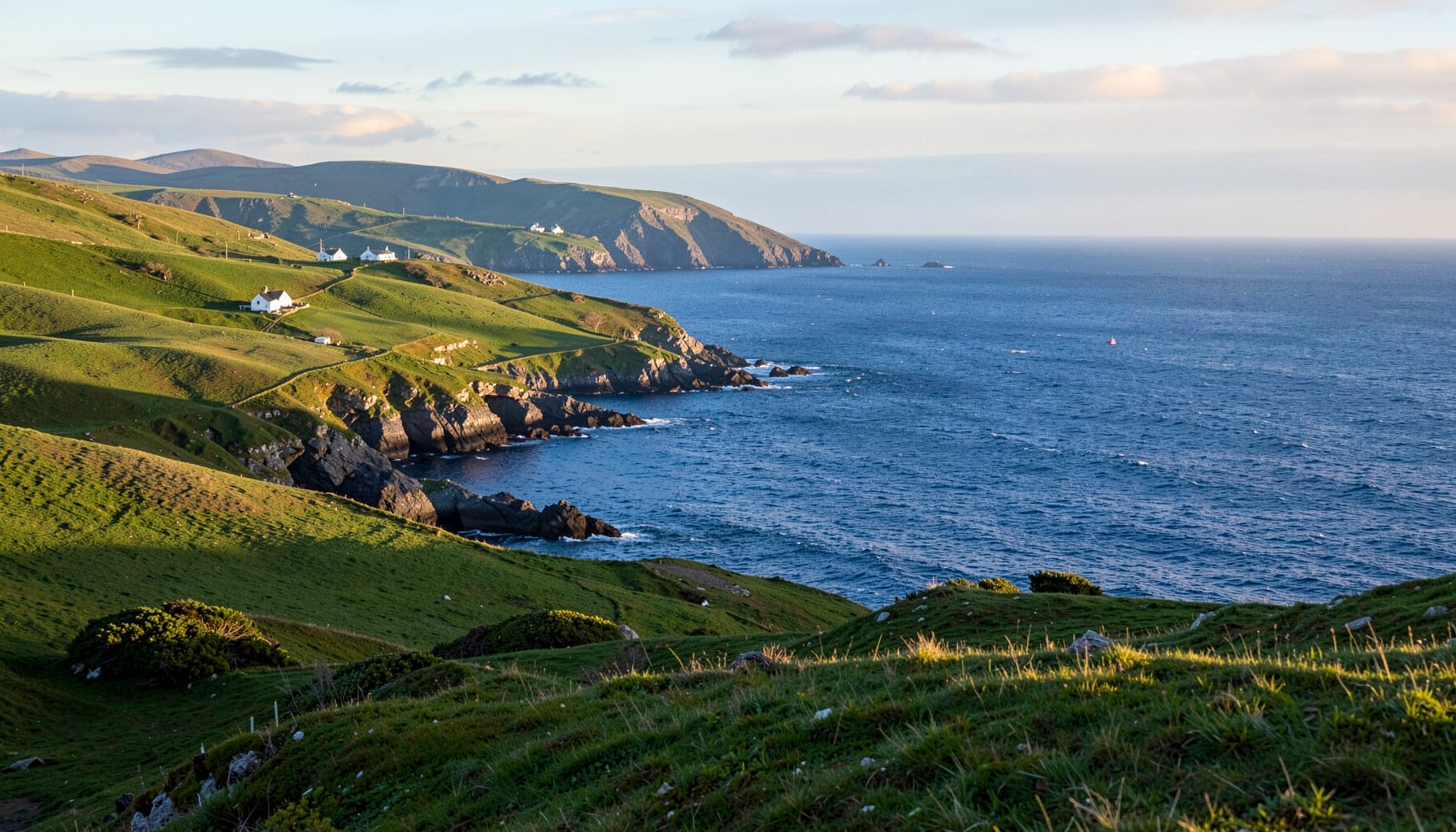
The O’Connell family and Derrynane’s enduring influence
Derrynane is a coastal townland on the Iveragh Peninsula where landscape, memory and political history remain closely connected. Its coves, stone walls and broad Atlantic views are associated most strongly with Daniel O’Connell, the nineteenth-century campaigner remembered as “The Liberator”. Yet the story belongs to a wider family whose land, education, Catholic identity and local relationships shaped the area for generations.
The O’Connells were part of the Catholic landed community that survived the restrictions imposed after the Williamite wars and the Penal era. Their position was unusual: they owned property and carried local influence, while remaining connected to the religious and political disadvantages experienced by most Irish Catholics. Derrynane became the setting from which Daniel developed a public life that reached far beyond Kerry.
For Australian visitors, this history can feel especially relevant because Irish migration helped shape communities in Sydney, Melbourne, Brisbane and regional New South Wales and Victoria. Many family histories begin with an ancestor who left Ireland during the nineteenth century, whether through assisted migration, famine-era displacement or the search for work. Derrynane offers a place to connect those family stories with the politics that influenced Catholic rights.
The estate is also a living part of the Skellig Coast rather than a museum detached from its surroundings. Derrynane House, the nearby national historic park, the beaches and the coastal roads all help explain why the O’Connell name remains central to local identity. The setting rewards visitors who allow time for both the documented history and the details of the landscape.
| Period or theme | O’Connell role | What remains at Derrynane | Relevance for Australian visitors |
|---|---|---|---|
| Eighteenth century | Catholic landholding and family consolidation | Estate, house and local connections | Context for Irish-Australian family history |
| 1775–1829 | Daniel O’Connell’s education and political formation | Derrynane House and interpretive displays | Background to Catholic emancipation |
| 1820s–1840s | National campaign for civil and religious rights | O’Connell memorial landscape | A link to diaspora ideas of political participation |
| After 1847 | Family memory and changing fortunes | Historic house, park and place names | Heritage shaped by both local and international memory |
A Catholic family on the Kerry coast
The O’Connells had deep roots in County Kerry. Their family network included landholders, clergy, lawyers and political allies, and their status developed through a mixture of inheritance, marriage and practical management of property. Derrynane was not simply a private residence; it was the centre of an estate whose farms, tenants, workers and neighbours formed part of everyday life.
Daniel O’Connell was born in 1775 and spent important parts of his childhood at Derrynane with his uncle Maurice O’Connell. He later studied on the European continent, gaining an education that exposed him to law, political philosophy and the effects of revolution. That experience helped form his belief that Catholic political rights could be won through constitutional organisation rather than armed rebellion.
The family’s Catholic faith was central to its identity. In Kerry, religious affiliation was intertwined with schooling, landholding, local authority and access to public life. The O’Connells’ ability to maintain a substantial estate gave Daniel a platform that most Catholic families did not possess, while his knowledge of rural hardship kept his political work connected to the concerns of ordinary people.
Derrynane and the making of The Liberator
Daniel O’Connell’s greatest political achievement was Catholic emancipation. Through organisation, public meetings and legal campaigning, he helped build pressure that contributed to the Roman Catholic Relief Act of 1829. The legislation allowed Catholics to sit in the Westminster Parliament, although it also raised the property qualification for the vote and did not remove every barrier to equality.
His election as Member of Parliament for County Clare in 1828 demonstrated the strength of popular mobilisation. O’Connell could not take his seat immediately because he would not swear an oath that conflicted with his Catholic beliefs. The confrontation helped make Catholic emancipation a British political necessity, and it gave an international profile to an Irish campaign rooted in local networks.
Derrynane supplied the emotional and geographical centre of that public story. The house represented family continuity, while the coast and surrounding hills embodied the Ireland O’Connell claimed to defend. His later campaign to repeal the Act of Union was less successful, but his methods influenced political movements that relied on newspapers, associations, fundraising and peaceful mass participation.
For Australians, the campaign can be read alongside the history of civic organising in Irish-Australian communities. Parish groups, friendly societies and cultural associations in Melbourne and Sydney often provided places where political ideas, news from Ireland and family connections were maintained. The scale differs, but the habit of turning community networks into public action has a recognisable connection.
The house, estate and local economy
Derrynane House was the family home associated with Daniel O’Connell and is now interpreted as a heritage attraction. Rooms, objects and explanatory material help place the politician within domestic life: correspondence, family relationships, hospitality and estate management. The house also shows that political influence depended on practical foundations, including income, land and trusted local connections.
The wider estate should be understood as a working landscape. Fields, lanes, woodland, shoreline and historic structures reveal how people lived alongside the O’Connell household. A visit to the house becomes richer when paired with time outdoors, because the views across the Atlantic and towards the Skellig region explain the strong sense of place behind the family’s public identity.
The local economy has changed substantially since O’Connell’s lifetime. Modern Derrynane depends on heritage visitation, walking, coastal recreation and seasonal tourism, alongside the needs of residents. That creates a different relationship between the house and the community: the site is a source of cultural pride and visitor income, but it must also be cared for as a fragile historic and natural environment.
Australian travellers are familiar with this balance from places such as Port Arthur in Tasmania, the Blue Mountains and the Great Ocean Road. A heritage site may sit within a popular tourism market while still requiring quiet behaviour, conservation funding and respect for residents. Ireland’s smaller roads and compact villages make considerate parking and avoiding peak congestion particularly important.
Family memory after Daniel O’Connell
Daniel O’Connell died in Genoa in 1847 while travelling towards Rome. His body was returned to Ireland and buried in Glasnevin Cemetery, Dublin, while his heart was placed in Rome. His death came during the Great Famine, a period that transformed Ireland’s population and intensified the separation of families across the Atlantic.
The O’Connell family continued to be associated with Derrynane, although inheritance, estate finances and the pressures facing the Irish landed class changed over time. Later generations could not preserve the same political prominence. The property’s survival as a historic place owes much to public heritage efforts and the recognition that its importance extends beyond one family.
The memory of O’Connell also travelled with Irish migrants. In Australia, commemorations, Catholic institutions and family records helped preserve his reputation as a defender of civil rights. His name appears in streets, schools, clubs and historical collections across the Irish diaspora, although the detail of his career is sometimes reduced to the simple title of Liberator.
A visit to the Derrynane heritage story can broaden that context by showing how other sites on the Skellig Coast carry their own layers of social and political history. Cahersiveen, nearby villages and coastal properties should not be treated as background scenery; together they reveal the region in which O’Connell’s influence developed.
Reading the landscape around Derrynane
The physical setting is essential to understanding the family’s story. Derrynane lies among beaches, rocky inlets, low hills and open sea, with weather that can change quickly. The same Atlantic conditions that make the coast visually striking can produce wind, rain and slippery paths, so sturdy footwear and a waterproof layer are sensible even during an Irish summer.
The national historic park gives visitors an opportunity to move beyond the house and consider the relationship between estate, shoreline and community. Walking can reveal old boundaries, mature trees and views that would have been familiar to the O’Connells. Interpretation is strongest when visitors take time to connect individual objects in the house with the larger landscape outside.
This is a different rhythm from an Australian road trip between major attractions. Distances may look short on a map, yet narrow roads, local traffic and stops for viewpoints can extend travel times. Travellers based in Cork, Dublin or Galway often combine the Ring of Kerry with other destinations, while those flying from Australia may need to allow recovery time before tackling a long day of driving.
Weather and seasonal demand also matter to the local market. Australian school-holiday habits can bring families to Europe during July, September or December, but Irish daylight, opening hours and attraction schedules vary throughout the year. Checking official information before leaving a base in Killarney or Cahersiveen is more dependable than assuming every site follows the hours of a large Australian attraction.
Why the O’Connell legacy still matters
O’Connell’s influence rests on more than his family name or political success. He showed how a campaign could combine local loyalty, legal knowledge, public speaking, fundraising and disciplined organisation. His achievements also reveal the limits of reform: emancipation did not end poverty, unequal land relations or the political tensions that later shaped Irish nationalism.
Derrynane presents this complexity in a particularly direct way. It honours a major public figure while remaining a place of domestic memory and regional history. Visitors can admire O’Connell’s constitutional campaign without treating the past as uncomplicated. The estate prompts questions about who owned land, who worked it and whose voices were recorded.
That perspective is useful for Australian audiences living with their own layered heritage. Ireland’s colonial and religious history cannot be transferred directly to Australian experience, and Australian heritage legislation operates under different state and federal systems. The Australian Consumer Law may protect a purchase or booking made in Australia, but it does not replace Irish site regulations, access conditions or conservation requirements once a visitor reaches Kerry.
Planning also benefits from distinguishing cultural travel from commercial packaging. The Skellig Coast is an information and community region, not a single resort or booking provider. Independent research, local notices and official heritage guidance help visitors make responsible choices, while broader destination resources such as regional travel information may be useful when comparing places and planning a longer itinerary.
Set aside time for Derrynane House, the park and the coast rather than treating them as a quick photograph between Ring of Kerry stops. Read the local interpretation, walk carefully, support nearby businesses and bring the family histories that connect Australia and Ireland into the experience. Exploring the Skellig Coast in this way turns the O’Connell legacy from a famous name into a richer understanding of people, place and civic life.