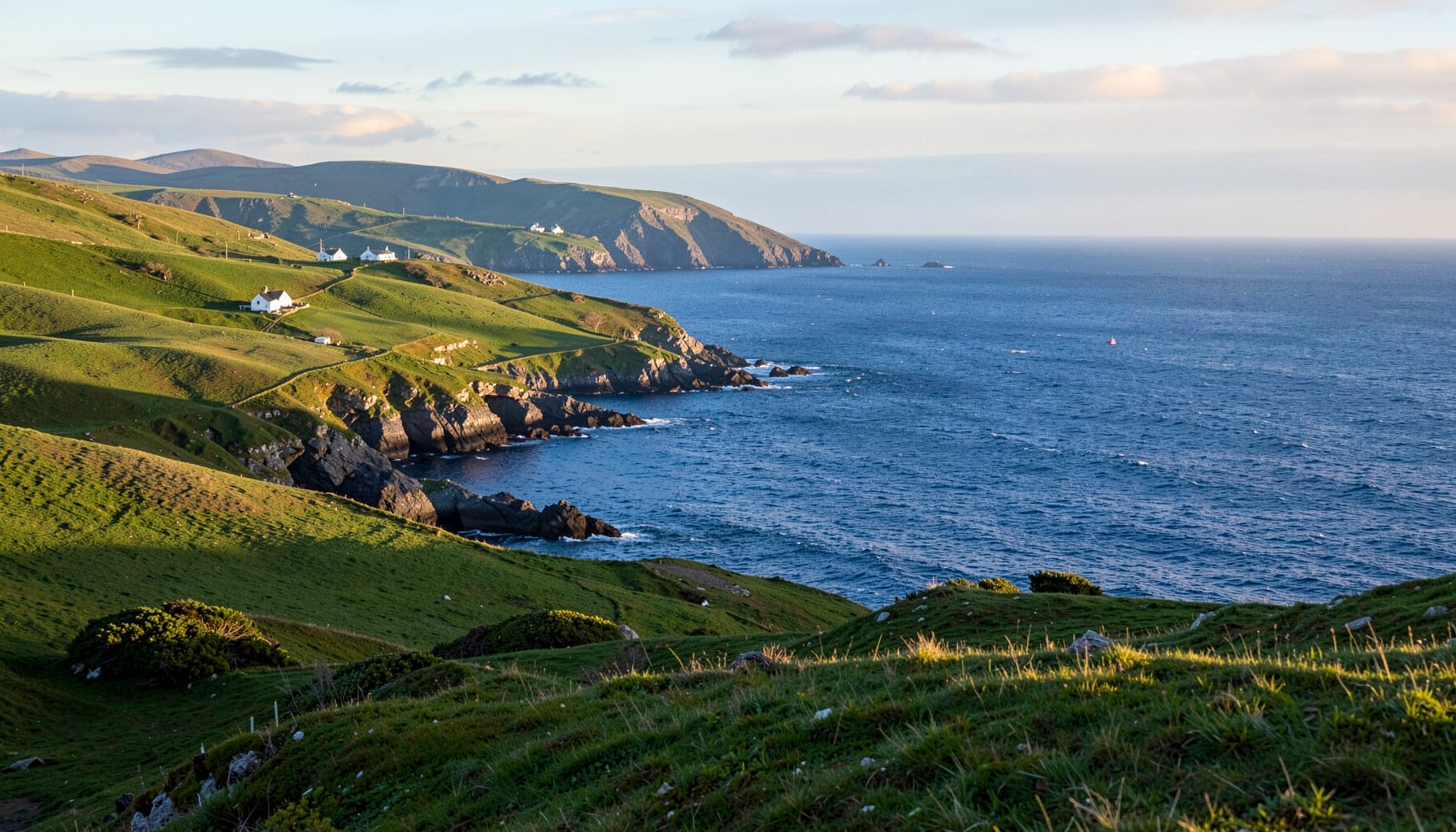
The History of the Potato Famine and Its Impact on the Skellig Coast
The potato famine that began in 1845 reshaped Ireland during the middle of the nineteenth century. Disease, repeated crop failures and a crisis of food distribution devastated communities, while British government policy, landholding arrangements and the continuing export of food affected how people could respond. About one million people died and at least another million left Irish shores. Ireland’s population fell from roughly 8 million in 1841 to about 6.6 million in 1851.
On the Iveragh Peninsula, the consequences were immediate and deeply personal. Potatoes supplied calories, but they did not create prosperity. Rocky ground, fragmented holdings, exposed Atlantic weather and slow transport left many families vulnerable. The arrival of blight could ruin a household’s seed potatoes as well as its food, leaving few choices after the first missed harvest.
The story of the Skellig Coast is therefore about fields and families, not simply a damaged crop. Families lost members, separated across oceans and changed the way farms, kitchens and communities were organised. Kells, Castlecove, Waterville, Sneem, Portmagee and the coastal settlements of west Kerry all carry traces of the demographic collapse that followed the famine.
For Australians, this history can also connect with family migration records and community commemoration. A search through a state archive, parish register or oral account may reveal a departure from County Kerry and an arrival in Sydney, Melbourne, Adelaide or a rural town. Such links place Ireland’s Great Hunger within the lived history of Australian communities.
Potato blight and the food crisis
The disease responsible was Phytophthora infestans, a water mould that devastated susceptible potatoes in repeated seasons. Damp conditions encouraged its spread, although weather alone did not explain the disaster. Farmers often had little capital, few alternative seeds and no effective treatment. A failed field meant lost wages, food and planting material at the same time.
British rule shaped the wider crisis. Cereals, meat and other foods continued to move through Irish markets, while the state’s relief system was slow and frequently stigmatising. Many tenants depended on seasonal labour that had disappeared. Landlords could evict households unable to pay rent, and emigration often became the only viable option available to an entire family.
The figures contain many different experiences. Some people died at home, some in workhouses or hospitals, and some survived only after leaving. Records of births, marriages and deaths show missing generations rather than a single dramatic moment. For Iveragh families, the crisis unfolded through failed harvests, funerals and departures.
Life on Iveragh before the blight
Potatoes were a substantial part of the everyday diet in west Kerry, often eaten with buttermilk, cabbage and, where available, herring. Families tended small plots beside larger fields, while neighbours shared labour during planting and lifting. The crop was valuable because it grew relatively quickly, fed several people and could survive in cool, damp conditions.
Rural life was closely connected to family and place. Households drew on language, music, religious observance and local knowledge to get through winter. News travelled between farms, markets and coastal settlements, although mountainous terrain and poor roads limited contact with distant towns. A diseased field could therefore affect an entire network of households.
Fishing, boatbuilding, quarrying and coastal trades supplemented income from land. Around Valentia and other western settlements, employment could vary with shipping and weather. Estate improvements near Kells and Castlecove brought roads and new buildings, yet they did not remove tenants’ dependence on landlords or the crop that sustained them.
The Great Hunger reaches the peninsula
The first severe national crop failure occurred in 1845, and blight spread widely in 1846. By 1847, hunger and disease were affecting communities in every part of Ireland. On Iveragh, families faced the loss of both food and seed potatoes at a time when many had no income, stored grain or livestock to sell.
Land was concentrated in estates, and much of the peninsula’s farming population worked as tenants. A poor harvest could lead to arrears and eviction even when an entire family wanted to remain. Private subscriptions, clergy and local relief funds provided assistance in some places, while the Poor Law system operated institutions such as the Cahersiveen workhouse. Neither source offered enough support for every household.
Census and parish records show steep population losses across many west Kerry districts. Some communities recovered slowly during the 1850s, but they never returned to their 1841 size. Abandoned holdings, altered house sites and sharply reduced school rolls reveal the scale of the change. The famine also weakened Gaelic-speaking traditions already facing pressure from English education and migration.
Emigration transforms the coastal communities
Most emigrants travelled to North America, especially Canada and the United States, because routes and ticket prices could be more accessible. Others sailed from Liverpool to distant Australian colonies. Families sometimes migrated in stages: one person earned fares and sent money home before another relative followed.
Every departure altered the remaining household. Children could be raised by relatives, farms might be divided or abandoned, and money sent from overseas could keep another family alive. Letters also carried news, grief and practical advice. Even where an emigrant disappeared from daily life, absence became part of the family story.
Australia’s distance made the journey especially costly. Ships could carry illness, and a migrant might spend weeks at sea before reaching a new labour market. For descendants today, records may begin with a ship’s name but quickly lead to employment, housing, religion and children’s names. These traces demonstrate that the famine’s effects continued long after the last harvest failure.
Traces of hunger in the living landscape
Evidence survives in fields, boundaries, roads, wells, houses and burial grounds across the peninsula. Some graveyards contain clusters of famine-era graves, while local accounts connect particular settlements or buildings with families who left during the crisis. Such places require care because incomplete records can blur individual lives into broad statistics.
Language and oral tradition also changed. In some communities, households increasingly used English as younger generations attended schools or prepared to emigrate. Stories could fade, be retold differently or survive within particular families. The phrase An Gorta Mór, meaning the Great Hunger, preserves the event in Irish, while local English accounts often call it the potato famine or simply the Famine.
The region’s living heritage extends beyond memorials. Skellig Michael, a UNESCO World Heritage Site and monastic settlement, attracts visitors from around the world, while villages provide settings for interpreting landscape, food and migration. Understanding the famine adds another layer to the Skellig Coast and helps visitors appreciate why small settlements, roads and harbours developed as they did.
Reading Iveragh’s story from Australia
Australian descendants can use several kinds of records to trace a Kerry connection. The National Library of Australia in Canberra, the State Library of New South Wales in Sydney and Public Record Office Victoria in Melbourne offer substantial collections. Civil registration and shipping records were generally organised separately by colonial governments, so researchers often need to search more than one state archive.
Local historical societies and family historians can hold documents absent from major collections. In Australia, many descendants simply say “the Famine” when discussing Irish ancestors, much as Irish speakers use An Gorta Mór. At St Patrick’s Day gatherings, school assemblies and commemorative events, the story may be passed through music, photographs and spoken testimony. The familiar Australian pub or church hall can serve much the same communal role as meeting places in Ireland.
Commemoration also appears in Australian museums, memorial displays, exhibitions and community heritage projects. Many families know a town in New South Wales, Victoria or South Australia but not the Irish parish, making it necessary to search by family names rather than location. Long distances between cities and regional towns have encouraged online research, although volunteer-run museums and historical societies remain valuable for records that have never been digitised.
Remembering the people behind the numbers
Remembering the famine begins with place. Visitors to Kells, Sneem, Waterville, Portmagee, Valentia and Castlecove can connect the scenery with local history, while museums, archives and community events provide deeper context. Private homes, burial grounds and archaeological sites should be approached respectfully, with local access and conservation guidance followed.
Attend a local talk, read the parish and census records, and speak with people whose families remember migration. Supporting community heritage organisations also helps preserve documents and ensure that famine-era lives are represented accurately. By learning the names and choices behind the statistics, visitors can keep the communities of the Skellig Coast present in Australian memory for generations to come.