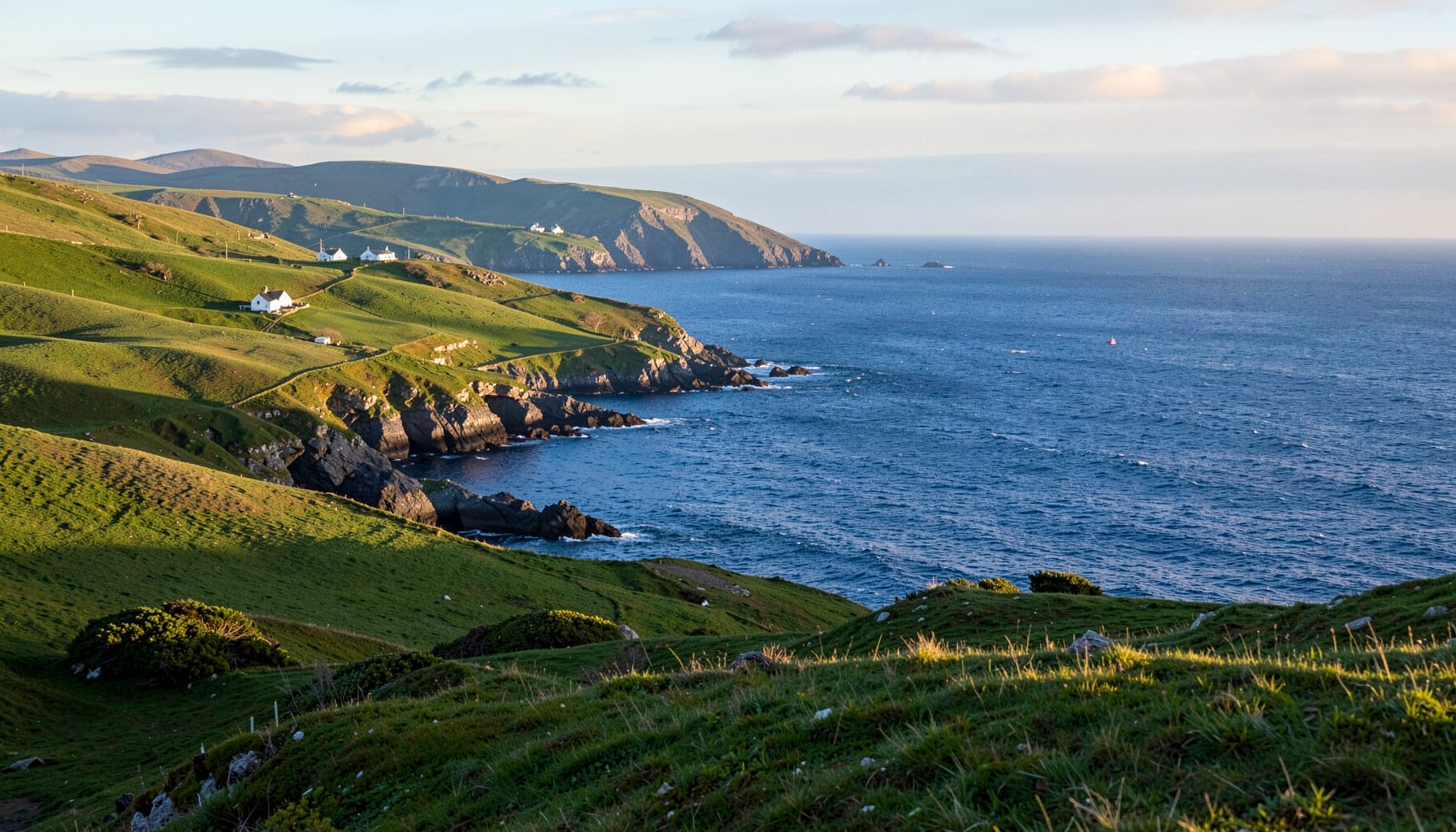
Ancient coral reefs of Ireland’s Skellig Coast
Fossilised coral reefs in the rocks of the Skellig Coast record seas that existed hundreds of millions of years ago. On the Iveragh Peninsula and around the Ring of Kerry, ancient marine limestone contains the mineralised remains of corals, sea lilies and other organisms that lived on former seabeds. Their fossils may resemble branching twigs, horn-shaped cups, curved ribbons or clusters of tiny tubes.
These remains are scattered through coastal outcrops rather than forming one continuous reef wall exposed like a modern coral reef. Some are easy to overlook, while others are revealed only after rain, quarrying or a storm has cleared the rock. The evidence is especially associated with the Portmagee Channel and Valentia Island, although fossil-bearing rocks occur elsewhere along the Iveragh coast.
Where fossil-bearing rock meets the sea
The Portmagee Channel and Valentia Island are useful places to begin exploring the geology. Fossil-bearing limestone appears in coastal cliffs, old workings and wave-washed platforms, particularly where the sea has removed weathered material from the surface. Visibility changes with tides, landslips and erosion, so a location that looks promising on a geological map may be inaccessible on the day.
The wider coast between Kells, Portmagee and Castlecove tells a broader story. Rock that began as sediment on an ancient seabed was later uplifted, fractured and exposed. Along the way, iron staining, quartz veins and erosion have created distinctive banded or jagged surfaces. Travellers can therefore learn about the fossils by looking at the whole outcrop, not by searching only for individual specimens.
Old slate quarries, roadside cuts and low cliffs may offer safer viewpoints than exposed cliff edges. Access can also change through weather or rockfall, making recent local information more reliable than an old photograph online. A nearby heritage or learning hub may be able to explain which exposures are publicly accessible and which should be viewed only from a distance.
What the coral fossils reveal
Reef-building corals were community organisms. Each tiny skeletal cup, known as a corallite, belonged to a colony connected to its neighbours. Palaeozoic forms included rugose corals, often called horn corals because of their curved, tapering shape, and tabulate corals that sometimes left honeycomb-like or layered patterns in limestone.
After the animals died, their calcium carbonate skeletons were buried beneath sediment. Dissolved minerals filled pores and cracks, gradually turning the remains into stone. Later movement of groundwater and pressure within the rock transformed the limestone, sometimes preserving fine internal structures that reveal the original growth arrangement.
Good hand specimens reward slow inspection. Look for repeated corallites, radiating partitions, orderly branching or curved rows of cups. Quartz veins can imitate pale markings, but they tend to be brighter, glassier and sharper, and they cut across the surrounding rock rather than following its fossil structures. Colour alone is not a reliable test, and cleaning a specimen may damage evidence or require permission.
Reading an ancient seabed
A living reef and a pile of transported coral fragments can look similar in a small sample. On a larger scale, their relationship to the surrounding beds provides clues. Massive limestone containing colonies in their original positions may indicate an ancient reef, while layers full of broken, sorted and mixed fragments suggest material moved by currents after the reef formed.
The presence of marine fossils confirms an ancient marine setting, but it does not by itself prove that every fossil-bearing bed was a reef. Palaeontologists examine the rock texture, fossil orientation, bedding and relationships between beds to distinguish a reef structure from other seafloor deposits. Different exposures can also represent different geological periods, so each outcrop has its own history.
Skellig Michael has its own internationally important geology, but it should not be confused with these fossil coral beds. Its ancient sandstone and quartzite formed in a very different environment. Its UNESCO status and its appearance in the Star Wars films make it a major part of the regional story, while the coral fossils provide evidence for older marine communities around other parts of the coast.
Adapting to a Kerry field visit
Australians already drive on the left, as people do in Ireland. Visitors who have driven around Sydney or Melbourne may still find Kerry’s narrow lanes, blind bends, stone walls and grazing sheep unfamiliar. Distances are marked in kilometres, forecasts use degrees Celsius, and the local currency is the euro rather than Australian dollars.
Before departing from a village or accommodation, a few practical checks can prevent an unsuccessful search:
- Compare the location with a current geological or heritage map.
- Check tide tables, swell conditions, daylight and access warnings.
- Tell a host or companion where you are going and when you expect to return.
- Carry water, waterproof layers and a charged offline map.
Australian expressions such as “no worries” will be understood, although local speech has its own patterns. “Grand so” means thank you, and “now” can mean soon rather than at the present moment. Cards are accepted by many businesses, but carrying some cash is useful for small rural venues and places without a connection to payment terminals.
Weather can also change faster than a morning forecast suggests. A blue sky above Kerry does not guarantee a dry walk along an exposed coast. Atlantic wind and rain may reach the peninsula with little warning, so waterproof outer layers are more useful than relying on heavy clothing alone.
The Skellig Coast website functions as an information and community hub rather than a booking desk. It can help visitors locate heritage centres, outdoor programmes and community events, after which guides, transport providers and activity organisers can be contacted directly. This approach keeps the visit connected to the places hosting it.
Protecting a fragile coastal record
The ancient seabed forms part of a much wider cultural landscape. Fossil-bearing rock sits alongside prehistoric sites, old quarrying traditions, maritime settlements and the working landscapes of coastal villages. Learning about one layer can therefore lead naturally into local history, architecture and stories about how stone has been used in the region.
Local knowledge adds another dimension to the geology. Community organisations may know how a familiar path has shifted after a storm, where a safe public viewpoint is available or which educational programme covers local rocks. Their information is especially valuable because a scientifically interesting exposure can still be dangerous when waves, unstable ground or falling debris are involved.
Fossils belong in their setting unless collection is explicitly permitted. Photographing, sketching or gently examining loose material is usually a better approach than using a hammer, pry bar or brush. Do not undercut cliffs, move marked stones or enter restricted sites to reach a specimen. Visitors should also remember that the communities from Kells to Castlecove host these landscapes on their doorsteps, not merely as a backdrop for touring.
Put the ancient coast within your itinerary
Build a visit around one verified exposure, a safe coastal walk and a nearby heritage stop rather than searching from one cliff to the next. Begin by checking the Skellig Coast information resources, then confirm recent access and tide conditions with a local organiser. A camera, small notebook and hand lens are enough for careful observation without removing anything.
A visit to the wider region can also include Skellig Michael, village heritage centres, outdoor programmes or a community event. Learning how the coral fossils fit into the peninsula’s larger story gives greater meaning to the coast, while direct bookings with local providers help sustain the knowledge and services that make an informed visit possible. See the ancient evidence, travel responsibly and carry its story home through photographs rather than fragments.