The Well of the Four Beautiful Saints
Along Ireland’s Iveragh Peninsula, stories often cling to places as firmly as stone walls and turf-roofed cottages. A spring, a ruined chapel or a bend in an old road may carry memories that were never recorded in a formal history book. The Well of the Four Beautiful Saints belongs to this tradition: a sacred water source surrounded by devotion, local storytelling and the quiet authority of the landscape.
The tale is best understood as folklore rather than a single fixed account. As with many Irish holy wells, details may change between families, villages and generations. The saints’ identities, the reason for their gathering and the powers associated with the water can appear differently in different tellings. Those variations do not weaken the story. They show how a community has kept it alive.
For visitors from Australia, the well offers a different way to experience heritage. It is not a monument separated from ordinary life, with every detail printed on a sign. Its meaning comes through place, memory and custom: the same qualities that can make an old meeting tree, a country church or a waterhole significant in regional Australia.
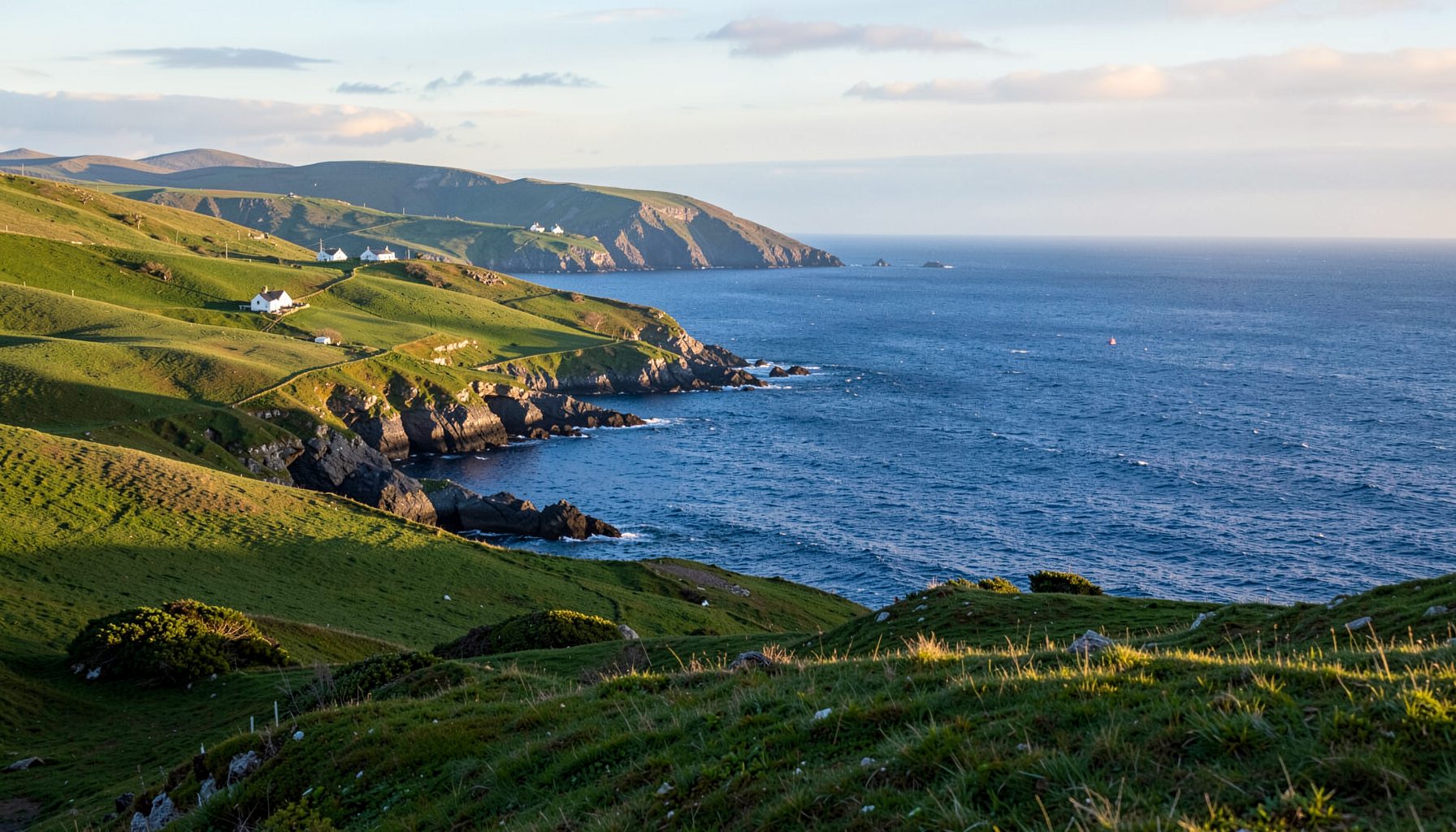
The story also belongs to the wider cultural landscape stretching from Kells towards Castlecove. It sits among ancient routes, maritime communities, monastic associations and the dramatic scenery that draws people towards Skellig Michael. To approach it with care is to encounter a small but vivid strand of the Skellig Coast’s living heritage.
The Well In Its Landscape
A holy well is usually more than a natural spring. In Irish tradition, water emerging from the ground may be understood as a gift, a sign of blessing or a point where the visible and invisible worlds meet. The well’s location matters: it may stand near a church site, a burial ground, a road used by pilgrims or a field remembered through local names.
The Four Beautiful Saints well belongs to this kind of landscape. Its story is connected to the older Christian imagination of the peninsula, where saints travelled between settlements, prayed in remote places and left traces of their presence. The rugged coast helped preserve those memories because communities remained closely attached to particular rocks, streams, hills and paths.
A modern map can show a location, but it cannot fully explain why one spring became special while another remained an ordinary source of water. That knowledge is often held in spoken accounts, family recollections and the habits of people who return to the place over many years.
A Story Carried By Water
The phrase “four beautiful saints” immediately gives the tale a memorable shape. Beauty in this context need not mean appearance alone. It can suggest spiritual grace, purity, kindness or the radiance associated with holy people. Irish legends frequently use physical description to express moral and sacred qualities.
One version of the story may be heard as a meeting of four holy figures whose presence blessed the spring. Another may focus on the water as a source of healing or protection. A further telling might emphasise the journey to the well, making the act of walking there part of the devotion. These strands can coexist without needing to be forced into one official version.
The water therefore becomes a carrier of memory. It connects the saints with the people who came after them, and it links a local place with a much broader pattern of Irish pilgrimage. The story’s power lies in that connection between the everyday act of drawing water and the larger belief that a landscape can remember.
The Four Saints And Their Meanings
The number four may have encouraged the story’s endurance. Four figures create a sense of balance and completeness, while the word “beautiful” makes the tale distinctive enough to be remembered by children and adults. Whether the saints were imagined as companions, travellers or spiritual guardians, their presence gives the well a communal character.
Local folklore often protects uncertainty. Rather than supplying a neat list of names, storytellers may preserve an atmosphere, a warning or a ritual action. In this way, the story remains open to interpretation. The well is sacred because generations treated it as sacred, even when the original explanation became incomplete.
That approach is useful when visiting heritage places along the Skellig Coast. It avoids treating oral tradition as a failed version of written history. A story can reveal how people understood illness, luck, landscape and belonging. Its value is cultural as well as factual.
Healing, Custom And Local Memory
Holy wells across Ireland have long been associated with cures, blessings and protective practices. Visitors might pray, wash a particular part of the body, leave a small offering or walk around the well in a prescribed direction. Customs vary, and many are connected to saints’ feast days or local patterns of pilgrimage.
The Well of the Four Beautiful Saints should be approached with respect rather than treated as a prop for a photograph. Do not remove stones, disturb offerings or assume that a private custom is available for public performance. A quiet visit, careful observation and attention to local guidance are more appropriate than turning the place into a spectacle.
The social history of wells also includes difficult periods. Water sources could become especially important during disease outbreaks, when people relied on familiar springs and traditional forms of protection. The cholera folklore associated with nineteenth-century Ireland shows how fear, memory and belief became woven together during public health crises.
For Australians, the comparison with drought-affected communities or remote settlements that depend on reliable water can be helpful, although the cultural contexts are different. In a city such as Melbourne or Sydney, water arrives through regulated infrastructure; at a rural holy well, water can still be experienced as a direct and meaningful part of place.
Reading The Story Today
The legend can be read through several overlapping lenses. None needs to erase the others. A religious reading may focus on grace and intercession; a historical reading may ask how Christian devotion adapted older attitudes towards springs; an environmental reading may emphasise the importance of clean water and local ecosystems.
| Feature of the tradition | What it may express | A respectful modern response |
|---|---|---|
| Four saintly figures | Community, balance and spiritual completeness | Allow different local versions to coexist |
| The spring itself | Healing, blessing and continuity | Protect the water and surrounding ground |
| A journey to the well | Pilgrimage, effort and remembrance | Walk quietly and follow access guidance |
| Offerings or rituals | Personal devotion and family memory | Observe without taking or imitating casually |
| Oral storytelling | Local authority and changing detail | Listen before presenting one version as final |
This layered reading is particularly important in an age of fast online tourism. A short caption can reduce a complex tradition to a supernatural curiosity, while a respectful account shows how the well belongs to people, history and landscape together.
Heritage interpretation in Australia has faced similar questions around whose story is being told and who has the authority to tell it. Aboriginal cultural heritage laws differ between states and territories, yet the central principle is widely recognised: culturally significant places should not be treated as scenery without considering custodianship, permission and living community connections.
Visiting With Care
The well can be included in a broader exploration of the Skellig Coast, alongside village histories, walking routes, archaeological remains and community-led cultural activities. Its appeal is quiet rather than theatrical. Visitors may remember the place because it offers a pause from busy roads and major attractions.
People travelling from Brisbane, Perth or Adelaide may be accustomed to checking fire warnings, track conditions and access rules before visiting rural landscapes. Similar care is needed here. Weather can change quickly on the Iveragh Peninsula, paths may be wet, and a site that appears accessible on a map may cross private land or require local permission.
Australian visitors may also recognise the importance of small local markets in keeping regional identity visible. A farmers market in Hobart, a weekend produce stall outside Bendigo or a community craft event in regional New South Wales can carry stories through food, objects and conversation. Along the Skellig Coast, local knowledge works in a comparable way: the person who knows the road, name or custom may be the most valuable source of context.
Keeping The Tradition Alive
The legend survives when it is shared accurately, carefully and with room for uncertainty. Schools, local historians, walking groups and community organisations can all contribute by recording memories, protecting access and making sure that visitors understand the difference between documented history and oral tradition.
Responsible storytelling should also respect Irish heritage protections. Archaeological sites and historic structures may be covered by the National Monuments Acts, while access to land can depend on ownership and local arrangements. Taking stones, digging near a spring or moving objects can damage evidence that cannot be replaced.
Useful ways to engage with the story include:
- Listen to local custodians and record differing versions without treating one as automatically superior.
- Keep the well and its approaches free from litter, damage and unauthorised offerings.
- Share photographs and descriptions that protect privacy and do not encourage unsafe access.
- Support community museums, heritage projects and local events that sustain regional knowledge.
- Treat claims about healing as folklore, never as a substitute for medical advice.
A Living Heritage Along The Coast
The Well of the Four Beautiful Saints is valuable because it remains connected to a real landscape rather than existing only in a book. Its spring, its name and its changing story bring together Christian tradition, older attitudes towards water and the practical memory of people who have lived beside the coast.
Its meaning also sits comfortably beside the larger heritage of the region. Skellig Michael may draw international attention through its monastic history and appearance in film, yet smaller places such as holy wells reveal how heritage is experienced at a local scale. They show that cultural importance is not measured only by size, fame or visitor numbers.
For readers exploring from Australia, the story offers a gentle reminder that heritage can be intimate. It may be found beside a lane, beneath a hedge or in a spring known chiefly through family memory. Learn the local account, travel lightly and allow time for the landscape to speak through the people who care for it.