The Valentia Island Transatlantic Cable Story
On Ireland’s south-western coast, Valentia Island became the European gateway to a technological revolution. In the nineteenth century, news between Europe and North America travelled by ship, often taking weeks. The laying of a submarine telegraph cable promised something astonishing: messages crossing the Atlantic in minutes rather than months.
The cable reached the shore at Foilhommerum Bay, on Valentia’s western side, linking the Iveragh Peninsula with Newfoundland. The project brought engineers, sailors, investors and government interest to a remote coastal community. It also placed Valentia at the centre of a new international communications network.
The first connection was short-lived, but its significance endured. Later cables created a reliable transatlantic link, and Valentia remained associated with the cable service for more than a century. Today, the surviving landscape and local heritage sites tell the story of the people and experiments behind that achievement.
Why Valentia Was Chosen
Valentia Island offered a practical departure point for a cable running westwards across the Atlantic. Its position on the south-western edge of Europe reduced the distance to Newfoundland, while the deep waters and sheltered approach around Valentia provided suitable conditions for landing and maintaining a submarine line.
Foilhommerum Bay became the chosen landing place. The area was remote, but it had the essential ingredients for the undertaking: access to the sea, a natural harbour nearby and a route towards the developing settlement of Knightstown. The cable station later connected the island’s coastal landing point with the wider telegraph network in Ireland and Britain.
The project also depended on local labour and knowledge. Building roads, station facilities and cable infrastructure required the involvement of residents as well as specialist workers from outside the region. A global communications breakthrough therefore became part of the economic and social history of Valentia.
The First Atlantic Experiment
American businessman Cyrus West Field was a leading figure in the effort to connect Europe and North America by telegraph. The Atlantic Telegraph Company brought together capital, engineering expertise and political support. The plan involved laying a cable from Ireland to Newfoundland, where messages could continue by land and existing telegraph lines to destinations such as New York.
The first attempts were difficult. In 1857, the cable broke during laying, forcing the expedition to return. A second effort in 1858 succeeded in bringing the cable ashore at Heart’s Content, Newfoundland, and at Valentia. Ships including HMS Agamemnon and USS Niagara played important roles in the operation, carrying the cable across the ocean.
The connection opened in August 1858. On 16 August, a message from Queen Victoria to United States President James Buchanan travelled through the new system. The exchange was celebrated as a triumph of science and international cooperation, even though the cable soon showed serious technical weaknesses.
A Brief And Fragile Success
The 1858 cable was made from copper conductors surrounded by insulating gutta-percha and protected by an outer covering of iron wires. Its design represented advanced engineering for the period, but the line was vulnerable. Electrical signals weakened over the immense distance, and attempts to increase the transmission speed damaged the insulation.
Messages became slower and less dependable. The cable finally failed in September 1858, after operating for only a few weeks. The failure did not erase the achievement, but it exposed the gap between making a connection and creating a dependable commercial service.
The episode also changed telegraph engineering. Scientists and operators learned that an undersea cable needed carefully controlled electrical currents, improved insulation and stronger construction. The first Valentia landing was therefore both a public triumph and a practical lesson in the limits of nineteenth-century technology.
The Cable That Made History Last
A further cable attempt in 1865 ended when the line was lost in the Atlantic during the laying operation. The breakthrough came in 1866, when the huge steamship Great Eastern successfully carried a new cable to Newfoundland. This connection proved reliable, and the ship later recovered and completed the unfinished 1865 cable as well.
The 1866 success transformed the project from a dramatic experiment into a working communications service. Telegraph messages could cross the ocean far faster than any ship. Financial information, diplomatic reports, business instructions and personal news began moving through an international network of cable stations.
Valentia remained an important European terminus. The local station handled messages arriving from Newfoundland and transmitted them onward through Ireland and Britain. The island’s role formed part of a much larger system stretching between continents, linking remote coastal locations with major cities and commercial centres.
| Date | Development | Importance |
|---|---|---|
| 1857 | First cable-laying attempt fails | Demonstrated the practical dangers of deep-ocean cable work |
| August 1858 | Cable lands at Valentia and Heart’s Content | Created the first direct telegraph connection across the Atlantic |
| 16 August 1858 | Royal and presidential messages are exchanged | Gave the new technology international public attention |
| September 1858 | The first cable stops working | Revealed problems with insulation and electrical transmission |
| 1865 | A new cable is lost during laying | Encouraged further engineering improvements |
| 1866 | Great Eastern completes a successful cable | Established a dependable transatlantic telegraph service |
| Twentieth century | Cable communication continues from Valentia | Kept the island connected to global communications history |
Life Around The Cable Station
The transatlantic service changed the character of Valentia. Telegraph operators worked in a specialised environment where accuracy and speed mattered. Their work involved receiving coded electrical pulses, interpreting Morse code and passing information into the next stage of the communications network.
The station also created employment and brought a new professional culture to the island. Cable ships, engineers and maintenance crews became familiar sights. Repairs could be urgent and demanding, since a fault under the Atlantic threatened the entire service. The cable was an international asset, but its daily operation depended on people working in a small local community.
Knightstown developed as an important point of contact between the island and the outside world. The cable story belongs alongside Valentia’s maritime history, slate quarrying, fishing traditions and role as a gateway to the Skellig Coast. It demonstrates how a rural place could become central to a global system without losing its local identity.
What Remains On Valentia Island
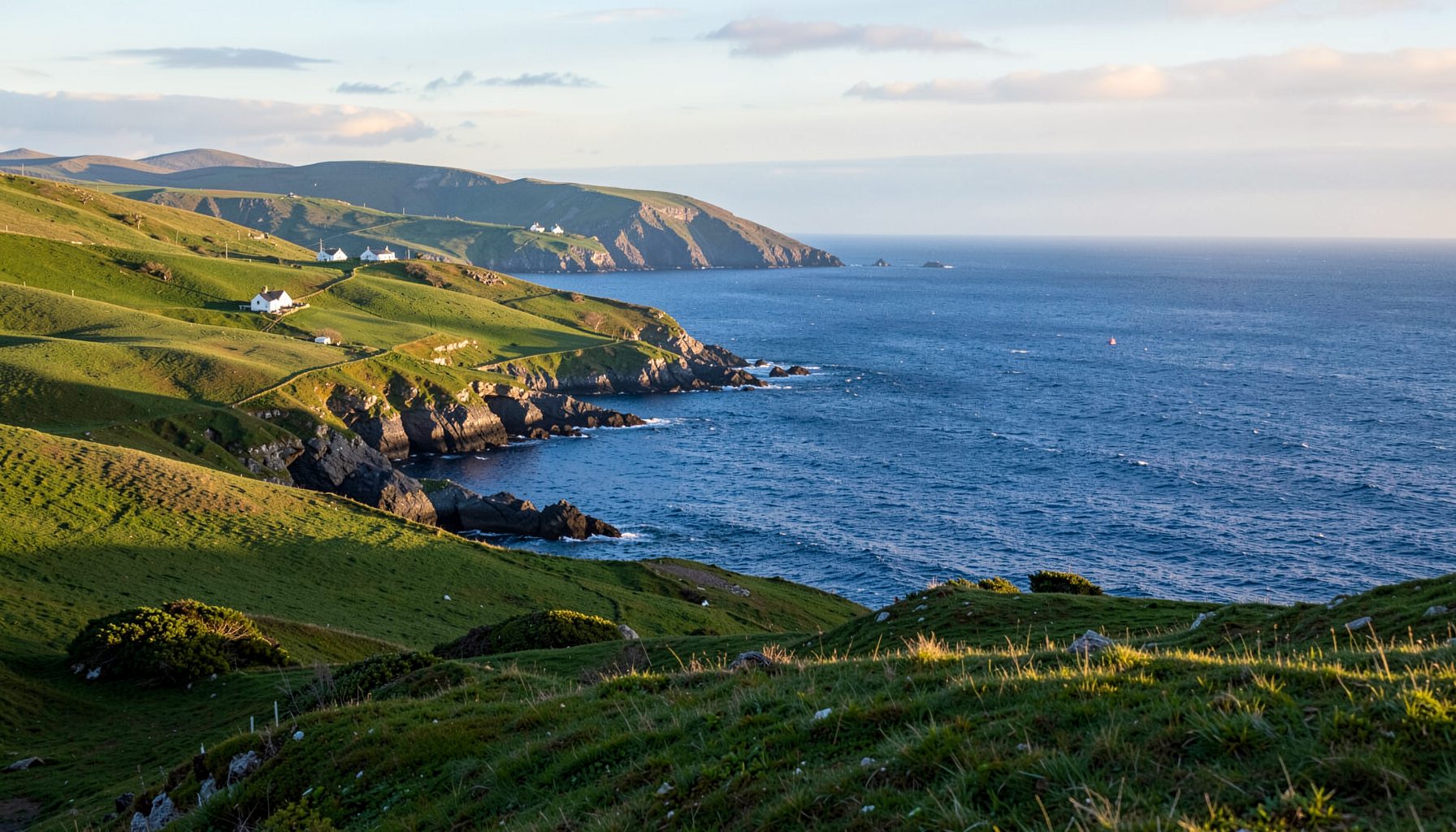
The cable landing area at Foilhommerum Bay is the most evocative part of the story. A monument marks the site connected with the first transatlantic telegraph cable, and the surrounding landscape helps visitors understand the scale of the undertaking. From this rugged coastline, messages once began a journey beneath the Atlantic seabed.
Valentia Cable Station in Knightstown preserves further details about the enterprise. Exhibitions and interpretation explain the construction of submarine cables, the work of telegraph operators and the effect of the service on Valentia. The heritage experience connects technical history with the island’s communities and maritime setting.
The surviving sites are especially valuable because the cable was more than an isolated invention. It involved international finance, naval vessels, scientific debate, industrial manufacturing and local labour. Visiting the island makes those connections easier to grasp: the quiet shoreline at Foilhommerum Bay was once the edge of a rapidly expanding global network.
Exploring The Story Responsibly
A visit to the cable heritage sites works best when combined with time to understand the wider landscape. Foilhommerum Bay is exposed and coastal conditions can change quickly, so appropriate footwear and care near cliffs and uneven ground are important. Visitors should follow local access guidance and respect private land, monuments and sensitive areas.
The story can also be explored through local museums, community interpretation and regional heritage resources. Combining the cable station with other Valentia Island sites creates a fuller picture of how geology, maritime activity, science and settlement shaped the island. The nearby Skellig Coast adds another layer of history, from early Christian heritage to modern tourism and environmental stewardship.
Useful ways to engage with the story include:
- Visit the Valentia Cable Station and allow time for its interpretation of the telegraph era.
- Travel to the Foilhommerum Bay monument to see the historic landing landscape.
- Learn how Morse code and submarine cable technology changed nineteenth-century communication.
- Pair the cable heritage sites with Valentia’s geological, maritime and community attractions.
- Check local opening times, access conditions and guided programme information before travelling.
The Valentia Island transatlantic cable story remains powerful because it joins a remote Irish landscape to a worldwide transformation. The first cable failed, yet the experiment helped create the knowledge needed for a lasting connection. From Foilhommerum Bay and Knightstown, Valentia became a place where local life met global ambition.
Explore the Skellig Coast’s community, cultural and heritage resources to discover more about Valentia Island, its cable pioneers and the people who continue to preserve this remarkable chapter of Ireland’s history.