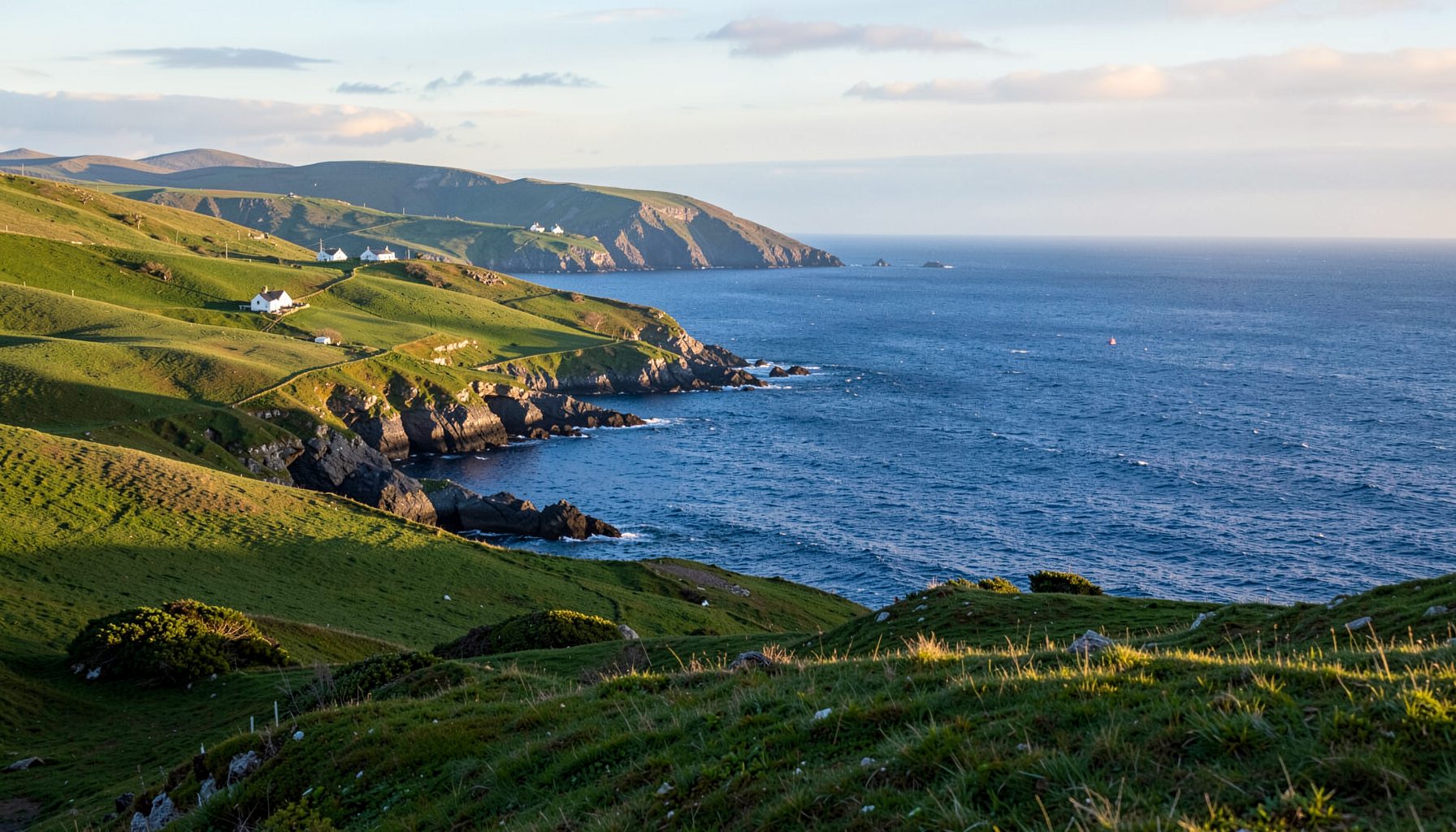
The story of the Valentia Island slate quarries
On the western edge of Ireland’s Iveragh Peninsula, Valentia Island holds a remarkable record of industry within a landscape better known for sea cliffs, stone walls and views towards the Skelligs. The island’s slate quarry is part of that story: a place where local geology became a valuable building material and connected a small Kerry community with major construction projects far beyond the Atlantic coast.
The quarry is more than an abandoned industrial site or a source of attractive roofing stone. Its history brings together geology, maritime trade, skilled labour and the changing fortunes of rural enterprise. The surviving landscape also helps explain how people on Valentia Island made use of the resources beneath their feet while depending on the sea for transport and communication.
Today, Valentia slate remains associated with durability, distinctive colour and a strong sense of place. Its story adds another important layer to the heritage of the Skellig Coast, alongside the island’s transatlantic cable station, prehistoric monuments, fishing traditions and maritime connections.
A geological resource shaped by time
Slate begins as rock that has been altered by pressure and heat, allowing it to split into thin, workable layers. On Valentia Island, the quarry’s stone is valued for its close grain, strength and weather-resistant qualities. Its colours can range through blue-grey, purple and muted green tones, giving finished roofs and paving a character that changes with the light.
The island’s rocks were formed long before human settlement, when the landscapes of what is now southwest Ireland were part of a very different geological world. Folding and pressure later shaped the beds into material that could be split and dressed. For quarry workers, this ancient geological history became a practical advantage: carefully handled blocks could produce roofing slates and other architectural stone.
This relationship between landscape and craft is especially visible around the quarry. The exposed rock faces, spoil heaps and working areas show how extraction altered the ground. They also demonstrate why local geology matters in regional heritage. The quarry is not separate from Valentia’s natural identity; it is one expression of it.
The quarry’s early development
Commercial slate extraction on Valentia Island is generally traced to the early nineteenth century, with quarrying established around 1816. This was a period when construction was expanding across Britain and Ireland, and durable slate was in demand for roofs, floors and public buildings. Valentia’s position on the Atlantic made export possible, even though it also created practical difficulties.
The work required much more than removing rock. Quarrymen split blocks along natural planes, shaped them with specialist tools and sorted the finished pieces according to size and quality. Such skills were learned through experience and passed between workers. The quarry therefore provided a form of employment rooted in local knowledge, with the rhythm of work governed by weather, orders and shipping.
Valentia slate acquired a reputation beyond the island. It has been associated with prestigious buildings including the Paris Opera House and the Houses of Parliament, although claims about individual projects should be treated carefully because building records and later promotional accounts do not always give the same level of detail. The broader point is clear: the quarry produced a material that entered architectural markets well beyond County Kerry.
Moving stone across the Atlantic coast
The quarry’s success depended on transport. Finished slate had to travel from the working area to the shoreline, then be loaded for onward shipment. Before modern roads and mechanised handling, this involved considerable physical effort. Blocks and crates were moved by cart, boat and larger coastal vessels, linking Valentia to ports in Ireland and Britain.
Knightstown became particularly important in the island’s maritime life. The planned village and harbour developed during the same era when Valentia was gaining significance as a centre of trade, fishing and communication. Slate formed part of this wider network, sharing the harbour with goods, passengers and vessels connected to the island’s other enterprises.
The sea was therefore both an opportunity and a constraint. It opened a route to distant customers, yet storms, tides and limited harbour facilities could delay shipments. The quarry’s history cannot be understood simply as a story of extraction. It was also a story of logistics, where the value of the finished slate depended on getting it safely from a remote island to the building sites that needed it.
| Period | Main character of the quarry | Wider significance |
|---|---|---|
| Early nineteenth century | Commercial extraction becomes established | Valentia joins regional and international building-material networks |
| Victorian era | Skilled hand quarrying and maritime shipment | Local labour supports export trade and island employment |
| Early twentieth century | Falling demand and changing materials affect production | Industrial decline reflects wider changes in construction and transport |
| Later twentieth century | Historic workings gain heritage value | The quarry becomes part of Valentia’s cultural and geological identity |
| Today | Specialist production and preservation continue in different forms | Valentia slate remains linked to craftsmanship, place and sustainable local materials |
Skilled work and community life
Quarrying influenced the social history of Valentia as much as its physical appearance. It offered work in a region where employment was often seasonal and closely tied to agriculture, fishing and the sea. A quarry wage could support households while also strengthening connections between the island’s workers, harbour businesses and local transport services.
The work was physically demanding and carried real risks. Stone splitting, lifting and dressing required strength, patience and precision. Dust, falling rock and unstable surfaces made quarrying a hazardous occupation, especially before modern protective equipment and safety standards. Like many historic extractive industries, Valentia’s slate trade involved a balance between economic opportunity and difficult working conditions.
The quarry also belongs to a wider pattern of rural industrialisation in Ireland. Small-scale and medium-sized enterprises could serve international markets without resembling the large coal or metal works associated with industrial Britain. Valentia’s operation was shaped by island geography, family networks, craft knowledge and coastal trade. That combination makes it a particularly useful example of how industry developed in remote communities.
Decline, survival and renewed interest
The original quarrying era eventually faded. Changes in building practice, competition from other slate-producing regions, the growth of alternative roofing materials and the disruption of maritime trade all affected demand. By the early twentieth century, the quarry’s commercial importance had diminished, and the historic workings entered a quieter phase.
Industrial decline did not erase the quarry’s value. Its rock faces, abandoned working areas and surviving stories remained part of the island’s inherited landscape. As interest in industrial archaeology and local history grew, the site could be understood in a new way: not simply as a closed business, but as evidence of the people and systems that once connected Valentia with international commerce.
Later efforts to work Valentia slate again helped preserve its reputation as a specialist natural material. Modern production is far smaller than the nineteenth-century industry and operates within different environmental, commercial and safety conditions. The emphasis is now on quality, craftsmanship and the distinctive identity of the stone rather than on large-scale export.
Slate in architecture and memory
Slate has a practical life and a symbolic one. As a roofing material, it protects buildings from Atlantic weather. As a floor tile, wall facing or landscape feature, it brings the colours and textures of Valentia’s geology into the built environment. Its long service life also makes it an important example of a durable local material.
The stone’s appearance changes depending on whether it is freshly split, weathered, wet or illuminated by low sunlight. That variation helps explain its appeal to architects, craftspeople and property owners. A roof made from Valentia slate can appear restrained from a distance, then reveal subtle colour and texture close up.
Its memory is equally important. Stories about the quarry preserve the names of workers, routes, buildings and harbour activities that might otherwise disappear from the historical record. Local heritage projects, museums, guided walks and community archives can connect the physical quarry with family history and the broader development of Valentia Island.
Reading the quarry as heritage
A visit to the quarry landscape is most rewarding when it is approached as part of the island’s wider story. The site can be considered alongside the Valentia Island Lighthouse, the transatlantic cable heritage at Knightstown, the island’s archaeological remains and the maritime routes that shaped the Skellig Coast. Each place shows a different relationship between people, technology and the Atlantic environment.
Visitors should take care around exposed rock, uneven ground and private or active working areas. Quarry landscapes can contain hazards that are not obvious from a distance, and access arrangements may change. Respecting signs, boundaries and local guidance helps protect both people and the fragile remains of the site.
The quarry also encourages a slower kind of tourism. Rather than treating it as a single photo stop, visitors can look at the colour of the stone in boundary walls, notice slate roofs in nearby settlements and consider how materials travelled from a remote island to distant cities. That perspective turns a geological feature into a story about labour, trade and community resilience.
Ways to connect with the quarry’s story
- Explore local heritage information before visiting so the quarry can be understood within Valentia Island’s maritime and industrial history.
- Look for examples of slate in nearby roofs, walls, paving and monuments, while avoiding private property.
- Include Knightstown and the transatlantic cable heritage in the same wider historical journey.
- Follow local access guidance and keep away from unstable faces, machinery and restricted working areas.
- Support community museums, cultural initiatives and local interpretation projects that preserve island stories.
The Valentia Island slate quarries show how a remote Atlantic community could participate in an international economy through geology, skill and seafaring. Their legacy survives in the stone itself, in the landscape shaped by extraction and in the memories attached to generations of quarry workers.
Discover more stories from Valentia Island and the Skellig Coast through local heritage projects, community archives and responsible visits to the places that connect Ireland’s natural landscape with its working past.