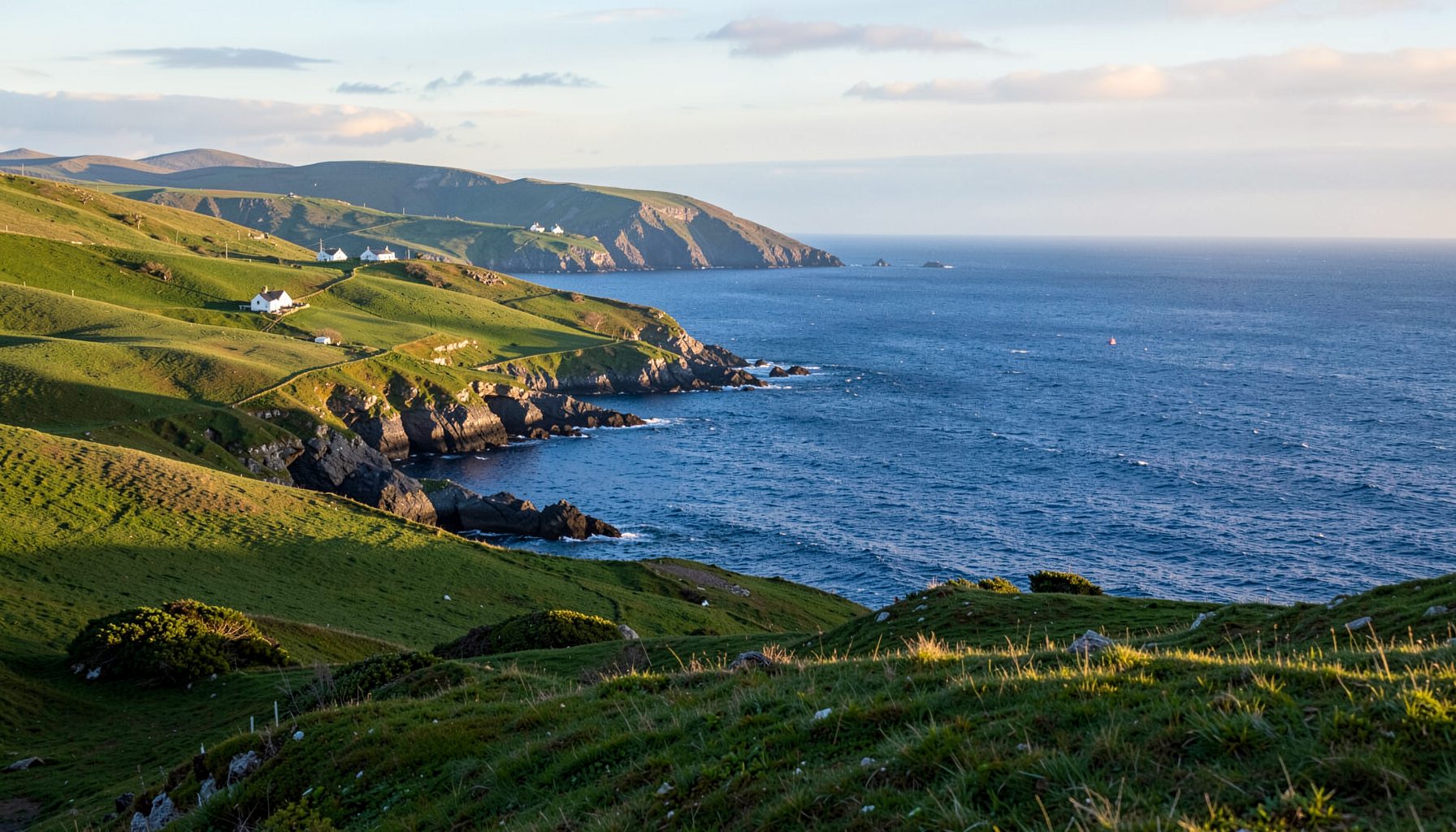
Stone and sea: the early Christian heritage of St. Finian's Bay
The Skellig Coast stretches along the southwestern edge of Ireland's Iveragh Peninsula, a wedge of Atlantic coastline where rocky headlands fold into sheltered coves. Between the villages of Kells and Castlecove lies a small inlet whose name rarely appears on international headlines but whose character shaped the spiritual geography of early medieval Ireland. St. Finian's Bay carries the memory of a saint who retreated to this shore long before the Viking longships probed these waters, and the traces of that presence still linger in the landscape.
Australian travellers planning a slower-paced exploration of Ireland often find this stretch of the Ring of Kerry more rewarding than the busier sights inland. With direct flights from Sydney or Melbourne into Dublin or Shannon, a road trip south-west lets visitors settle into a landscape defined by stone walls, bog cotton, and the texture of monastic ruins. Many who arrive from Melbourne's café strips or Sydney's harbour suburbs are struck by how the rhythm of coastal Kerry mirrors something they left behind: a working coastline, scattered settlement, and weather that drifts in horizontal layers.
A Hollow in the Atlantic
St. Finian's Bay opens along the southern edge of the Iveragh Peninsula, framed by the folded headland of Bolus Head to the north-west and the gentle cliffs that rise toward Valentia Island. The Sleeping Warrior rock formation, a long ridge of stone that, when seen from a particular angle, resembles a recumbent giant, dominates the northern flank. Local folklore claims that the warrior will awaken when a great ship finally lands, a story that travels well along trade winds and across the diaspora, surfacing as far away as the Irish pubs of Brisbane's West End.
Beneath that dramatic silhouette, the bay itself is sheltered. Currents tumble around the Skellig islands some fifteen kilometres offshore, yet close to the shore the water settles into a pool of blues and greens the colour of wholegrain glass. Walking the strand, a visitor passes a slipway used by currach boats, a handful of cottages, and a small graveyard cradled behind the strand. The graveyard sits on the site of an early ecclesiastical enclosure associated with St. Fionán, a saint whose Latin name in the genealogies is Finánus and whose life is recorded in the old Irish calendars.
The saint and the settlement
Fionán, known in English as Finian, is counted among the earliest monastic founders of Munster and is believed to have lived in the sixth century. The Martyrology of Donegal groups him with the holy men who trained or laboured under the umbrella of Skellig Michael's parent house, although the exact institutional link remains uncertain. He is venerated locally on 6 March, a date that Irish communities around the world mark quietly, and his name attaches to several places along the Iveragh Peninsula.
Tradition holds that Fionán sought a remote location away from the rivalries of larger monasteries. His foundation at this bay belonged to a wider pattern of beehive cells, oratories, and small communities that multiplied along the south-west coast during the fifth and sixth centuries. The peninsula acted as a kind of archipelago of small monastic households, each looking to the Atlantic for both inspiration and isolation. A simple stone enclosure, with a leacht (a flat slab used as an altar or memorial) and the remains of at least one clochán, formed the heart of his settlement.
Architecture of memory
The materials used by these early builders tell their own story. Without mortar, they stacked flat local stone into corbelled domes that have weathered more than a thousand winters. A handful of these clocháns survive on the slopes near St. Finian's Bay, although most have collapsed into mounds that look at first like natural humps in the pasture. Irish monastic archaeologists use the term "lustral slab" for the stones used to mark the dead, and several can be found in the small graveyard that clings to the same ground.
Outside the burial area, the foundations of what is interpreted as an oratory sit in a field crossed by sheep. Its low walls, thick in proportion to their height, speak of construction techniques borrowed from beehive huts but reworked to face eastward toward the rising sun. Nearby, a holy well tucked into a rocky alcove still attracts visitors who leave coins, rosaries, or small offerings. The well is dedicated to St. Finian, although some scholars suggest older origins, perhaps to a pre-Christian spirit of the place absorbed into Christian devotion.
A network of Skellig-era communities
The early Christian settlement at the bay did not exist in isolation. Monks and lay brothers maintained contacts with Skellig Michael, the double-peaked island now a UNESCO World Heritage Site that preserves one of Europe's most striking examples of early medieval asceticism. They also reached inland centres such as Kerry's principal early monastery and other settlements along the Iveragh Peninsula. Boat routes linking these places followed natural shelter along the coast, sometimes terminating at landings that have since silted up or vanished under centuries of storm.
During the medieval period, the bay's pattern day drew pilgrims from across Munster. Mass was celebrated in the open air or at the holy well, livestock were blessed, and offerings were made for safe seasons. The pattern continued in fragile form into modern times and has been revived in recent decades as part of a broader regional effort to keep early Christian heritage visible. Community organisations, often supported by Heritage Council grants and Fáilte Ireland initiatives, work alongside archaeologists to map, document, and explain what remains.
Following the trail from afar
Australians visiting the Skellig Coast will find that reaching St. Finian's Bay requires planning around the same Atlantic weather that shaped the early monks' world. Most travellers fly into Kerry Airport from Dublin or arrive from Shannon, collecting vehicles built for narrow boreens rather than the wide carriageways of Perth or Adelaide. Rental cars in Ireland typically come with manual transmissions by default, and visitors used to Sydney's toll network should note that Ireland has few toll roads, instead using open-road speed limits up to 100 km/h on rural routes.
From Cahersiveen or Portmagee, the bay is a short drive along the Iveragh Peninsula's southern edge, with the sea visible for much of the way. Travellers should bring waterproof layers, sturdy footwear, and a degree of patience; there is no café waiting at the strand, although honey from a nearby beekeeper and refreshments at the nearest villages can fill the gap. New Australian visitors to Ireland are entitled to a refund of the 23% VAT charged on goods they take home through the Retail Export Scheme, a useful detail for anyone planning to buy local craft, tweed, or books.
Plan a slow journey along the Ring of Kerry, allow St. Finian's Bay the quiet hours it deserves, and connect with the Skellig Coast community calendar to see how the early Christian heritage of this part of Ireland is being kept alive today.