Valentia’s Cable Station and the Titanic Connection
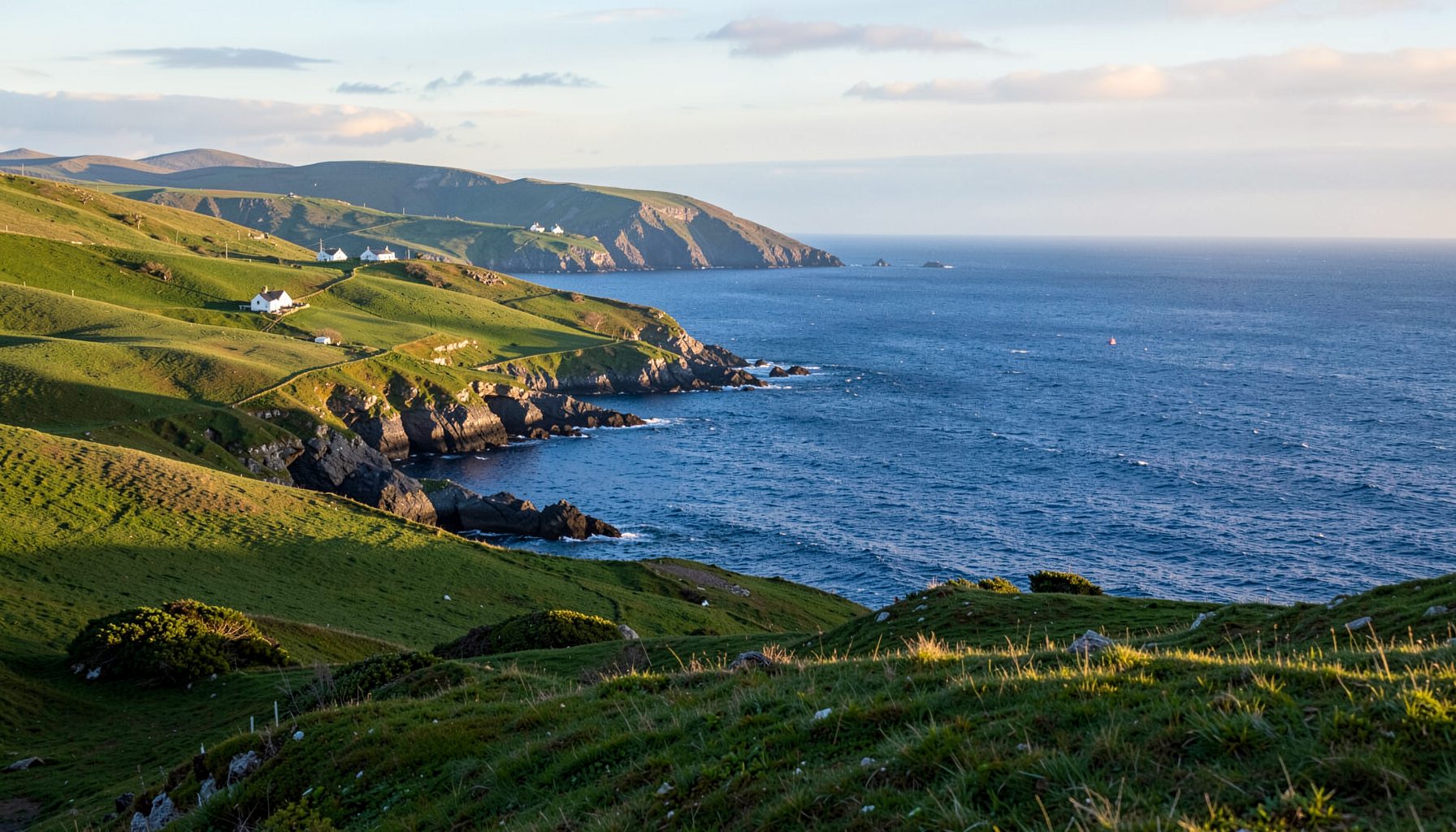
On Ireland’s south-western edge, Valentia Island is associated with dramatic cliffs, monastic heritage and the Atlantic passage to Skellig Michael. It also occupies an important place in the history of global communications. From the shore near Foilhomerrum Bay, engineers sent a submarine telegraph cable beneath the ocean, linking Ireland with Newfoundland and changing the speed at which news travelled between continents.
That achievement helps explain the cable station’s connection with Titanic. The station did not receive Titanic’s wireless distress calls directly, and it was not the place where the rescue operation was coordinated. Its significance was broader: Valentia formed part of the transatlantic telegraph network that carried information between North America and Europe. To understand the Titanic story properly, it is essential to separate the cable system from the newer wireless technology used aboard the ship.
The Atlantic Cable Begins At Valentia
For most of the nineteenth century, a message travelling from Europe to North America had to go by ship. News, business instructions and government information could take weeks to cross the Atlantic. The idea of laying a telegraph cable on the ocean floor promised an extraordinary change: words could move almost instantly between continents.
The western end of the first successful attempt was at Valentia Island, where the cable came ashore at Foilhomerrum Bay in 1858. The project was led by American businessman Cyrus West Field and supported by engineers, investors and governments on both sides of the Atlantic. A message exchanged between Queen Victoria and United States President James Buchanan attracted worldwide attention, even though the cable soon failed.
The early failure did not end the project. Improved cable design and laying methods led to a lasting connection in 1866 between Valentia and Heart’s Content in Newfoundland. A second cable was also recovered, giving the service greater reliability. Valentia became one of the key European terminals in a communication network that reduced transatlantic messaging from weeks to minutes.
The achievement was comparable, in its own era, to the arrival of undersea fibre-optic cables and high-speed internet. For an Australian audience, the change can be imagined through the distance between Sydney and London. Before modern communications, a message crossing that distance depended on ships, schedules and weather. The Atlantic cable did not create instant global communication everywhere, but it established the principle on which later international networks were built.
How The Cable Network Worked
A submarine telegraph cable carried electrical signals rather than spoken conversation. An operator tapped out a message using Morse code, and the signal travelled through a conducting wire protected by layers of insulation and armour. At the receiving station, another operator interpreted the pattern of dots and dashes and wrote the message down.
This system required specialised buildings, trained staff and carefully maintained connections to inland telegraph lines. The Valentia station was therefore more than a coastal landmark. It was a working communications hub, where messages arriving from Newfoundland could be passed into the Irish and European telegraph network. News could then reach government offices, newspapers, banks, shipping companies and commercial firms.
The cable also had limitations. A cable could break, signal quality could deteriorate and messages had to be handled by trained operators. It was not a telephone line, and it could not receive a radio transmission from a ship. The distinction matters when examining Titanic, because the ship’s emergency messages travelled by wireless radio rather than through the old undersea cable.
Valentia’s location made practical sense. The island lies close to the direct Atlantic route towards Newfoundland, while its sheltered bays offered a suitable landing point. The surrounding community had to accommodate new buildings, technical workers, transport links and the commercial activity created by international communication. This was a major transformation for a remote part of the Iveragh Peninsula.
Titanic And The Age Of Wireless
Titanic carried a Marconi wireless installation, operated by Jack Phillips and Harold Bride. On the night of 14 April 1912, after the ship struck an iceberg, the operators sent distress messages using the established CQD signal and the newer SOS signal. Nearby ships with wireless equipment could hear those calls, and the RMS Carpathia responded after receiving the emergency traffic.
The most important shore station in the immediate Titanic communications story was Cape Race in Newfoundland. Its operators heard messages from Titanic and relayed information through the wider communications system. Other ships, including Californian, were involved in the confusing and tragic sequence of wireless messages that followed. Valentia was not the direct receiving station for Titanic’s distress call.
The cable station’s role was connected to the flow of news after the disaster. Once information reached North America, it could be transmitted by submarine cable to Europe, where telegraph offices distributed reports to newspapers and public authorities. Valentia belonged to that chain of international communication. It helped make it possible for events across the Atlantic to become European news far more quickly than would have been possible by ship alone.
This is the most accurate way to describe the Titanic connection. Valentia was part of the communications infrastructure that carried the story, while wireless operators and radio-equipped vessels handled the emergency at sea. The cable station did not guide Carpathia to the survivors, but the telegraph network helped the world learn what had happened.
A Remote Station With A Global Reach
The contrast between Valentia’s rural setting and its international importance is one of the most compelling aspects of the site. Today, visitors encounter a landscape of Atlantic weather, stone walls, narrow roads and open views. In the nineteenth and early twentieth centuries, the same coast was tied to financiers in London, merchants in New York, shipping companies in Liverpool and newspapers in cities across Europe.
The station also reflects the changing character of the local economy. Valentia Island’s earlier life was shaped by fishing, farming, quarrying, coastal transport and maritime work. The telegraph introduced a different kind of employment, based on technical expertise and continuous international contact. It connected a small island community with the commercial and political centres of the world.
For visitors from Australia, the setting may recall other remote communications sites, such as historic telegraph routes across the interior or coastal signal stations around Tasmania and New South Wales. The difference is that Valentia’s defining line ran beneath the Atlantic rather than across a desert or along a national coastline. Its story is still recognisable: infrastructure arrives in an isolated place, creates new work and links local lives to distant events.
The Titanic connection adds a human dimension to the engineering history. A cable network may seem abstract, but it carried real consequences: prices, family news, shipping instructions, election reports and urgent disaster bulletins. The station’s history is therefore about people trying to overcome distance, first with telegraph cables and then with wireless signals.
Reading The Site Today
The cable station story is best understood alongside Valentia’s other heritage. The island’s geology, maritime traditions, lighthouse views and links with the Skellig Coast create a wider picture of how communities have lived beside the Atlantic. Foilhomerrum Bay is especially meaningful because it joins landscape and technology: the ocean that once separated continents became the route through which they were connected.
A visit can also be paired with the island’s cultural and outdoor experiences. Walking routes, local heritage displays and viewpoints help place the cable landing in its physical surroundings. Travellers should allow time for weather changes, narrow roads and the slower pace of exploring a rural island. Conditions can shift quickly, just as they do along the Great Ocean Road or Tasmania’s west coast, so practical planning matters.
For Australians, Valentia offers a useful way to connect familiar communications history with Irish heritage. A visitor from Melbourne might compare the cable’s economic impact with the arrival of rail and telegraph infrastructure in Victoria. Someone from Brisbane, Adelaide or Perth may recognise the importance of reliable connections in communities distant from major centres. The story also suits families travelling during Australian school holidays, when a historical site becomes more memorable through a clear link to a famous event such as Titanic.
Local visitor information is the best source for opening arrangements, seasonal activities, walking conditions and community events. The area is served by local businesses and cultural initiatives rather than functioning as a single packaged attraction. Visitors looking at the Irish tourism market can combine heritage visits with cafés, food producers, guided walks and other experiences across the Skellig Coast, while supporting the communities that preserve the region’s stories.
Ways To Explore The History Respectfully
- Visit the cable landing area and connect the shoreline with the transatlantic route to Newfoundland.
- Read the Titanic story through both technologies: wireless radio at sea and submarine telegraphy on land.
- Allow extra time for local heritage sites, walking routes and weather-dependent viewpoints.
- Check community listings for talks, exhibitions, festivals and seasonal cultural activities.
- Support local cafés, food producers, guides and small businesses during a heritage visit.
- Treat the landscape as part of the story, including the coast, roads, fields and working communities.
- Use reliable local information before travelling, especially outside the main summer season.
The lasting importance of Valentia is that a small Atlantic community became a gateway for global communication. Its cable station did not send Titanic’s final distress call, yet it belonged to the international system that carried the disaster’s news across the ocean. Standing on the island today, visitors can see how engineering, maritime history and community life meet in one remarkable place.
Explore Valentia through its cable heritage, coastal landscape and living community history, then follow the wider Skellig Coast to discover how the region continues to connect local stories with the wider world.