The Ballinskelligs Priory and Its Augustinian Monks
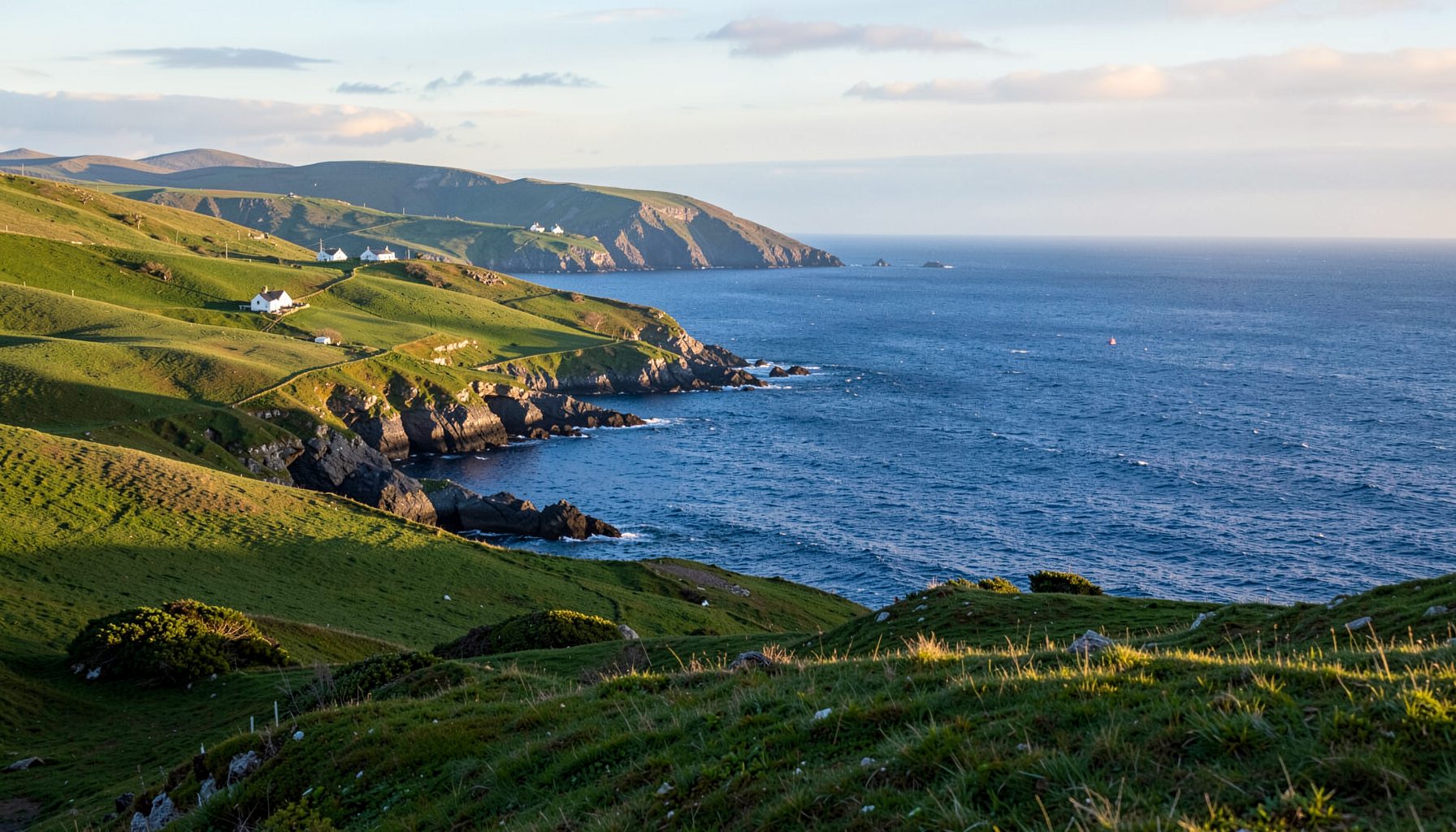
On the southern edge of Iveragh, where the Atlantic rolls in beneath cliffs scattered with fulmars and choughs, the ruined walls of Ballinskelligs Priory rise from a meadow that once rang with plainsong. Travellers arriving from Cahersiveen along the coast road often stop here before pressing on toward Waterville, unaware that the quiet stones before them are the remains of one of the most intriguing Augustinian foundations in the southwest of Ireland.
Founded in the early decades of the thirteenth century, the priory served as a bridge between the older ascetic world of the Skellig rock and the more structured religious life that followed the reforms of the twelfth century. Its story is partly one of stone and mortar, but it is mostly a story of people, of monks who sought a livelihood from the land, of pilgrims who crossed the seas, and of a community that adapted, endured, and finally faded as the wider world shifted around it.
A foundation on the edge of the world
The Augustinian canons who arrived at Ballinskelligs around 1210 were drawn to a site that already carried deep monastic memory. The bay looked south toward the now-iconic silhouette of Skellig Michael, and local tradition long held that the great cliff monastery had been a beacon for centuries of religious settlement along this coastline. The Augustinians, following the Rule of St Augustine, were a different sort of community from the eremitic monks of the rock: they were organised, pastoral, and oriented toward the people of the surrounding parishes.
Patronage came from the local ruling family, and the new foundation was endowed with lands, tithes, and fishing rights that would sustain the canons for generations. Records suggest that the priory was built to serve both the spiritual needs of the rural population and as a stopping point for those travelling by sea between Kerry and the ports of southern France and northern Spain. In an age when the long Atlantic crossing was as familiar to Iberian and Breton sailors as a flight from Sydney to Perth is to Australian holidaymakers today, the Iveragh coast sat firmly within a maritime world.
The Augustinian way of life
Unlike the Cistercians, who sought remote valleys, the Augustinians at Ballinskelligs embraced a life that balanced contemplation with active ministry. Their day revolved around the eight canonical hours, with matins before dawn and compline after nightfall, but they also tended livestock, welcomed travellers, and maintained a hospice for the sick. The priory functioned as a local centre of stability in a region where weather, famine, and raiding fleets could turn a season on its head.
The canons wore a white habit over a black robe, a uniform that became a familiar sight along the lanes leading to the priory. They were often the most literate men in the parish, copying manuscripts, recording births and deaths, and offering what today might be called community development. Their commitment to education would echo far beyond the peninsula; centuries later, Irish Augustinian missionaries would establish communities as far away as Sydney, where the tradition of pastoral learning is still honoured in places such as the precinct surrounding the historic St Mary's Cathedral.
The priory's archive, much of which has been lost, would once have recorded alms given to passing pilgrims and grants made to nearby chapels. This pastoral role gave the Augustinians a foothold in daily village life that the older monastic orders, isolated on their headlands, could not match. Where the early monks of Skellig had withdrawn from the world, the canons of Ballinskelligs walked into it, hearing confessions, blessing harvests, and mediating disputes over land boundaries.
Stone, layout, and craftsmanship
What remains of the priory today speaks to a community of moderate wealth and architectural ambition. The church, set on a gentle slope above the sea, follows the typical Augustinian arrangement of nave, chancel, transept, and a tall central tower. The tower, though reduced to a jagged stump, still hints at the original height of a building meant to be seen from the water and heard across the bay.
Local sandstone and slate were quarried within a short distance, and the masons left tool marks on the lintels that archaeologists can still date to the early thirteenth century. The east window was enlarged in the later medieval period, a sign of growing prosperity, and traces of a decorated altar stone suggest a level of liturgical ornamentation that visitors from Melbourne's Gothic Revival churches, or from the sandstone cathedrals of Brisbane, would find quietly familiar. The cloister, which would have stood to the south of the church, has largely vanished, but the foundations of the canons' dormitory and refectory can still be traced in the grass after a dry summer.
A satellite of Skellig Michael
The relationship between the priory and the cliff-top monastery on Skellig Michael is one of the most discussed aspects of the site. By the time the Augustinians arrived, the older monastery was already in decline, its gruelling asceticism increasingly difficult to sustain. The priory acted as a mainland anchor, a place where the spiritual authority of Skellig could be preserved without the physical hardships of life on the rock.
Pilgrims who climbed the narrow steps to the summit of Skellig Michael were encouraged to descend to Ballinskelligs, where they could find rest, a meal, and the more accessible liturgy of the canons. In this sense the priory was both a refuge and a gateway, softening the harshness of the earlier monastic ideal without abandoning it. The connection between the two sites shaped local identity for centuries, and even today the parish of Ballinskelligs keeps the memory of both foundations alive through community walks and heritage talks.
Daily rhythms and the wider economy
Life at the priory was anchored to the rhythms of land and tide. The canons kept sheep on the commonage above the village, fished the rich waters of St Finian's Bay, and maintained orchards whose fruit was preserved through long winters. Wool from the priory flocks was sold at markets in Cahersiveen and beyond, providing coin that paid for roof lead, candles, and imported wine for the mass.
The priory also operated a small school, where boys from the surrounding farms learned Latin, arithmetic, and the practical skills of surveying and accounting. Australian readers tracing their own family histories often discover ancestors who left west Kerry in the nineteenth century carrying habits of literacy and bookkeeping that owed much to foundations such as this one. The story of the Ballinskelligs priory is, in a small way, the story of the wider Irish diaspora, from Boston and New York to Sydney and Adelaide.
Decline, abandonment, and modern memory
The priory weathered the usual medieval disruptions of storm, plague, and shifting patronage, but its real decline came with the Tudor Reformation in the sixteenth century. The Augustinian houses were suppressed, their lands confiscated, and the community dispersed. Some canons slipped away to the Continent, others returned to lay life in the parish, and a few perhaps withdrew to the more remote corners of the peninsula.
After the suppression, the church fell into ruin, the lead was stripped from the roof, and the cloister buildings were quarried for stone by generations of farmers. What survives is what the community chose to preserve. In the twentieth century, the Office of Public Works consolidated the ruins, and the priory was placed in the care of the state. Today it stands as a focal point for the village, a place where schoolchildren learn about their own locality and where summer visitors pause to read the small interpretation panels set among the grass.
For travellers planning a journey along the Skellig Coast, a visit to Ballinskelligs Priory offers a quieter counterpart to the drama of Skellig Michael itself. Pair a morning at the priory with an afternoon walk along the shore at St Finian's Bay, then settle in for the evening in one of the nearby villages where the music, the seafood, and the warmth of the Iveragh welcome still carry something of the old monastic generosity.
If the story of the Ballinskelligs Priory has stirred your curiosity, consider extending your visit along the Skellig Coast to discover more of the region's layered heritage. Subscribe to the Skellig Coast newsletter for seasonal guides, community event listings, and new articles on the people and places that shape Iveragh. Share the article with fellow travellers, history enthusiasts, or anyone planning a journey along the Ring of Kerry, and help keep the story of these Augustinian monks alive for the next generation of visitors.