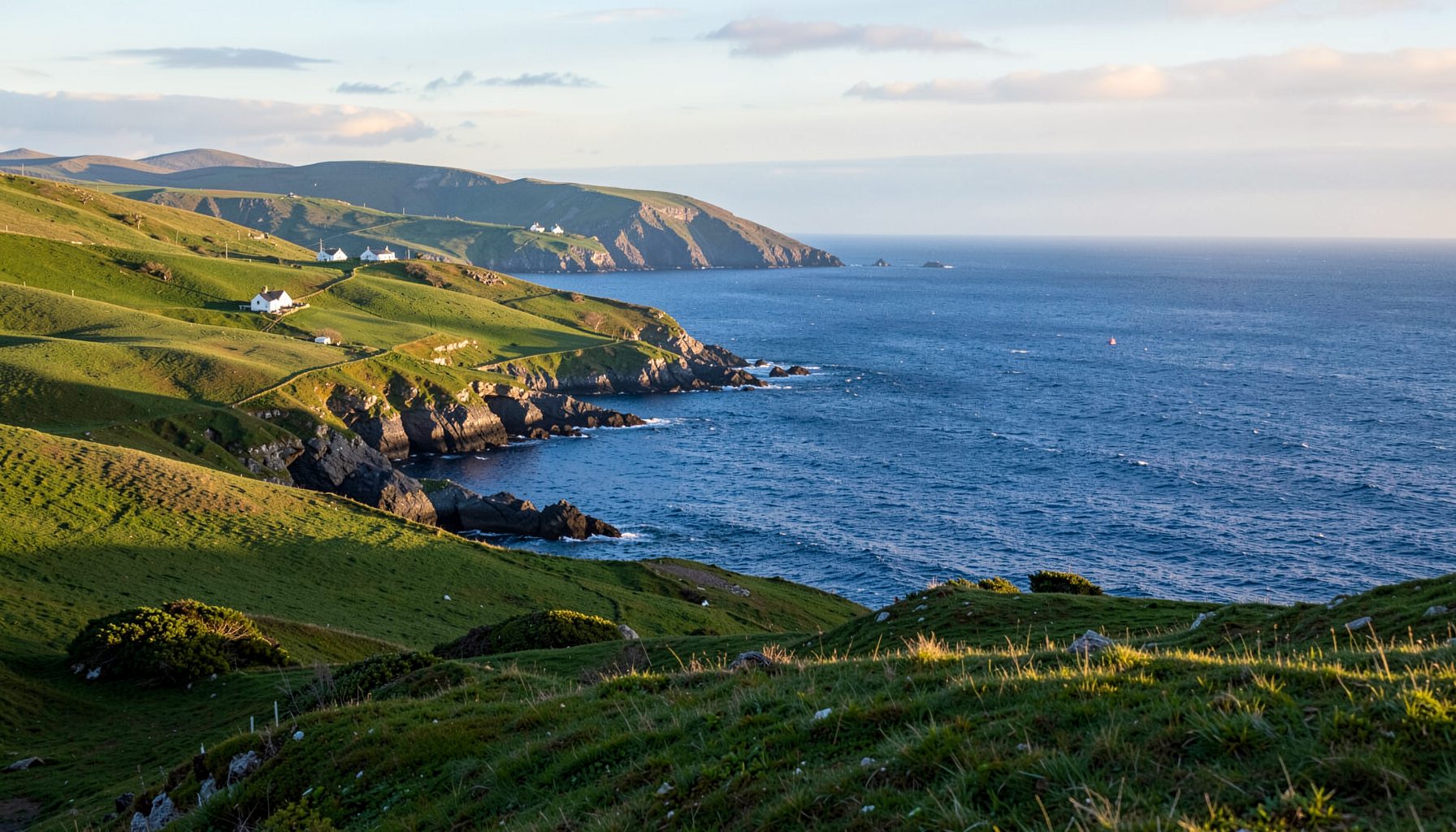
Seaweed Gatherers and Kelp Burners of the Skellig Coast
Before the diesel engine reached every cove and the chemical works of Germany undercut the smallholdings of Kerry, the rhythm of life on the Iveragh Peninsula was tied to the smell of burning kelp drifting in from the shoreline. From the stony inlets around Kells down through Cahersiveen and on to Castlecove, families walked the tideline at dawn, rakes over their shoulders, and spent the long months of late spring and early summer turning Atlantic weed into a coarse grey ash that travelled by donkey, boat, and rail across the British Isles.
The work belonged to no single estate or factory. It was an everyday coastal occupation, paid for in cash that rarely stayed long in the pocket, demanding stamina and stubbornness from anyone who took it up. Men, women, and children contributed to the harvest, and the trade left its mark on local speech, boat-building, music, and memory. Few trades changed the landscape as visibly as the kelp burner, whose low stone pits darkened the sea cliffs from Valentia Island to the eastern reaches near Castlecove.
Today the shoreline still speaks of that activity. Heapsteads and pit walls survive in fragments, place names carry the trade forward, and seaweed is once again the focus of small-scale gathering and processing. To stand on the Skellig Coast during a late spring tide is to see two kinds of history at once: the working shore of the nineteenth and early twentieth centuries and the slow revival of a coastal craft in the twenty-first.
Seasonal Rhythms Along the Atlantic Edge
The gatherer worked the tides, not the clock. Spring tides in April and early May opened the lower shore and exposed the deep brown fronds of kelp that grew just below the low-water line. Storms through the winter loosened the holdfasts and piled loose weed high on the rocks, giving the season its unpredictable beginning. A man might miss two days of hay-making in July to catch a brief weather window between south-westerlies.
In some villages the harvest stretched into August, though the ash made from late-summer weed carried less iodine and was graded lower. There were no calendars pinned to the cottage wall; timing came from instinct, the height of the moon, and the colour of the sea. The same rhythms on a small scale still guide today's shore foragers on the coast, whether gathering dulse for the table or wrack for garden use.
Yields varied wildly between parishes. A sheltered bay near Portmagee with rolling, gently sloping reefs could produce six or seven tonnes of cut weed in a good week, while the exposed Atlantic face below the cliffs at Bolus Head yielded heavier but more dangerous crops. The harvester reading the sky and the swell was, in practice, the same kind of coastal observer as a fisher, and the trade shared many hands across the generations.
Tools of the Trade and the Gathering of the Crop
The kit was simple and almost entirely home-made. A long-handled rake with tines bent into hooks was the central tool, used to drag cut fronds from the rock into small piles. A short, broad blade on a short shaft served as a cutting hook for the densest growth, and a coiled length of rope allowed the gatherer to lower himself onto shelves of weed that would otherwise be out of reach.
Currachs built along the piers of Valentia and Cahersiveen ferried crews and weed around the headlands. Currachs are the traditional skin-boats of the western seaboard, ribbed with hazel and covered with tarred canvas, light enough to launch from a stony beach and stable enough for a heavy working day. On shore, the weed was tossed into loose stacks to allow the first seawater to drain before being carried by barrow or creel to the burning ground.
The skill was in the choosing. A practised gatherer walked the lower shore and read the colour, weight, and texture of the fronds with the same quickness a Sydney auctioneer reads the lot in front of him. Tangled, older weed with a brittle feel signalled lower iodine content, while the deep red-brown blades of Laminaria digitata cut in clean stands were preferred for ash. Discarded pieces went back to the sea, where they would root again and seed new growth within a season.
The Pit, the Fire, and the Ash
Burning took place in stone-lined pits, typically one or two metres across, sited on flat ground above high water. The dried weed was layered in small bundles, with the driest stalks at the base and the weightier, sappier pieces set above. A slow, smothered fire was the aim, and the burner kept the lid of dried turf and seaweed thatch in place to limit airflow. The smell carried for miles: heavy, oily, faintly mineral, and unmistakable to anyone familiar with the western coast.
A good burn took between twelve and twenty-four hours, after which the smouldering heap was raked out and cooled, sometimes with seawater. The finished ash, sometimes called kelp, sometimes pearl-ash in trade ledgers, was packed into sacks and sold on to merchants who shipped it on the small harbours of Valentia, Renard, and Knightstown. Its main markets were the soap, glass, and bleaching works of Glasgow, Bristol, and Liverpool, and for a time, the iodine factories of Scotland.
Production was high and wages low. A man's earnings during a strong summer might match a farm labourer's winter rate, though the work was harder and the smoke stained skin and clothing for weeks at a time. The trade collapsed quickly in the second half of the nineteenth century as chemical sources of soda and iodine entered the market, and the pits fell silent across most of the Iveragh coast within a generation. The shape of those pits, and the names of the people who worked them, stayed on the map.
Community Memory and the Trade's Quiet Revival
Local memory of the trade is long and detailed, stored in oral history collections from Ballinskelligs to Castlecove. Older residents still speak of their grandmothers carrying sacks of dried weed up the cliff paths, of children raking weed before school, of the smell drifting across the bay during a calm evening. Schools along the coast have begun to fold the trade into heritage projects, sometimes in partnership with the Skellig Coast visitor programme, with children drawing the rakes and models of the pits.
A handful of gatherers still work parts of the shore for edible seaweeds sold to restaurants and markets. Some supply small drying racks behind cottage kitchens; others supply local food hubs whose packaging bears the Skellig Coast name. The volumes are tiny compared to the late nineteenth century, but the trade is no longer entirely silent, and it is the older gatherers, once again, who are teaching the younger ones how to read the shore.
The revival also reaches out across national waters. Australia, with its own Atlantic-facing extremes in Tasmania and Bass Strait, has developed a working seaweed industry along the southern coastlines that, in some respects, mirrors the small, artisanal scale of the current Irish revival. A conversation between a gatherer near Portmagee and a Tasmanian operator working beds of giant kelp winds around a shared vocabulary of tides, drying racks, and ash.
Cross-Hemisphere Comparison of Harvests
| Aspect | Skellig Coast, Ireland | Tasmania, Australia |
|---|---|---|
| Main species harvested | Laminaria digitata, Laminaria hyperborea, Ascophyllum nodosum | Macrocystis pyrifera, Durvillaea potatorum, Phyllospora comosa |
| Season of harvest | Late spring to early autumn, peaking in May and June | Year-round in some areas, with peaks between November and March |
| Main products historically | Iodine-rich ash for soap, glass, and chemical works | Fertiliser, cattle fodder, and thickening agents |
| Modern focus | Edible seaweeds, small-batch ash, tourism storytelling | Aquaculture for food, abalone feed, alginate extraction |
| Scale of operation | Very small, often family-run or single-person | Small to medium enterprises, with a few commercial growers around Hobart and the Tasman Peninsula |
Both coasts share the underlying reality that the resource is wild, the weather is the boss, and the price of processed product has rarely kept up with the cost of gathering. The recovery of the trade in either hemisphere depends on whether coastal communities can find a price that respects the labour behind it.
The Future of a Coastal Calling
A range of pressures now frames the conversation. Conservation groups worry that hand-cutting, if poorly managed, can damage holdfasts and reduce recovery time for slow-growing kelp. Harvesters point out that their ancestors understood this and rotated patches over a cycle of years. Climate change is shifting the bands of useful weed northwards along both the Irish and the Tasmanian coastlines, and what was a reliable cut at Valentia in the 1970s may now sit further down the shore.
Within these constraints, the trade has real prospects. Tasmanian growers have shown that high-value food and aquaculture markets can sustain small operators, and that is a model closely watched from Cahersiveen to Derrynane. Closer to home, food markets from Melbourne to Sydney now feature Irish-style dried seaweeds, and the same curiosity that once drove the iodine industry drives a new generation of chefs and home cooks.
If you travel the Skellig Coast during the late spring tides, pause on the cliff paths above Waterville and Castlecove, look down at the stone-lined pits still standing in the heather, and picture the long summer days when smoke drifted out of every cove. Then step into any of the local heritage centres, market halls, or community festivals along the peninsula to meet the gatherers and their families, hear their stories, and taste the harvest that is slowly coming back to life on the shore.