The life cycle of basking sharks off the Skellig Coast
Each summer, the waters around Ireland’s southwest coast can become a feeding ground for one of the Atlantic’s most remarkable fish. Basking sharks arrive where plankton gathers, their huge mouths open as they move slowly through the sea. From a distance, a dorsal fin or a dark shape just below the surface may be the only sign of this seasonal visitor.
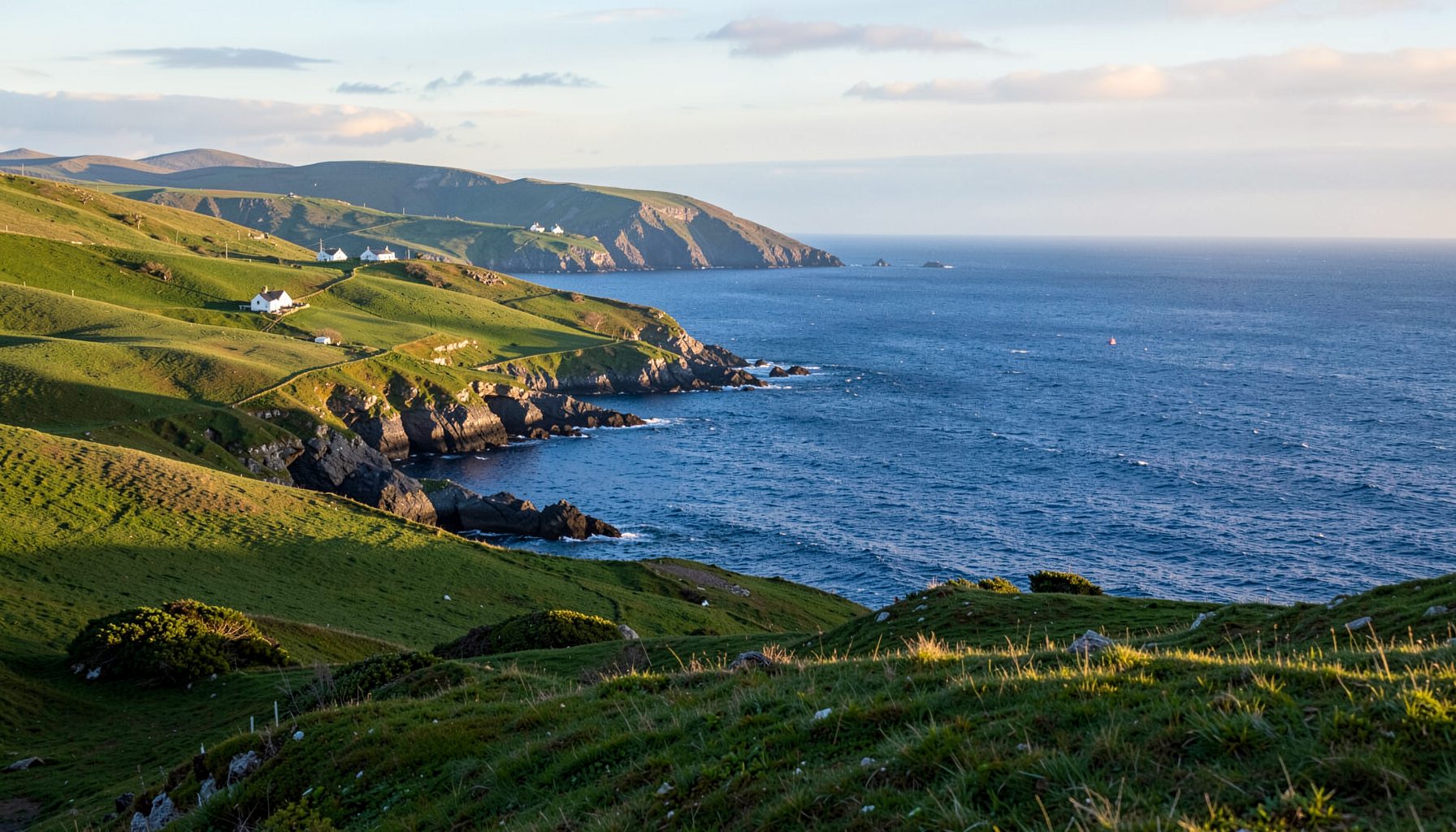
The waters between Kells, Castlecove, Valentia Island and the wider Iveragh Peninsula form part of a coastline shaped by strong tides, deep channels and productive marine habitats. These conditions can support blooms of copepods and other plankton, creating the food supply that draws basking sharks close to shore.
Seeing one is memorable, but a surface encounter reveals only a small part of the animal’s story. Much of its life cycle remains hidden in deeper water, including where young sharks are born, how long pregnancy lasts and where adults spend the winter. Understanding that uncertainty makes every sighting more valuable.
A gentle giant of Atlantic waters
The basking shark, Cetorhinus maximus, is the second-largest living fish after the whale shark. Adults may reach around 10 metres in length, with some individuals growing larger. Their size can look intimidating, yet these sharks are specialised filter feeders and pose no threat to people when left undisturbed.
Their name comes from their habit of “basking” at the surface, often with the dorsal fin and the upper part of the body visible. This behaviour may help them feed in dense plankton patches, although surface basking can also be linked to social activity, courtship or movement through warm, productive water.
Basking sharks are found in temperate seas around the world. In Irish waters, sightings are especially associated with the warmer months, when long daylight hours and ocean conditions encourage plankton growth. The animals may gather in loose groups, travel singly or pass through coastal waters during wider migrations.
Why the Skellig Coast attracts them
The Atlantic edge of the Iveragh Peninsula is exposed to ocean swells, tidal currents and changing water masses. These forces stir nutrients through the sea and can concentrate plankton along headlands, bays and tidal fronts. A feeding shark may therefore appear near the surface in one location and disappear from it within hours as the food moves.
The coast from Ballinskelligs Bay towards the Skellig Islands contains a mixture of open water, rocky promontories and sheltered areas. Such variety creates different marine conditions over a relatively short distance. Basking sharks are capable swimmers, so they can follow plankton-rich water along the coast rather than remaining in one fixed feeding ground.
Spring and summer sightings are often connected with seasonal plankton blooms. The largest concentrations do not necessarily occur beside the most accessible shoreline, and weather can make observation difficult. A calm day may reveal fins and surface trails, while rough seas can conceal animals that are still present below.
The sharks’ presence also links the communities of the Skellig Coast to a much wider marine system. Their movements connect local waters with the Atlantic around Kerry, Cork and beyond. A shark seen near the coast may be travelling between feeding areas rather than beginning or ending its journey there.
From birth to a slow adulthood
The early life of a basking shark is difficult to observe. Females are believed to give birth to live young after a very long pregnancy, possibly lasting two to three years or more. Researchers have proposed different estimates because pregnant females are rarely studied and births have almost never been witnessed in the wild.
Inside the mother, developing embryos first use their yolk supply. Later, they may feed on unfertilised eggs produced by the female, a reproductive strategy known as oophagy. This provides energy for the embryos as they grow. The number of pups is thought to be small compared with the litter sizes of many other shark species.
Newborn basking sharks may measure roughly 1.5 to 2 metres, already larger than many adult fish. Their size gives them a better chance of avoiding some predators, but they still face the risks of limited food, accidental capture and changing ocean conditions. Young sharks may spend much of their early life away from crowded coastal feeding areas.
Growth is gradual, and sexual maturity may not be reached until the sharks are many years old. Estimates vary, with males possibly maturing earlier than females. Individuals can live for several decades, and some research suggests that the oldest may survive for 50 years or more.
| Life stage | What is understood | Where uncertainty remains |
|---|---|---|
| Embryo | Develops inside the mother and may consume unfertilised eggs | Exact pregnancy length and embryo survival |
| Newborn pup | Born live at around 1.5–2 metres long | Birth locations and early movements |
| Juvenile | Grows slowly and feeds on plankton | Routes, feeding grounds and age at maturity |
| Adult | Migrates between productive waters and may form seasonal groups | Winter habitat and population connections |
| Breeding adult | Reproduces infrequently, probably after a long gestation | Courtship, mating sites and litter size |
A reproductive cycle hidden from view
Basking sharks reproduce far more slowly than many smaller fish. Females probably produce young only at widely spaced intervals, and a long gestation limits the number of pregnancies possible during a lifetime. This is one reason the species is vulnerable when adult numbers fall.
Courtship and mating have rarely been documented. Researchers have observed groups of sharks travelling together, sometimes in formations that could relate to social or reproductive behaviour, but it is difficult to distinguish courtship from feeding or migration. Much of the breeding cycle likely takes place offshore or at depths where observation is challenging.
The small number of young, late maturity and long lifespan create a population strategy based on survival rather than rapid replacement. An adult lost through entanglement or collision may represent decades of growth and a missed opportunity to reproduce. Protection therefore has value at every stage, with particular importance placed on large mature animals.
Scientists also continue to investigate whether basking sharks return to the same breeding or pupping areas. Satellite tags and photographic identification can reveal movement patterns, but tagging a large, wide-ranging fish is complex. Data from Irish waters contribute to research across the northeast Atlantic.
Feeding with a natural filter
A basking shark feeds by swimming forward with its enormous mouth open. Water passes across specialised gill rakers, which trap plankton while filtered water exits through the gill openings. The shark then swallows the concentrated food. It does not need to chase individual prey.
Copepods are especially important, although the diet can include other small crustaceans, fish eggs and tiny marine organisms. The shark’s feeding success depends on the density and distribution of plankton. This explains why a large animal may spend hours moving slowly at the surface and then leave when currents shift the food elsewhere.
The gill rakers are delicate structures. Historical hunting targeted basking sharks for their liver oil, meat and fins, while their slow swimming and tendency to gather made them easier to capture. Modern pressures include accidental entanglement in fishing gear, vessel strikes, disturbance and changes in the marine environment.
A feeding shark may appear calm, but it is still a wild animal working through a precise biological routine. Boats that cut across its path can interrupt feeding and increase collision risk. Giving the animal space protects both the shark and the people observing it.
What local sightings can tell us
A basking shark sighting is a useful piece of natural history, especially when it includes details such as date, location, number of animals, direction of travel and behaviour. Photographs of the dorsal fin can sometimes help researchers identify individuals, although images should be taken from a safe distance and without pursuing the shark.
Patterns in sightings can show when sharks arrive, how long they remain and whether particular bays or headlands are used repeatedly. Local knowledge from fishers, boat operators, coastal residents and visitors can complement formal marine surveys. Reports become more valuable when they are consistent and accurately recorded.
The absence of sightings does not prove that basking sharks have left the region. Sea conditions, visibility, plankton distribution and observer effort all affect what people see. A shark feeding beneath the surface may pass unnoticed, while a calm spell can produce several reports in a single day.
For communities along the Skellig Coast, these observations connect outdoor learning with marine conservation. Schools, local groups and visitors can use sightings to explore food webs, migration, oceanography and the relationship between wildlife and coastal livelihoods.
Ways to observe without disturbing them
Responsible wildlife watching allows basking sharks to remain focused on feeding and travelling. Their protected status in Irish waters reflects the need for care around a species that grows slowly and reproduces infrequently. Good practice is straightforward:
- Keep a wide distance and never attempt to touch, feed or swim closely with a shark.
- Approach slowly from the side, avoid cutting across its path and leave a clear route ahead.
- Reduce engine speed and noise when a shark is nearby, following local marine-watching guidance.
- Do not gather several boats around one animal or chase a shark to obtain photographs.
- Record sightings responsibly and share reliable details with recognised marine research or conservation groups.
Shore-based observers should remain aware of tides, cliffs, slippery rocks and changing weather. Binoculars are often more useful than moving closer, and a long-lens photograph can document a sighting without placing pressure on the animal. The best encounter is one that ends with the shark continuing its journey undisturbed.
Learning about the species also means recognising what remains unknown. There is no dependable public map showing every feeding, breeding or nursery area, and conditions can change quickly along the Atlantic coast. Patience, restraint and accurate observation are more helpful than trying to guarantee a close view.
A basking shark passing the Skellig Coast is part of a much larger natural rhythm, linking plankton blooms with migration, feeding and reproduction across the northeast Atlantic. Explore local marine programmes, heritage resources and community wildlife initiatives to discover how the waters from Kells to Castlecove are being understood and cared for.