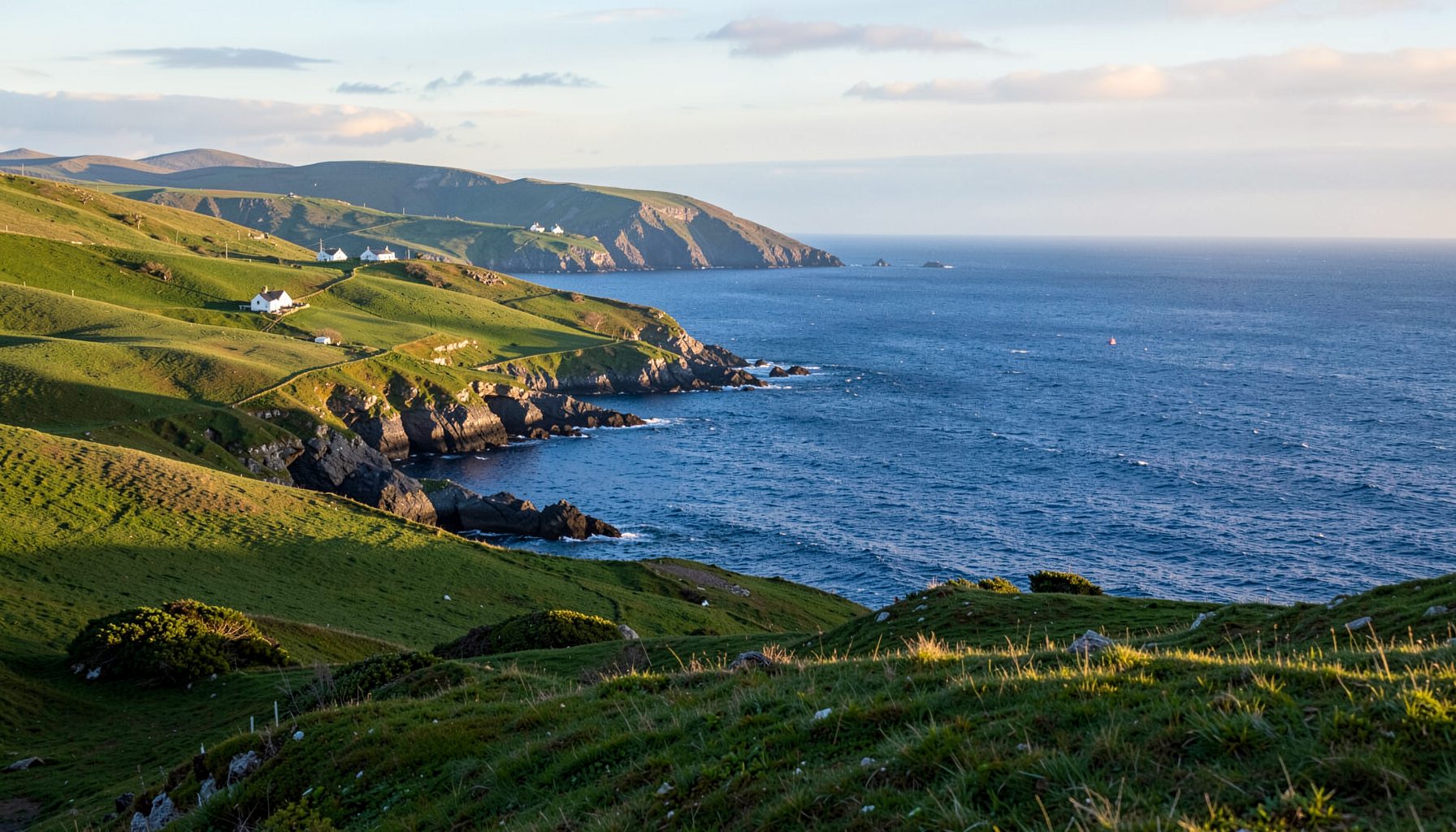
Valentia Island And The Cable That Connected Continents
Before radio, satellites and the NBN made instant communication seem ordinary, messages between Europe and North America travelled by ship. A letter could take weeks to cross the Atlantic, and business decisions depended on vessels arriving safely in port. The telegraph promised something extraordinary: words sent beneath the ocean at almost the speed of electricity.
On Ireland’s south-western coast, Valentia Island became central to that ambition. Its position at the western edge of Europe made it a natural landing place for submarine cables reaching from Newfoundland. From the small community around Knightstown and the cable shore at Foilhommerum Bay, engineers, sailors and telegraph operators helped reshape global communications.
The story is one of bold investment, repeated failure and eventual success. It links the Iveragh Peninsula with Victorian industry, North American commerce and the development of the modern information age. For visitors from Australia, it offers a particularly vivid reminder that today’s rapid connection between Sydney, Melbourne, Perth and the rest of the world has deep roots in nineteenth-century maritime technology.
Why Valentia Island Was Chosen
Valentia Island stood close to the westernmost point of Ireland and offered a practical departure point for a transatlantic cable. Across the ocean, Newfoundland was the nearest North American landfall. The route between the two locations was still immense, but it was shorter than many alternatives and could be approached by cable-laying ships from an established European harbour.
The island also had a sheltered harbour at Knightstown, local maritime knowledge and links to the mainland. Valentia’s position within County Kerry was remote by Victorian standards, yet it was close enough to support the construction of a telegraph station, staff accommodation and landing infrastructure. The project brought international attention to a place previously known chiefly for fishing, farming and coastal trade.
The cable did not come ashore at the village itself. Its landing point was at Foilhommerum Bay, where the shoreline and surrounding terrain became associated with one of the most ambitious engineering schemes of the age. Cables ran from the beach to the station, where electrical signals could be received, decoded and transferred into written messages.
The First Atlantic Attempts
The first serious attempt took place in 1858, backed by the Atlantic Telegraph Company and associated with American financier Cyrus West Field. The cable-laying vessel Great Eastern was not yet involved; the expedition used the smaller ships USS Niagara and HMS Agamemnon. They tried to carry the cable from Newfoundland towards Ireland, joining their efforts in the middle of the Atlantic.
After several failures, the ships eventually completed the connection. The first official message reached Valentia on 5 August 1858, and the cable was formally celebrated soon afterwards. Queen Victoria sent a message to United States President James Buchanan, marking a symbolic moment in Anglo-American relations. The words crossed the ocean in hours rather than weeks, even though the system was extremely slow by modern standards.
The triumph did not last. The cable’s electrical performance deteriorated, and it stopped working within a few weeks. Its delicate insulation, the pressure of deep water and the high voltage applied during attempts to speed transmission all contributed to the breakdown. The episode showed that a transatlantic cable was possible, but it also demonstrated how little engineers understood about reliable underwater communication.
Building A More Reliable Connection
A further attempt in 1865 ended when the cable broke during laying operations. The damaged cable sank beyond recovery, creating another expensive setback. Engineers revised the design, improved the protective iron covering and developed better methods for handling the cable aboard ship. These lessons were essential to the success that followed.
In 1866, the Great Eastern, then the largest ship in the world, carried a new cable across the Atlantic. The vessel’s size allowed the cable to be stored in large tanks and paid out with greater control. After reaching Heart’s Content in Newfoundland, the ship completed the connection with Valentia. A second cable was later recovered from the seabed and brought ashore, providing additional security for the route.
The successful line transformed the reputation of the project. Messages could now pass regularly between Europe and North America, allowing merchants, newspapers, governments and shipping companies to exchange information with unprecedented speed. Valentia became the eastern terminus of a communications network that formed part of the Victorian world’s emerging commercial infrastructure.
Life At The Cable Station
The station required more than machinery. Skilled operators had to interpret faint electrical signals, record messages accurately and maintain equipment in a damp, windswept coastal environment. Telegraph work demanded concentration and discipline, especially when a brief or commercial message represented a considerable sum of money.
The cable also created employment and altered the character of the local area. Workers, engineers and company officials came to Valentia, while nearby businesses supplied food, transport and services. The station became part of everyday community life, even though its purpose was connected to international affairs far beyond Kerry.
Telegraph messages were expensive, so the service was initially used mainly by governments, newspapers, shipping interests and wealthy businesses. A short message could carry news of markets, military developments or a ship’s movements. Information that once travelled at the pace of a sailing vessel could now influence decisions on both sides of the Atlantic within the same day.
For an Australian audience, the change can be imagined through the distance between Melbourne and London. Before undersea telegraphy, news from Britain could take months to arrive by sea. The cable did not make communication as immediate as a text message or video call, but it established the principle that oceans need not separate people from timely information.
Valentia In The Wider Cable Network
The transatlantic line was part of a rapidly expanding system. Cables began linking European capitals, colonial ports, commercial centres and naval stations. Telegraph companies competed to improve speed, reliability and access, while governments recognised the strategic importance of controlling communication routes.
Ireland’s western coastline therefore became connected to a global network that included North America, Britain and later routes extending towards the Mediterranean, India and Australia. In the Australian colonies, telegraph lines and submarine cables were helping connect cities such as Sydney, Melbourne and Adelaide with one another and with overseas news. The same technological movement that reached Valentia would eventually support faster imperial, commercial and personal communication across the southern hemisphere.
The system still depended on ships, shore stations and human operators. Cable faults could interrupt service, storms could disrupt landing operations, and repairs required specialist vessels. A message might cross the Atlantic quickly but still face delays at either end. This mixture of speed and fragility is part of what makes the cable era so historically interesting.
Valentia’s importance also reflected a shift in how people understood distance. The Atlantic was no longer simply a barrier to be crossed by passengers and cargo. It became a space through which information could move, helping establish the interconnected world that later communication technologies would expand.
The Legacy Preserved Today
The original cable station and the wider Valentia Cable Station heritage experience help explain the people and machinery behind the headline of the first transatlantic message. Displays and interpretation connect the local landscape with the engineering companies, cable ships and operators who made the project possible. At Foilhommerum Bay, the cable landing area gives the story a physical setting, with the coastline making the scale of the undertaking easier to appreciate.
The station’s history belongs to Knightstown and the wider Skellig Coast as much as it belongs to international technology. It sits alongside Valentia’s geological heritage, maritime traditions and connections with the Skellig Islands. Visitors can see how a remote island community became part of a global story without losing sight of the people who lived and worked there.
Australian visitors may find familiar themes in this heritage: remote communities supporting major infrastructure, coastal settlements shaped by maritime technology and local history connected to international trade. The comparison is clear in places such as Hobart, Fremantle and Newcastle, where ports and communication systems have also influenced regional identity. Valentia shows an earlier stage of the same long movement towards faster links between distant communities.
The story remains relevant in an age of fibre-optic cables, cloud services and mobile networks. Modern internet traffic still crosses oceans through cables laid on the seabed. The equipment is more advanced, but the basic idea is recognisable: reliable international communication depends on physical infrastructure, specialist workers and carefully maintained landing points.
The history of Valentia Island’s telegraph cable station is therefore more than a tale of Victorian invention. It is a local account of persistence and adaptation, set against the birth of global communications. Explore the station, Foilhommerum Bay and the surrounding heritage of Valentia Island through the Skellig Coast community and tourism resources, and connect this remarkable Kerry story with the wider history of the modern world.