Valentia’s Telegraph Cable And The Atlantic Age Of Instant News
Before radio, satellites and undersea internet cables, a message crossing the Atlantic depended on ships, weather and patience. A letter from Ireland to North America could take weeks to arrive, while newspapers reported international events long after they had happened. The attempt to connect Valentia Island with Newfoundland changed that rhythm and placed a remote corner of County Kerry at the centre of global communications.
The Atlantic telegraph was a remarkable blend of local geography, Victorian ambition and difficult engineering. Its story belongs to the Skellig Coast because the cable station at Valentia linked the island’s working communities with financiers, engineers, sailors and governments across the ocean. For Australians, it also offers a useful way to understand how the telegraph helped create the connected world that later reached the Pacific and Australia.
Why Valentia Became The Irish Terminus
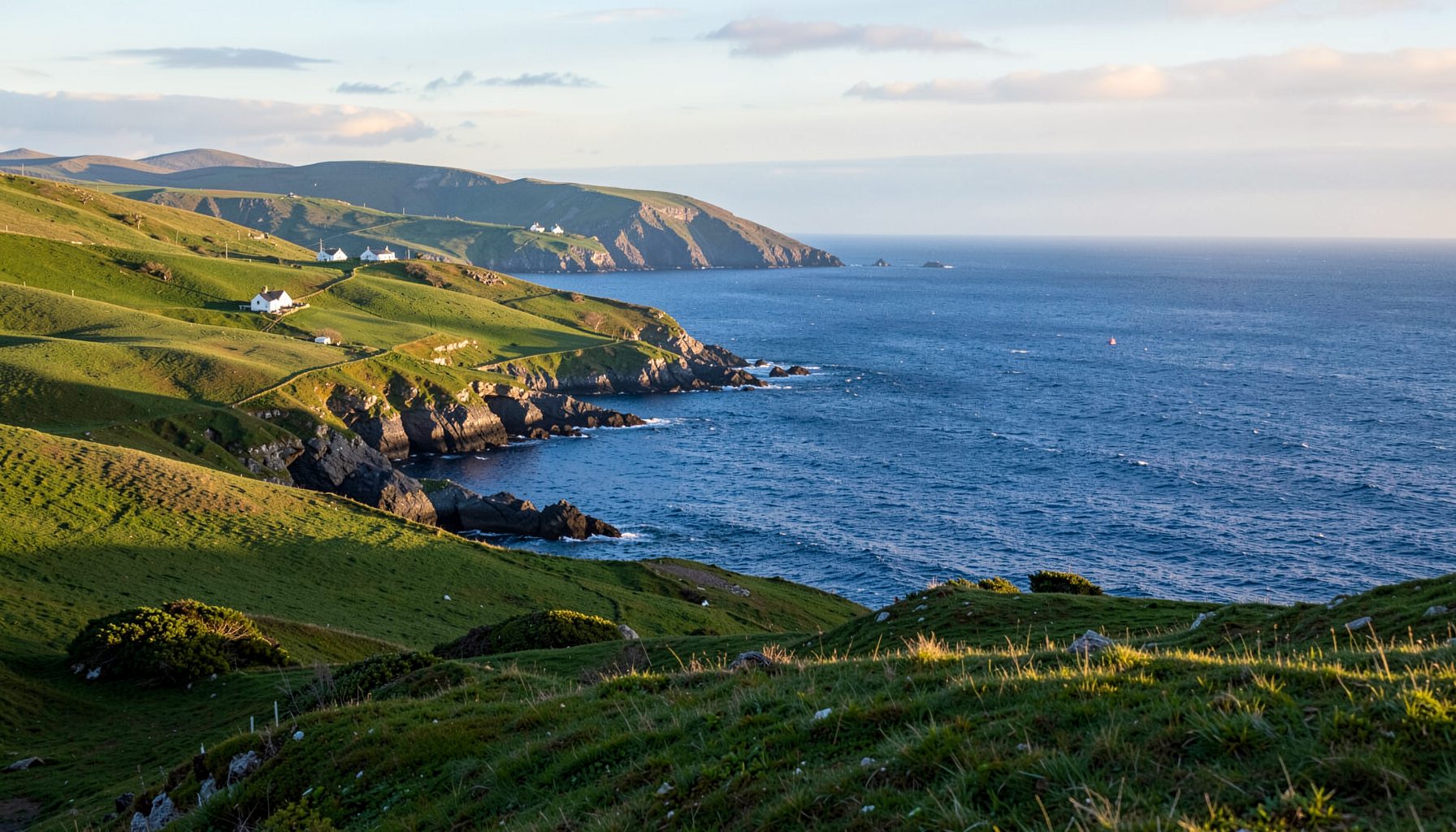
Valentia Island was chosen for practical reasons. Its position on Ireland’s south-western edge made the ocean crossing to Newfoundland shorter than a route from ports farther east. The island also had a sheltered harbour at Knightstown, access to nearby mainland communities and a coastline suitable for bringing a submarine cable ashore. In an era when every extra nautical mile increased cost and risk, geography mattered enormously.
The proposed connection was part of a larger Victorian dream: an electric wire running beneath the Atlantic and joining the telegraph systems of Europe and North America. American businessman Cyrus West Field became the project’s leading promoter, working with British engineers, governments and shipping interests. The plan sounded simple in public speeches, yet the cable had to survive manufacture, loading, ocean currents, great depths and the strain of being lowered from a moving ship.
Valentia was already connected to the growing Irish telegraph network, making it a suitable communications outpost. Once the station developed, the island received a stream of technical workers, officials and ships. Its story sits alongside older coastal livelihoods, from fishing to farming, and local accounts of the shoreline. Even the wider coast has stories of people responding to natural systems, such as Kells Bay’s salmon leap, a reminder that communications history is part of a much older human relationship with water.
The First Cable Expeditions
The first serious cable-laying expedition sailed in 1857. The naval vessels USS Niagara and HMS Agamemnon carried a cable made from copper conductors insulated with gutta-percha and protected by iron wires. The ships attempted to meet in mid-ocean, join the cable and pay it out towards Ireland and Newfoundland. The operation failed when the cable broke at sea.
A second attempt in 1858 used a different method. The ships joined the cable in the Atlantic, sailed in opposite directions and began lowering it towards their destinations. The cable parted several times, but the expedition eventually reached the Irish and Newfoundland shores. On 5 August 1858, Valentia and Trinity Bay were connected by an electric route running across the ocean floor.
The first successful messages produced huge excitement. Queen Victoria sent a message to United States President James Buchanan, and public celebrations followed on both sides of the Atlantic. Newspapers treated the achievement as proof that distance could be defeated by science. The cable was slow and fragile, yet its symbolic power was immense: news that once travelled at the speed of a steamship could now move as electrical signals.
Failure, Persistence And The 1866 Breakthrough
The first cable’s success did not last. Its signals weakened, transmission became increasingly difficult and the connection failed within a few weeks. The exact causes involved poor insulation, electrical damage and the pressure placed on the cable during operation. The project had demonstrated possibility without yet delivering a dependable service.
A new attempt in 1865 used the enormous SS Great Eastern, the largest ship afloat at the time. Its size made it capable of carrying thousands of kilometres of cable, but the expedition still ended in failure when the cable broke before reaching Newfoundland. Engineers recovered some confidence from the attempt, refining cable design, handling equipment and procedures for controlling tension.
In July 1866, the Great Eastern sailed again. This time the cable reached Heart’s Content in Newfoundland successfully. A second cable was later recovered from the 1865 attempt and completed, giving the Atlantic route some redundancy. The improved service carried messages in minutes rather than weeks, although telegrams were expensive and usually reserved for governments, newspapers, companies and wealthy individuals.
What The Telegraph Changed
The cable transformed diplomacy, finance and journalism. Governments could exchange urgent information without waiting for a ship. Business houses could respond more quickly to commodity prices, shipping movements and political developments. Newspapers gained access to overseas reports while events were still current, helping to create a more immediate international news culture.
The new speed had limits. Telegraph operators had to encode and decode messages, and charges were often calculated by the word. Messages were therefore short, formal and carefully edited. The system also depended on a chain of landlines, offices, staff and ships. A cable across the Atlantic was powerful because it connected into national networks at either end, rather than functioning as an isolated technical wonder.
Australia experienced a related communications revolution through its own telegraph expansion. The overland telegraph line linking Adelaide and Darwin was completed in 1872, connecting the colony to the international cable network through Southeast Asia. News from London no longer had to wait solely for a vessel rounding the Cape. In Sydney, Melbourne and Brisbane, a telegraph office became a familiar part of civic life; in remote areas, the line represented a precious link between the bush and the wider world.
Valentia And The Wider Cable Network
The Valentia station formed part of a network that expanded well beyond the original Atlantic experiment. Further cables were laid, landing points were improved and telegraph companies developed more reliable equipment. Valentia’s role continued for decades, and the island became recognised internationally as one of the birthplaces of modern telecommunications.
The physical cable route also changed how people imagined the ocean. The Atlantic was no longer only a barrier crossed by emigrants, merchants and naval fleets. It became a corridor containing infrastructure, with engineers and cable ships maintaining an invisible connection beneath the waves. That idea has a direct modern echo in the submarine fibre-optic cables that carry internet traffic today, including the systems that connect Australia with Asia, North America and Europe.
Visitors exploring the Skellig Coast can place the cable story within a rich local landscape. Knightstown, the cable station area, coastal viewpoints and Valentia’s historic sites all show how international events were grounded in a small island community. The location has also gained attention through the broader appeal of the Ring of Kerry, Skellig Michael’s UNESCO World Heritage status and the Star Wars filming connection. Those attractions draw visitors, while the cable history gives the island a deeper industrial and scientific dimension.
Reading The Story From Australia
For an Australian audience, the most useful comparison is the shift from long-distance isolation to dependable connection. A family in Perth once waited for overseas news by ship, just as communities in Ireland and Newfoundland did before 1858. Even after telegraph lines arrived, distance across Western Australia, the Northern Territory and Queensland made communication uneven. The cable from Valentia belongs to the same global process that eventually made a message from London to Melbourne routine.
The language of that change can still sound familiar. Australians may talk about “getting a wire”, “sending a telegram” or visiting an old telegraph station, even when the original technology has disappeared. The Overland Telegraph Line, Alice Springs’ Telegraph Station and the history of early offices in places such as Ballarat or Fremantle offer local reference points for understanding Valentia. They show that communication infrastructure was built through difficult terrain, trained operators and strong links between metropolitan centres and regional communities.
The history also suits the way Australia’s regional tourism market works. Travellers often combine a major attraction with smaller heritage sites, local museums, walking routes and community-run interpretation. Someone planning a self-drive journey through Kerry may be interested in Valentia’s cable story for the same reason a visitor to the Northern Territory stops at a historic telegraph station: the site explains how a landscape became connected to the world.
Ways To Explore The Cable Heritage
A thoughtful visit or classroom project can move from the technical achievement to the people who made it possible. The aim is to see the cable as part of Valentia’s landscape rather than as an isolated invention. These approaches work well for independent visitors, Australian students, community groups and anyone comparing Irish and Australian communications history:
- Visit the Valentia cable heritage sites and consider why the island’s position suited an Atlantic crossing.
- Compare the 1858 cable with the Adelaide–Darwin Overland Telegraph Line completed in 1872.
- Look at historic maps to trace the route from Ireland to Newfoundland and the connections beyond each landing point.
- Discuss how expensive telegrams shaped the short, formal style of early international messages.
- Include Knightstown, coastal viewpoints and local community history alongside the better-known Skellig Coast attractions.
- Connect the old cable route with today’s submarine internet infrastructure serving Australia and the wider world.
The most rewarding interpretation keeps both scales in view. The project involved international finance, naval vessels and advanced engineering, yet its success depended on shore crews, telegraph operators, harbour workers and local facilities. That combination of global ambition and regional labour is what makes the Valentia story especially valuable for a community-focused heritage website.
The telegraph cable from Valentia to America was an early step towards the instant communications taken for granted today. Its failed attempts, brief first success and eventual breakthrough reveal how progress was assembled through persistence rather than a single dramatic invention. Explore Valentia’s cable heritage alongside the villages, landscapes and cultural stories of the Skellig Coast, and follow the route from a Kerry shoreline to the connected world.