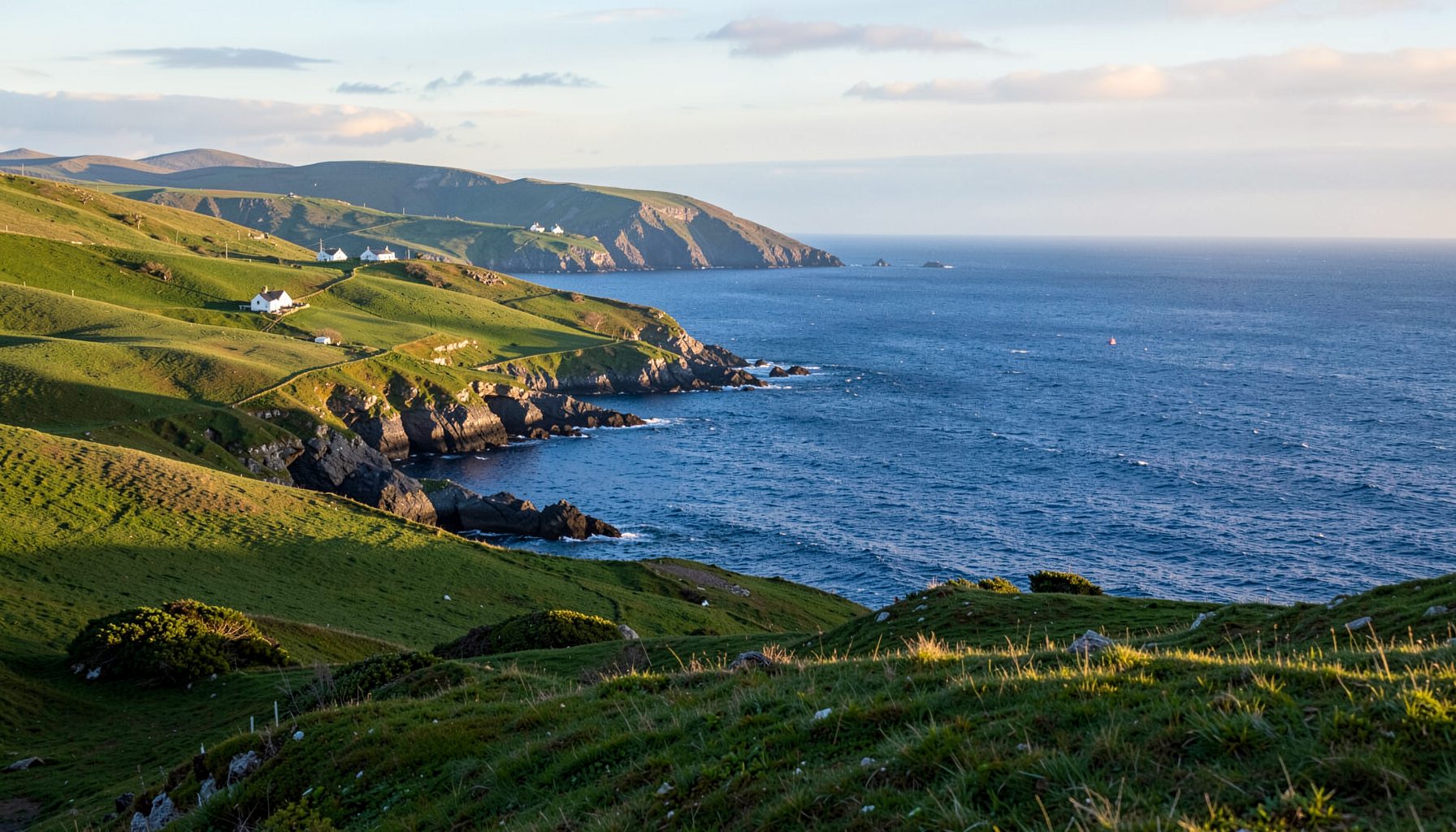
A lifeline across the water: the ferry between Valentia and Reenard
Valentia Island sits a short distance off the western tip of the Iveragh Peninsula, separated from the mainland by a narrow stretch of sheltered water that locals have crossed for centuries. Before any road bridge linked the island to the rest of County Kerry, the only practical way to reach Valentia by vehicle or by foot from the south was by boat, and the small ferry route running between Valentia harbour and the village of Reenard became a quiet but essential artery of the Skellig Coast.
That crossing shaped the rhythm of life for everyone who lived on or near the island. Schoolchildren, shopkeepers, postal workers, fishermen and visitors all relied on the same weather-dependent service, and the people who worked it became familiar figures in their own right. The story of the Valentia to Reenard ferry is therefore less a tale of ships than a portrait of a community bound together by water.
Early crossings before a scheduled service
Long before the first purpose-built ferry began to work the route, families living on Valentia made the crossing in open currachs and small sailing boats. These were nimble vessels well suited to the often choppy conditions of the sound, and they could be hauled up on either shore with relative ease. Farmers heading to the mainland markets at Cahersiveen, women visiting relatives along the peninsula, and fishermen chasing herring runs all relied on this informal network of small craft.
As Valentia grew in importance through the nineteenth century, particularly after the laying of the transatlantic telegraph cable in 1866, the volume of traffic across the water rose as well. Visitors arrived by steamship from Cork and other Irish ports, and many needed onward transport to reach the island's quarries, its slate works and the cable station. The absence of a formal crossing began to feel like a real obstacle, and local voices called for something more dependable than what weather and goodwill could offer.
The scheduled ferry era begins
The first recognisable ferry service between Valentia and Reenard took shape in the late nineteenth century, when local families and small businesses recognised that a regular boat could pay for itself if run with discipline. Operators typically based themselves at the slipway on the Valentia side and the stone quay at Reenard, both of which had been improved over the years to handle heavier vessels. Early ferries were modest affairs, often converted fishing boats fitted with simple decking and a handrail.
By the early twentieth century the route had settled into a recognisable pattern, with morning and afternoon sailings adjusted to the seasons and to demand. Operators changed over the decades, sometimes passing the licence from one family to another, but the basic arrangement remained remarkably stable. Crews knew the tides and the rocks by heart, and passengers accepted that a winter crossing might be cancelled on short notice when Atlantic swells rolled into the harbour.
Daily life shaped by the crossing
For islanders, the ferry was less a transport choice than a fact of life. Children crossed each morning to attend school on the mainland, and their parents timed shopping trips, medical appointments and social calls around the published schedule. Workers from Valentia who were employed in Cahersiveen or in the smaller villages around the bay depended on the same boats, and a missed sailing could mean a long detour by road through Kells and over the mountain.
Goods moved with them. Crates of fish, sacks of slate, parcels bound for the post office, and the occasional livestock consignment were loaded alongside paying passengers. The ferry crews became unofficial postal carriers, news carriers and weather observers, and a chat with the skipper was as informative as any morning paper. The rhythm of this small harbour was comparable in many ways to the commuter ferry networks that thread through Sydney Harbour today, where ordinary people have long used short crossings to connect workplaces, schools and homes on either side of the water.
The familiarity of the service also built strong social bonds. Families on both shores arranged christenings, wakes and seasonal gatherings around the ferry timetable, and crew members were often trusted neighbours rather than anonymous employees. It is this human texture, more than any technical detail of hull design or engine type, that defines the crossing in local memory. Even now, those who travel on Australian commuter ferries will recognise something of that shared rhythm, where staff greet regular passengers by name and the daily timetable quietly structures the life of the harbour.
Visitors and the age of tourism
The second half of the twentieth century brought a slow transformation. The opening of roads along the Ring of Kerry and the growing fame of Skellig Michael as both a monastic site and, much later, a filming location for a galaxy far, far away, drew a new kind of traveller to the Skellig Coast. Many of those visitors arrived without their own transport and looked to the Valentia to Reenard ferry as part of a day trip that combined island heritage with mainland scenery.
Tourists brought new pressures and new possibilities for the operators. Boats had to carry more passengers at peak times, and crews became accustomed to explaining local history, pointing out landmarks such as Bray Head and the Cromwell Point lighthouse, and occasionally fielding questions about the weather. Similar dynamics played out around the same period on Australian ferry routes, where the Spirit of Tasmania began its work linking Devonport to Melbourne in 1960, eventually reshaping tourism across Bass Strait in much the same way that the Valentia crossing knitted Skellig Coast visitors into a wider circuit.
The bridge and the slow fade of the service
The decisive moment came with the opening of the Valentia Bridge in 1971. After years of lobbying by islanders who had endured decades of weather-bound cancellations, a fixed link finally joined the island to the mainland at Knightstown. The bridge changed the calculus of the crossing almost overnight. Cars and lorries could now move freely, and the time-saving for commuters, businesses and emergency services was immediate and significant.
The ferry did not vanish at once. A reduced service continued for some years, often catering to walkers, cyclists and visitors who wanted the experience of the water crossing, but the practical case for the boat weakened with each passing season. Crews gradually moved on, vessels were sold for other work or broken up, and the slipways fell quiet. By the early 1980s the Valentia to Reenard ferry had become a memory rather than a daily service, and the harbour rhythms it had shaped adjusted to a new era shaped by the road rather than the tide.
Lasting echoes along the Skellig Coast
Although the boats no longer run, the cultural footprint of the crossing remains easy to trace. Old photographs hang in pubs around Cahersiveen and Knightstown, local history walks point out the former slipways, and older residents still speak of the ferry captains by name. The story also fits into a broader Irish maritime tradition that many Australian readers will recognise through their own family histories, given the steady movement of Irish emigrants to Melbourne, Sydney and beyond from the mid-nineteenth century onward.
Modern Australian ferry operators, regulated today by the Australian Maritime Safety Authority, carry on a tradition that the Valentia crews would have understood at once. The questions of crew training, passenger safety briefings and weather limits are familiar to anyone who works on commuter or tourist ferries in Brisbane, Perth or Hobart, and that shared professional language is one small reminder that maritime life across two hemispheres often has more in common than its geography suggests.
Today, visitors exploring the Skellig Coast can stand on the Valentia quay and look across to Reenard, and with the help of a local guide piece together what the crossing once meant. Heritage groups, school projects and the wider Skellig Coast visitor network continue to gather recollections from those who worked and travelled on the boats, ensuring that the ferry's role in shaping everyday life along this stretch of Kerry is not lost to time.
Plan a journey to the Skellig Coast, walk the old Valentia harbour, and follow the shoreline south toward Reenard to trace the route that once connected an island community to the wider world of the Iveragh Peninsula. Local museums, walking trails and community heritage pages offer a starting point for anyone keen to keep that maritime story alive.