Derrynane House And Daniel O’Connell
Derrynane House stands near Caherdaniel on the Iveragh Peninsula, surrounded by gardens, woodland, fields and the Atlantic landscape that shaped the life of Daniel O’Connell. Known as “The Liberator”, O’Connell became one of the most influential Irish political figures of the nineteenth century. His campaign for Catholic Emancipation and later efforts to repeal the Act of Union helped define modern Irish political history.
The house was the O’Connell family’s principal home and remains closely associated with the private, family side of a man often remembered through speeches, elections and public demonstrations. Its rooms, objects and surviving estate reveal how an important political leader was connected to rural Kerry, the Catholic landed class and the wider community of the Skellig Coast.
Today, Derrynane House is managed as a heritage attraction by the Office of Public Works. The house museum, historic gardens, coastal park and nearby ruins offer a way to explore both O’Connell’s career and the older cultural landscape around Derrynane Bay.
The O’Connell Family In Kerry
Daniel O’Connell was born in 1775 at Carhan House near Cahersiveen, but Derrynane became the central family estate during his adult life. He belonged to a prosperous Catholic family whose position had been shaped by the difficult political and religious conditions of eighteenth-century Ireland. Catholics faced legal restrictions under the Penal Laws, although wealthy Catholic families such as the O’Connells could retain influence through land, commerce and local relationships.
Daniel’s uncle, Maurice “Hunting Cap” O’Connell, was an important figure in his early life. Maurice owned the Derrynane property and helped support Daniel’s education, including his studies abroad. Daniel attended schools in France and later studied law in London and Dublin. These experiences exposed him to European political ideas while keeping him closely connected to his Kerry home.
When Maurice O’Connell died in 1825, Daniel inherited the Derrynane estate. By then, he was already a prominent barrister and political campaigner. The property became a place where family life, legal work and political organisation overlapped.
The House And Its Setting
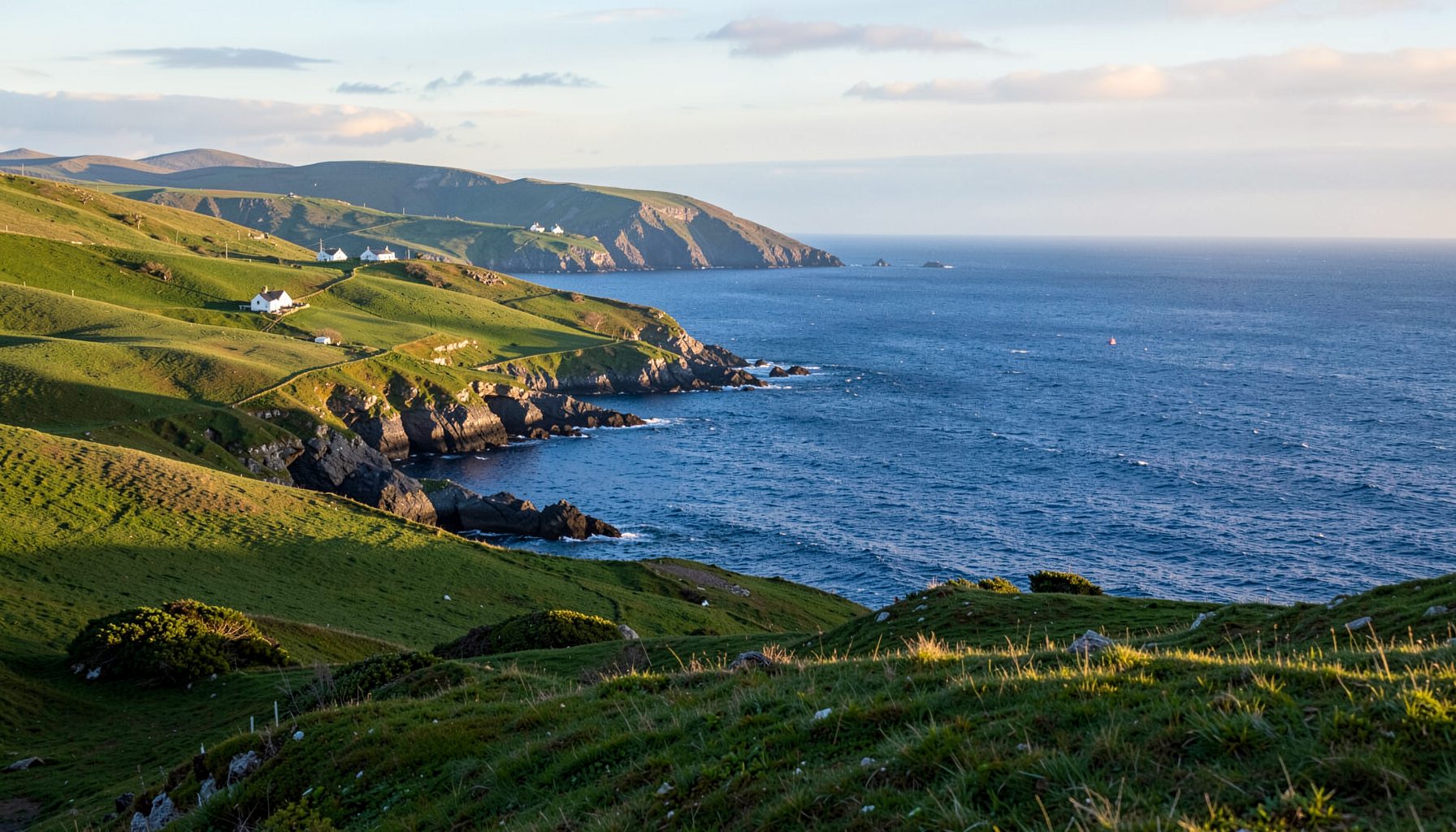
The present Derrynane House developed during the eighteenth century and was enlarged and adapted over time. It was a comfortable country residence rather than a grand aristocratic mansion, reflecting the status and resources of a successful Catholic landowning family. Its location is especially significant: the house looks across a coastal landscape of beaches, rocky ground, islands and sheltered water.
The interior preserves associations with O’Connell and his household. Portraits, furniture, documents and personal items help interpret his family relationships, public career and daily routine. The museum setting gives particular attention to the contrast between the public figure who addressed huge political gatherings and the family man who returned to Derrynane.
The surrounding Derrynane National Historic Park is part of the experience. Woodland paths lead towards the shore, while the gardens and coastal views show why the estate was important to the O’Connell family. The setting also makes clear that Derrynane was more than a political memorial: it was a living home connected to farming, local work and community life.
Daniel O’Connell And Catholic Emancipation
O’Connell’s most successful political campaign was the movement for Catholic Emancipation. Before 1829, Catholics could vote in some circumstances but were largely excluded from sitting in the British Parliament. O’Connell believed that organised, constitutional pressure could force the government to change the law.
In 1828, he won election as the Member of Parliament for County Clare. Because he refused to take the required anti-Catholic oath, he was initially prevented from taking his seat. His election created a political crisis, and the British government eventually passed the Roman Catholic Relief Act in 1829. This allowed Catholics to enter Parliament, although other restrictions and inequalities remained.
The campaign was remarkable for its use of large public meetings, local associations and subscription-based political organisation. O’Connell’s influence reached far beyond Dublin and London. In Kerry, as elsewhere in Ireland, his message connected national politics with the experiences of ordinary Catholic communities. Derrynane House provides a physical link to that campaign and to the network that supported it.
Repeal, Parliament And Public Leadership
After Emancipation, O’Connell turned his attention to the repeal of the Act of Union, which had joined the Irish and British Parliaments in 1801. He argued that Ireland should have its own legislature while remaining connected to the British Crown. The repeal movement gathered considerable support and drew enormous crowds to public meetings across the country.
The government treated the campaign as a serious threat. In 1843, O’Connell was arrested and convicted for organising an unlawful assembly at Clontarf, where a major repeal meeting had been planned. His imprisonment was later overturned, but the episode demonstrated the limits of constitutional agitation under British rule.
O’Connell’s political career also had weaknesses. His reliance on parliamentary methods frustrated more radical nationalists, and the repeal movement lost momentum. The Great Famine placed further strain on Irish society during the final years of his life. O’Connell opposed coercive policies and supported relief, but his health declined. He died in Genoa in 1847 while travelling to Rome. His body was returned to Ireland and buried at Glasnevin Cemetery in Dublin.
| Place | Historical Connection | What Visitors Can Explore |
|---|---|---|
| Derrynane House | Family home and inherited estate of Daniel O’Connell | Museum rooms, personal objects, gardens and coastal park |
| Carhan House, Cahersiveen | Birthplace of Daniel O’Connell in 1775 | Local connection to his early life and family background |
| O’Connell Memorial Church, Cahersiveen | Nineteenth-century memorial to O’Connell | Architecture, local heritage and links to the Liberator |
| Derrynane Abbey | Historic religious ruins near the family estate | Medieval remains and the long history of the coastal area |
| Glasnevin Cemetery, Dublin | Burial place of Daniel O’Connell | His tomb and a major site of Irish political memory |
Derrynane Abbey And The Coastal Estate
Near Derrynane House are the remains commonly known as Derrynane Abbey. The ruins are associated with the O’Connell family and their Catholic heritage, although the site’s religious history reaches further back than Daniel’s lifetime. The surviving structure, graveyard and coastal position add a sense of depth to the estate.
The abbey ruins also help explain the importance of religion in O’Connell’s identity and political outlook. Catholic belief shaped his opposition to discriminatory laws, his understanding of Irish national life and his relationship with communities across the country. The site is therefore part of the story of political history as well as ecclesiastical heritage.
The coastal setting gives the estate a distinctive character. Derrynane Bay, Abbey Island and the surrounding shoreline connect the house to maritime Kerry. Visitors can see how the landscape influenced the family’s sense of place, while also appreciating the natural environment that now forms part of the national historic park.
Preserving O’Connell’s Legacy
Derrynane House became a public heritage site in the twentieth century, allowing the state to conserve the building and interpret its contents for future generations. The museum does not present O’Connell as a figure removed from his time. Instead, it places his achievements within the political, social and economic conditions of nineteenth-century Ireland.
His legacy remains complex. O’Connell helped secure a major legal victory for Catholics through peaceful political mobilisation, yet he could not achieve repeal of the Union. He was committed to constitutional methods, but his movement inspired later generations whose approach became more radical. His views on social and economic questions also reflected the limits of his period.
For the Skellig Coast, the house is valuable because it connects international history with local places. The roads, villages, beaches and family sites around Caherdaniel and Cahersiveen form the setting in which O’Connell’s early life and public identity developed. A visit can therefore complement wider exploration of Iveragh’s heritage, from archaeological remains and historic churches to community museums and coastal landscapes.
Ways To Explore The Site
A visit is most rewarding when time is allowed for both the house and the wider grounds. The museum provides the political and family story, while the gardens, woodland and shoreline reveal the character of the estate. Seasonal opening times can vary, so visitors should check current information before travelling.
Useful ways to experience Derrynane include:
- Begin inside Derrynane House to understand O’Connell’s family background and political career.
- Walk through the historic gardens and national park to appreciate the relationship between the house and the coast.
- Visit the ruins associated with Derrynane Abbey and consider the area’s long Catholic and medieval history.
- Combine the trip with Caherdaniel, Cahersiveen and other heritage sites along the Iveragh Peninsula.
- Allow time for the landscape itself, including views across Derrynane Bay and the nearby islands.
Derrynane House is especially suitable for visitors interested in the links between biography, politics and place. It offers a more personal perspective on Daniel O’Connell than a textbook account can provide, while the surrounding park broadens the story into one about family, faith, community and the enduring landscape of the Kerry coast.
Visit Derrynane House and explore the rooms, ruins, gardens and shoreline that preserve the memory of Daniel O’Connell. Discover how one of Ireland’s most important political leaders was shaped by the people and places of the Skellig Coast.