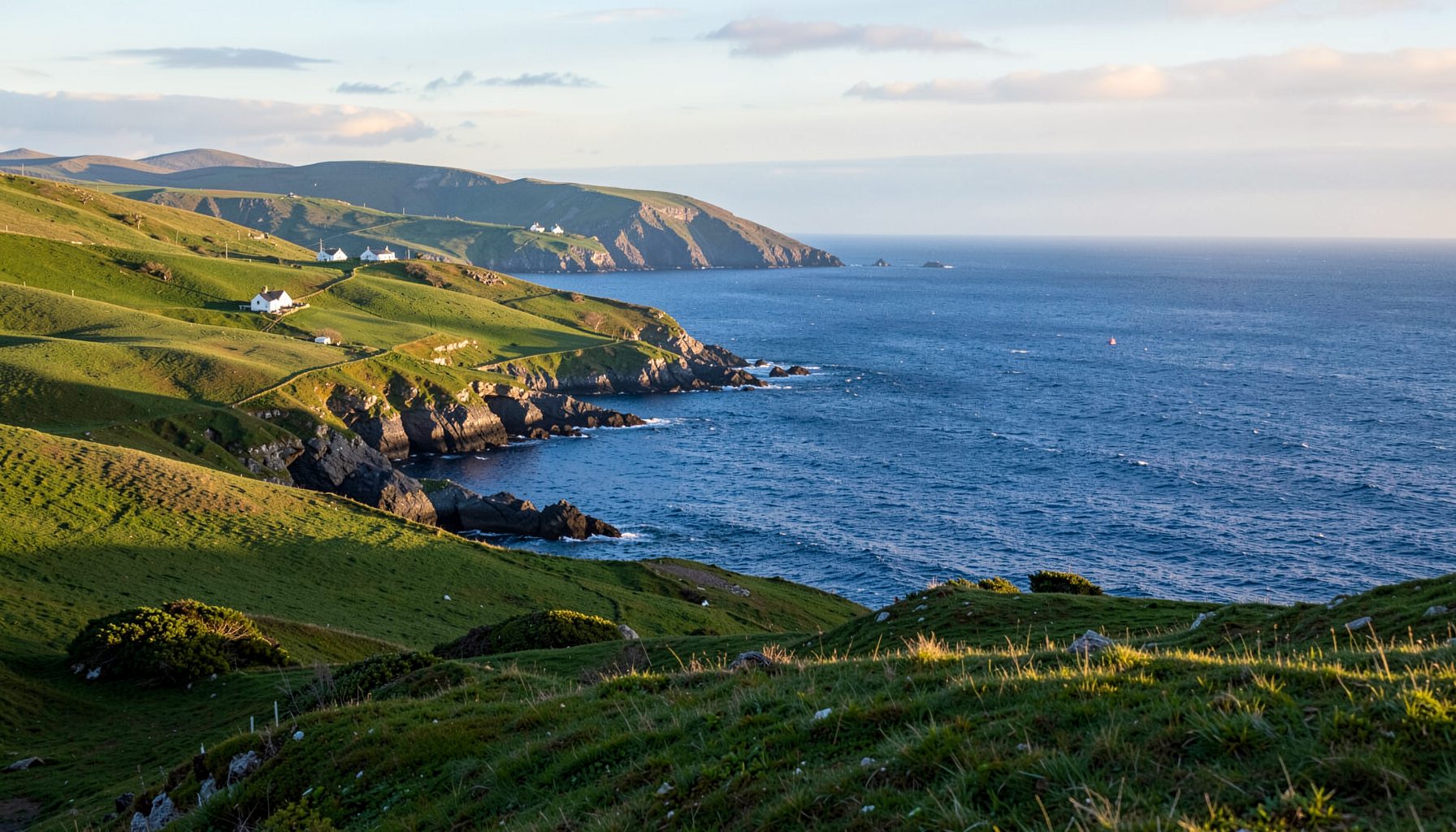
Allihies copper mines and the story of the Beara Peninsula
On Ireland’s south-western edge, Allihies sits beneath the Slieve Miskish Mountains with a landscape shaped by copper, Atlantic weather and generations of mining families. The abandoned engine houses, stone walls, spoil heaps and old tracks around the village are reminders of an industrial past that reached far beyond the mine shafts themselves.
The copper mines also connect Allihies with the wider Beara Peninsula. Mining influenced settlement, transport, engineering, migration and local identity from the early nineteenth century onwards. For visitors from Australia, the story may feel familiar: like Bendigo, Ballarat or parts of the Copper Coast, Beara combines dramatic scenery with the remains of an industry that once drove the local economy.
| Period or feature | What it reveals | What visitors can see today |
|---|---|---|
| Bronze Age and earlier | Early communities recognised and used metal-bearing landscapes | Archaeological traces across the peninsula |
| Early 1800s | Industrial copper mining expanded around Allihies | Mine tracks, ruins and spoil ground |
| Nineteenth century | Cornish expertise, capital and technology transformed production | Engine houses, shafts and processing remains |
| Late 1800s | Falling returns and difficult transport weakened the industry | Abandoned workings and emigrant stories |
| Present day | Heritage and walking routes keep the mining story alive | Allihies Copper Mine Trail and local exhibitions |
A mining landscape before the industrial boom
Copper working in the Allihies area did not begin with the industrial companies of the nineteenth century. The Beara Peninsula contains evidence of prehistoric metalworking, and communities in Ireland’s Bronze Age were skilled at extracting and shaping copper. The scale and methods were very different from later commercial mining, but the presence of mineral-rich ground had been recognised for thousands of years.
The hills above Allihies offered exposed veins, rocky ground and access to the sea. These conditions were valuable to industrial entrepreneurs, although they also made mining difficult. Shafts had to be cut into steep terrain, water had to be removed and ore needed to be carried from remote workings towards processing areas and coastal outlets.
The landscape can seem stark to a visitor arriving from the eucalyptus-covered ranges around regional Australian towns. In Allihies, the vegetation is low and wind-shaped, while Atlantic rain and mist can move quickly across the mountains. Those conditions help explain why the old mine sites are best understood as part of the terrain rather than as isolated ruins.
The rise of copper mining in Allihies
Commercial mining expanded significantly from the early 1800s. The Puxley family became closely associated with the Allihies mines, investing in operations and developing infrastructure in an effort to turn the peninsula’s mineral resources into a profitable enterprise. Copper ore was extracted from several workings around the mountains, with activity continuing through much of the nineteenth century.
The mines created employment for miners, labourers, quarry workers, hauliers, smiths and tradespeople. Allihies grew as a working community, and the mining industry affected nearby settlements across Beara. Wages from the mines supported shops, farms, workshops and public houses, while the demand for food and services linked the industrial sites with the surrounding countryside.
Mining was physically demanding and hazardous. Workers faced unstable ground, flooding, poor ventilation and the risk of accidents underground. Surface work could be equally strenuous, involving the breaking, sorting and washing of ore. The remains scattered through the hills represent this labour as much as they represent commercial ambition.
Cornish influence and industrial expertise
The development of Allihies was closely connected to Cornwall, where hard-rock mining had reached an advanced stage. Cornish miners and engineers brought practical knowledge of shaft sinking, blasting, drainage and ore processing. Their influence can be seen in the design of surviving engine houses and in the technical character of the old workings.
Steam engines were essential to deeper mining. They helped pump water from shafts and could power equipment used in processing ore. Engine houses were built to shelter large beam engines, with thick masonry walls designed to support machinery and withstand vibration. Although many roofs, floors and fittings have disappeared, the stone shells remain among the clearest signs of the peninsula’s industrial past.
The Cornish connection also forms part of a wider story of movement around the Atlantic world. Mining families travelled between Cornwall, Ireland and other mineral regions in search of work. Australians may recognise this pattern from the history of Cornish migration to South Australia, Victoria and Tasmania. The same mining knowledge that travelled to places such as Moonta and Burra also influenced industrial communities in south-west Ireland.
Transport, trade and the wider Beara connection
Copper mining could not succeed through extraction alone. Ore had to be moved from mountain workings to places where it could be processed, stored and shipped. Roads, tracks, bridges, jetties and harbour facilities therefore became part of the mining system. The old routes around Allihies reveal how closely industry was tied to the peninsula’s rugged geography.
Ballydonegan Bay and nearby coastal points provided access to maritime transport, although sea conditions and distance created constant difficulties. Moving heavy ore over steep ground was expensive, and the lack of large-scale rail connections limited the area’s competitiveness. Mining communities across Beara were connected by local roads and coastal routes, yet the peninsula remained remote from Ireland’s main industrial centres.
This connection is important when exploring the region today. Allihies should not be treated as a single heritage stop detached from Beara. The mines belong to a wider network that includes Eyeries, Castletownbere, Dursey Island, Ardgroom and the coastal communities along the Beara Peninsula. Each place adds context about farming, fishing, transport and migration.
For an Australian audience, the best comparison is often a self-drive heritage loop rather than a quick attraction visit. The distances can look modest on a map, much as routes through the Otways or around Tasmania can, but narrow roads, bends and weather slow the journey. Allowing extra time is part of experiencing the peninsula properly.
Decline, migration and local memory
The Allihies mines experienced periods of investment and renewed activity, but profitability was never secure. Ore quality, operating costs, transport limitations and changing international markets all affected the industry. By the late nineteenth century, large-scale mining had declined and many workings were abandoned or operated only intermittently.
The end of mining did not mean the end of its influence. Families carried mining skills and memories with them when they left for Cork, Britain, North America, Australia and elsewhere. Emigration shaped the population of Beara, particularly during the difficult decades surrounding the Great Famine and the later economic pressures of rural Ireland.
Local speech still reflects the importance of community memory. In an Irish conversation, a story about “the mines” may move easily from a shaft or engine house to a family name, a departed neighbour or a road once used for carrying ore. Visitors may hear “grand” used to mean fine or manageable, and “the craic” referring to good company and conversation. These small details help place the industrial history within living community culture.
The mines are therefore more than picturesque ruins. They are evidence of work, risk, class, technology and departure. Reading the landscape through those themes gives greater depth to a visit than simply photographing an old stone building against the mountains.
Exploring the copper mine heritage today
The Allihies Copper Mine Trail provides a practical way to interpret the remains. Walking routes lead through an open landscape of mine buildings, shafts, spoil heaps and elevated viewpoints. Some sections are uneven and exposed, so sturdy footwear, weather protection and care around old workings are important. The ruins are not a conventional fenced museum site, and conditions can change with rain and wind.
The Allihies Copper Mine Museum and local heritage resources add detail to what can be difficult to read from the ruins alone. Displays and community interpretation can explain the Puxley era, Cornish workers, mining technology and the social history of the village. Checking opening times before travelling is sensible, particularly outside the main summer season.
A visit also fits naturally into a broader Beara itinerary. Castletownbere offers a strong sense of the peninsula’s maritime economy, while the Beara Way links villages, uplands and coast through long-distance walking routes. The Ring of Beara is less crowded than Ireland’s most famous touring circuits, though roads remain narrow and drivers need to share them with walkers, cyclists, farm vehicles and local traffic.
Australian visitors should plan around the realities of regional travel. Distances from larger centres such as Cork can take longer than expected, mobile coverage may vary in remote areas, and many small businesses operate seasonally. A “cuppa” in a village café, a chat in a local pub or a stop at a community-run heritage site can provide context that an itinerary built only around major attractions will miss.
The copper mines of Allihies tell a story that reaches from prehistoric metalworking to nineteenth-century industry and modern heritage tourism. Their engine houses and mountain tracks connect the village to Cornwall, the wider Beara Peninsula and mining regions across the world, including Australia.
Explore the mine trail, visit local heritage displays and take time to travel through the surrounding villages. By supporting community museums, cafés, cultural events and locally managed attractions, visitors help keep Beara’s history visible while experiencing the landscape that made the mining story possible.