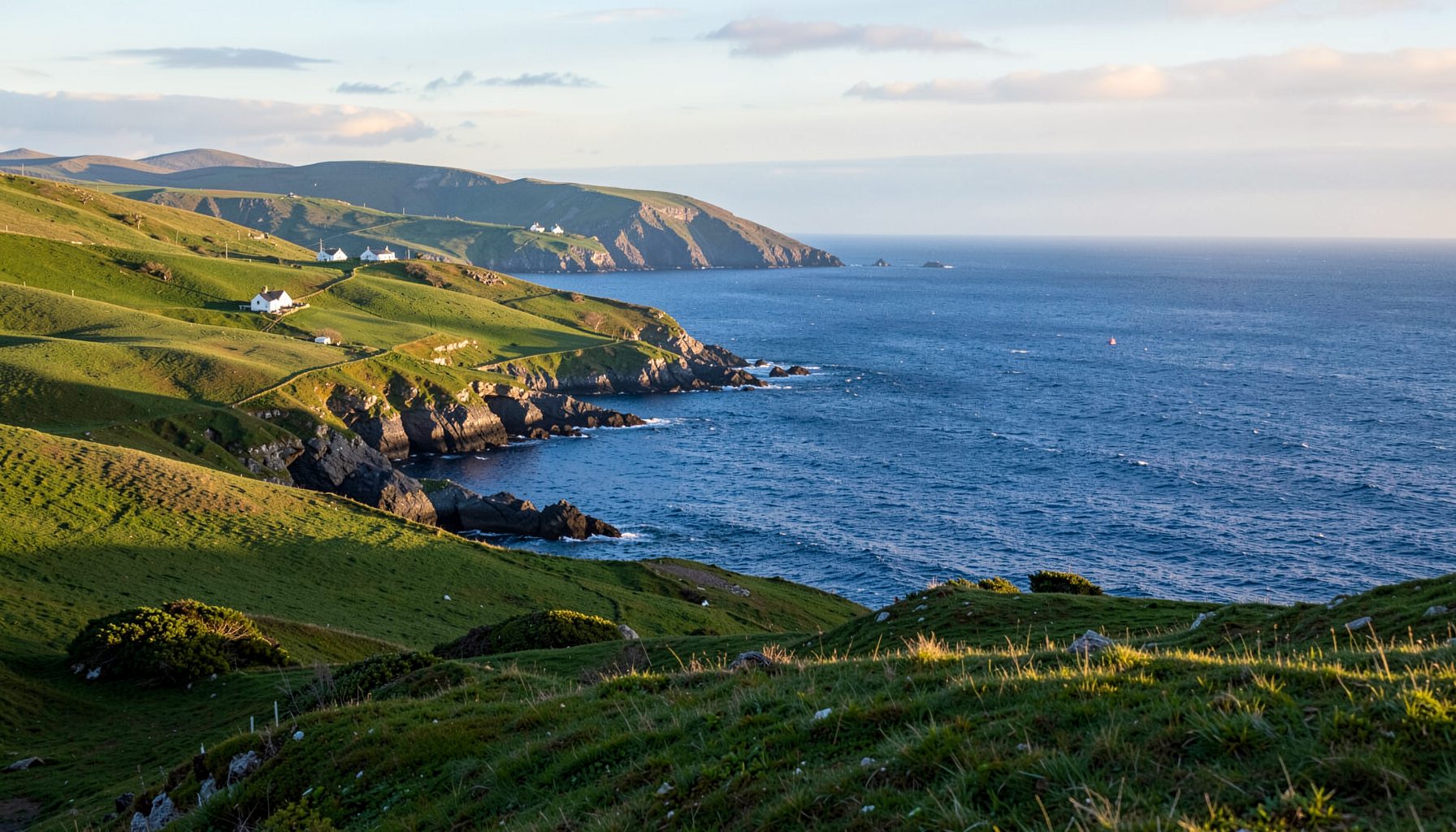
Ballycarbery Castle: A Ruined Stronghold On The Skellig Coast
Ballycarbery Castle stands on a grassy headland near Cahersiveen, looking across the waters of Valentia Harbour towards the Iveragh coast. Its broken walls, ivy-covered stonework and commanding position make it one of the most recognisable historic landmarks in southwest Kerry. The ruin is often associated with dramatic stories of Gaelic lords, military attack and abandonment, although the surviving evidence calls for some care when separating documented history from local tradition.
The castle forms part of a wider historic landscape that includes Cahersiveen, the old stone forts of the peninsula, the Skellig islands and the routes linking mountain, coast and settlement. Its importance comes from this setting as much as from the structure itself. Ballycarbery was a residence, a defensive site and a statement of authority in a region shaped by powerful Gaelic families and changing English rule.
Today, the castle is best understood as a protected ruin rather than an intact visitor attraction. The walls should be viewed from a safe and permitted location, since access conditions can change and parts of the masonry are unstable. Even from a distance, the site offers a vivid way to understand the political and architectural history of the Iveragh Peninsula.
A Strategic Coastal Setting
Ballycarbery occupies elevated ground west of Cahersiveen, close to the coast and the entrance to Valentia Harbour. This position gave its occupants broad views over the surrounding countryside and waterways. In medieval and early modern Ireland, such visibility was valuable: a fortified residence could monitor movement, protect important routes and display control over productive land.
The landscape also connected the castle with several other sites of regional importance. Cahergall and Leacanabuaile stone forts lie nearby, reflecting much earlier settlement and defensive traditions. Their presence shows that the area had been occupied and organised for centuries before the present castle was built. Ballycarbery therefore belongs to a long sequence of settlement rather than appearing as an isolated monument.
Its outlook helps explain the castle’s appeal in historical accounts and modern photographs. The combination of sea, pasture, mountains and ruined stone creates a strong sense of place. The building was designed for practical security, but it also occupied a position where its presence could be seen across the local territory.
The MacCarthy Connection
Ballycarbery is generally linked with the MacCarthy family, one of the leading Gaelic dynasties in Munster. The castle is often described as a stronghold of the MacCarthy Mór line, although the precise ownership history is complicated by shifting branches, alliances and changes in political power. Family names and titles in surviving accounts do not always align neatly, so broad descriptions are safer than assigning every phase to one individual.
The main castle is usually dated to the sixteenth century, a period when tower houses were being built or enlarged across Ireland. These buildings served as fortified homes for landowning families. They were designed to accommodate a household, retainers and visitors while providing protection during periods of unrest. Ballycarbery’s substantial tower and surrounding defensive enclosure reflect that combination of domestic and military purpose.
The name also points to a Gaelic place-name tradition, although translations and linguistic explanations vary. What remains clear is that the site formed part of a Gaelic-controlled landscape before the political upheavals of the seventeenth century. Its history is therefore tied to the wider decline of autonomous Gaelic lordships and the expansion of English administration in Munster.
Stonework, Towers And The Bawn
The principal building is a tall tower house with several storeys, thick walls and narrow openings suited to defence. A tower house was not a castle in the later European palace sense. It was a compact fortified residence, with living quarters arranged vertically and access controlled through strong doors, stairways and limited openings.
Ballycarbery also retains traces of an enclosing bawn, or fortified courtyard. Bawns commonly protected livestock, stores and smaller domestic buildings, giving the household space beyond the main tower. The surviving outer walls help visitors imagine the original complex as a working residence rather than simply a solitary stone tower.
Much of the castle’s character comes from its ruined condition. Ivy, weathering and vegetation have softened the outlines of the masonry, while collapsed sections reveal the thickness of the walls. These features should not be treated as decorative details alone. They are evidence of long exposure to Atlantic weather, changing land use and the loss of the roof and internal floors.
| Feature | Historical significance | What survives |
|---|---|---|
| Tower house | A fortified Gaelic residence, probably developed in the sixteenth century | Major wall sections, openings and parts of the vertical structure |
| Bawn | An enclosed area for protection, livestock and household activity | Portions of the surrounding defensive walls |
| Coastal position | Provided visibility across land and waterways | Open views towards Valentia Harbour and the Iveragh landscape |
| Ruined masonry | Records abandonment, weathering and structural change | Ivy-covered stonework, collapsed areas and uneven wall lines |
War, Damage And Abandonment
The most dramatic chapter in the castle’s story is connected with the Cromwellian conquest of Ireland during the 1640s and 1650s. Local tradition often states that Ballycarbery was attacked or damaged by Parliamentary forces during campaigns in Kerry. Some stories describe cannon fire and a determined defence, while other details have been repeated without firm documentary support.
The wider context is well established. Gaelic landowners faced military defeat, confiscation and the reorganisation of property under the Commonwealth and later regimes. Strongholds that had once supported local lordships lost much of their political purpose. Even where a castle was not completely destroyed in a single assault, changing ownership and insecurity could lead to its abandonment.
Ballycarbery’s damaged appearance has encouraged a clear narrative of siege and ruin, but historians must distinguish between physical evidence, written records and oral memory. The castle may have suffered during seventeenth-century conflict, yet the exact sequence of bombardment, occupation and decay is less certain than popular accounts suggest. Its abandonment was likely part of a longer process rather than the result of one isolated event.
Reading The Ruins Today
The walls offer clues about how people once moved through the building. Small windows limited exposure to attackers, while higher floors would have provided better light and views. The main entrance, internal divisions and stair arrangements can help visitors picture the difference between a fortified household and an ordinary rural dwelling.
The surrounding landscape is equally important. Looking from the castle towards the harbour, hills and fields reveals why this location mattered. The ruin was connected to roads, farmland, landing places and nearby settlements. Its strategic value came from its relationship with those features, not from its walls alone.
Ballycarbery should be approached with the same care given to other vulnerable heritage sites. Masonry can fall without warning, uneven ground creates hazards, and climbing damages the structure. Viewing the castle from an authorised public viewpoint or roadside location preserves both personal safety and the monument itself.
A Landmark Within The Skellig Coast
The castle’s story adds depth to the modern identity of the Skellig Coast. The region is widely known for dramatic shorelines, the Skellig islands and the UNESCO-listed monastery of Skellig Michael, but its heritage also includes ordinary settlements, defensive sites and community memories. Ballycarbery connects these themes through a landmark that is close to Cahersiveen yet rooted in much older patterns of power and landholding.
A regional perspective is available through the Skellig Coast heritage hub, which places local history, communities and cultural activity within the wider landscape. This broader context matters because the castle is not an isolated attraction. It belongs to a network of sites that includes ringforts, churches, townland boundaries, historic roads and coastal viewpoints.
The ruin also illustrates how heritage can serve different audiences. For residents, it is part of the familiar local landscape and a reminder of regional history. For visitors, it provides a visible connection to Gaelic Ireland and the political upheavals that reshaped Kerry. For researchers and educators, it offers an opportunity to examine architecture, memory, conservation and the limits of historical evidence.
Practical Ways To Engage With The Site
A thoughtful visit should focus on observation rather than entering unstable areas. Conditions around the castle may be affected by land ownership, conservation work or weather, so current local guidance should be followed. Respect for nearby homes, farmland and boundaries is essential, particularly because historic ruins often stand within working rural landscapes.
The castle can also be studied alongside nearby heritage sites. Comparing Ballycarbery with the stone forts near Cahersiveen shows the difference between early medieval ringfort construction and later tower-house architecture. Visiting the town, harbour and other local monuments provides a fuller sense of the territory that the castle once overlooked.
- Check current access information before setting out and remain outside closed or private areas.
- View the ruin from stable ground and avoid climbing walls, entering unsafe chambers or disturbing masonry.
- Pair the visit with Cahergall and Leacanabuaile to compare different periods of settlement.
- Allow time to observe the harbour, fields and mountains that shaped the castle’s strategic importance.
- Support local heritage initiatives by using reliable regional information and respecting the landscape.
Ballycarbery Castle remains compelling because it combines architecture, conflict and scenery in one place. Its broken walls preserve the outline of a Gaelic stronghold, while the surrounding coast carries the memory of many earlier communities. Visit with patience and care, read the ruin within its wider landscape, and let the site’s surviving stones tell a history that is richer than any single legend.