Irish on the Atlantic Edge: Language and Gaeltacht Communities of the Skellig Coast
In the far southwest of Ireland, where the Iveragh Peninsula meets the Atlantic, the Irish language lives in shop windows, schoolyards and evening céilí gatherings. This stretch of coast, stretching from Kells to Castlecove, holds one of the country's most concentrated Gaeltacht regions — areas where Irish remains a working community language rather than a relic of the past. For travellers, students and those tracing family roots, the Skellig Coast offers a window into a way of speaking that has shaped this land for centuries.
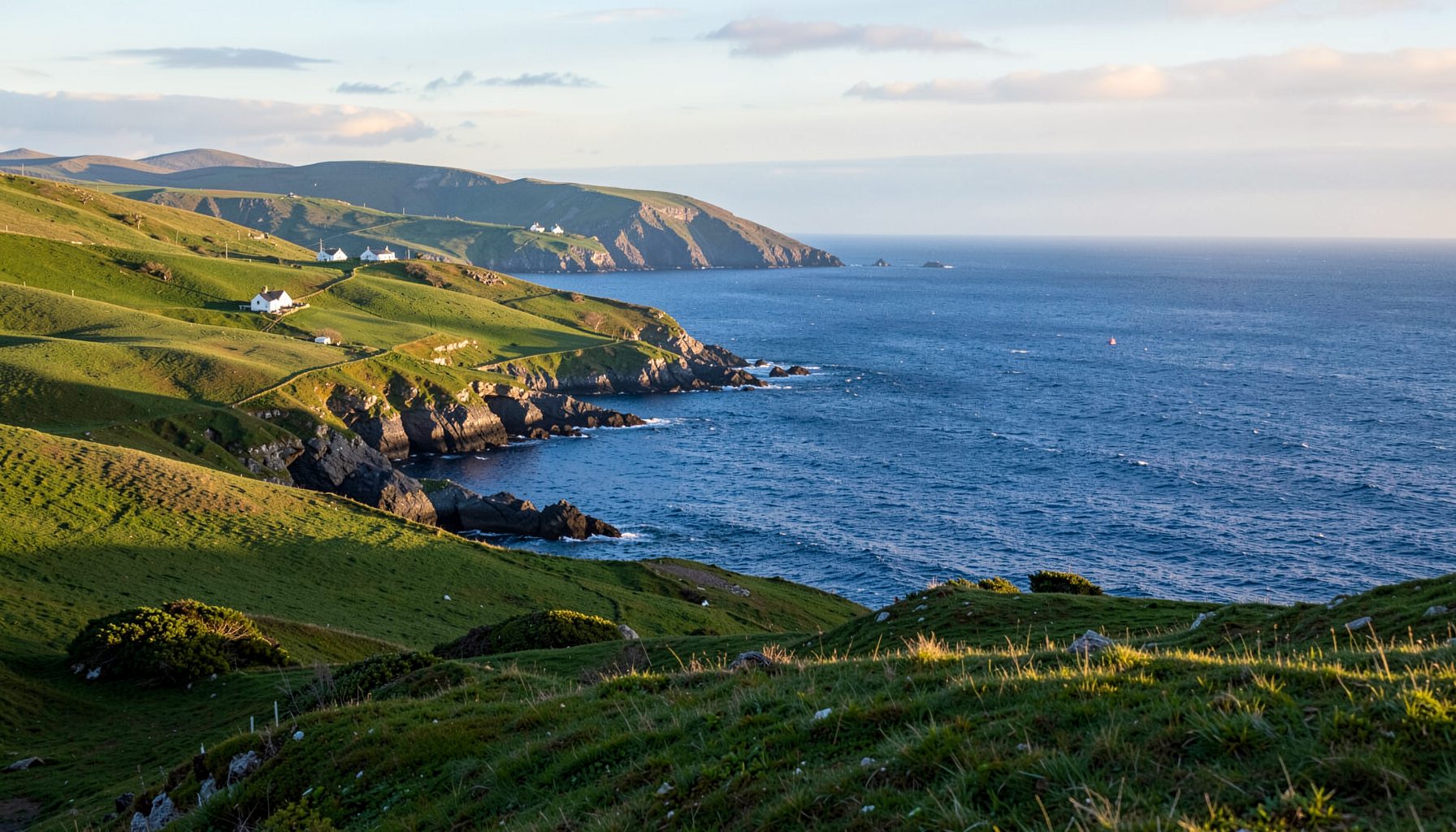
The geography shapes everything here. Stone walls thread between fields of sheep, the Skellig Islands rise like broken teeth from the sea, and villages like Portmagee, Cahersiveen and Ballinskelligs face the full brunt of Atlantic weather. Within this landscape, Irish words like sliabh, bád and bainne sit comfortably alongside English, and road signs officially carry both languages. Schoolchildren grow up switching between the two, often without noticing they have done so until they leave the peninsula.
For Australians in particular, the resonance is striking. Nearly a third of Australians claim some Irish ancestry, and in suburbs from Sydney's Surry Hills to Melbourne's Carlton, the Irish pub, the Irish dancing school and the annual St Patrick's Day parade remain fixtures. The relationship with the language itself is more complicated, however, because while Australian Irish identity is vibrant, Irish as a spoken tongue is rare outside dedicated classes and meet-up groups. Visiting the Skellig Coast allows that identity to be tested against a living linguistic landscape.
That landscape rewards anyone willing to listen. Whether your interest is genealogy, linguistics, photography or simply the pleasure of hearing a song sung as it was meant to be sung, the Gaeltacht communities of the Skellig Coast extend an open welcome. The following sections explore how the language is used, where the communities gather, and how an Australian visitor or learner can engage with this distinctive corner of Ireland.
Understanding the Gaeltacht and Irish Today
The term Gaeltacht refers to districts where Irish is the primary community language, recognised under Irish law and supported through state schemes. While the largest Gaeltacht areas sit in Connemara and Donegal, the Kerry Gaeltacht — centred on the Iveragh Peninsula and parts of the Dingle Peninsula — is one of the country's most distinctive. On the Skellig Coast, the Gaeltacht status covers a network of parishes where Irish is used in homes, churches and local clubs, often by people who also speak English fluently.
Irish itself, known natively as Gaeilge, belongs to the Goidelic branch of the Celtic language family. It shares ancestry with Scottish Gaelic and Manx, and its older form once shaped place names across Britain and beyond. Today, fewer than 100,000 people use Irish daily outside education, and the survival of those communities depends on factors that will sound familiar to Australians engaged with Kaurna in Adelaide, Murri in Brisbane or the revival of Yawuru in the Kimberley: intergenerational transmission, school provision and active community use.
The State plays a role through Gaelscoileanna — Irish-medium schools — and through Údarás na Gaeltachta, the authority responsible for development of Gaeltacht regions. Yet language preservation here does not depend on policy alone. It depends on grandmothers reading bedtime stories in Irish, on local radio presenters signing off in Gaeilge, and on the small social pressure that makes English feel faintly out of place at the weekly comhrá gathering.
The Skellig Coast Gaeltacht Communities
A community, in the Gaeltacht sense, is rarely a single town. On the Skellig Coast it is more often a parish or a clutch of villages whose families have lived in the same valleys for generations. Kells, Cahersiveen, Valentia Island, Portmagee, Waterville and Castlecove form a chain of small settlements, each with its own character and its own role in sustaining the language.
Valentia Island, joined to the mainland by bridge at the old Valentia slate quarry, holds a particular place. Its nineteenth century transatlantic cable station connected Kerry to Newfoundland, and its cliff-top views look towards the Blasket Islands — once home to a writing tradition that produced Peig and An tOileánach. Today the island still has an active Irish-speaking population and a primary school where children learn through the medium of Irish.
In Portmagee, fishing families have spoken Irish for as long as anyone can remember. The village's tidy harbour fills each morning with boats heading out for shellfish, and conversations on the quayside often begin in Gaeilge before drifting into English once a stranger approaches. Further west, Ballinskelligs combines a monastic site associated with St. Ciarán with a small Gaeltacht community that gathers around the local school and séipéal. These villages demonstrate what linguists call a sustainable speech community: a place where the language moves between generations without losing its everyday uses.
Irish in Daily Life From Signs to Song
Visitors are often surprised by how visible Irish is on the Skellig Coast, even in places where English dominates the soundtrack. Road signs are bilingual, place names appear in both forms on maps, and businesses frequently use Irish names — Tí an Bhodaigh, An Spailpín Fánach — that reflect local humour and history. Some shopkeepers will greet customers in Irish as a matter of habit, then switch without fuss when they realise the visitor responds only in English.
The oral traditions matter as much as the written word. Storytelling, poetry recitation and song remain central to community life, and the Kerry style of singing — raw, ornamented and often unaccompanied — is recognised across Ireland as one of the most distinctive regional traditions. Visitors attending a session in a Cahersiveen pub may hear songs whose lyrics date back two centuries, sung in a form of Irish that differs noticeably from the standard taught in textbooks.
For Australians accustomed to the cultural framing of Irish identity around pub sessions and St Patrick's Day, the Skellig Coast version offers something quieter and older. The Australian tradition tends toward the celebratory and the diasporic, centred on places like Sydney's The Rocks or Melbourne's Celtic Club. On the Skellig Coast, music and language are part of the working week, woven into school plays, community meetings and the rhythm of the farming calendar rather than reserved for one annual parade.
Festivals, Music and Cultural Gatherings
Throughout the year, the Skellig Coast's Gaeltacht communities gather for festivals that put Irish language and culture at their heart. Summer brings a procession of fleadh-style events, storytelling sessions and traditional music weekends, while quieter winter gatherings keep the social fabric intact during the off-season.
One of the most rewarding resources for planning around these events is the local festivals guide, which lists the seasonal rhythm of celebrations across the coast. Among the most notable is the Cahersiveen Festival of Music & the Arts, which has grown into a multi-day showcase of traditional and contemporary Irish culture. The Puck Fair in Killorglin, technically just outside the Skellig Coast but drawing visitors from across Kerry, dates back centuries and centres on a wild goat crowned king for three days.
For visitors with a specific interest in the language, Féile na Bealtaine and similar gatherings blend workshops, music and children's activities in Irish. These festivals are not staged performances but genuine community occasions, and attendees are often welcomed to take part in songs, sessions and even a caint — a chat in Irish — if they are willing to try.
Learning Irish and Bringing It Home
Australians visiting the Skellig Coast often arrive curious but unsure where to begin with the language itself. The good news is that the region's Gaeltacht communities have long experience of welcoming learners at every stage, from absolute beginners to advanced speakers seeking immersion.
Ways to engage with Irish during a Skellig Coast visit:
- Joining a weekly comhrá group in a local community centre, where learners and native speakers meet over tea to chat
- Enrolling in a short course at one of the Kerry Gaeltacht colleges, which run intensive programmes throughout summer
- Visiting during Seachtain na Gaeilge in March, when Irish-medium events are programmed across the country
- Listening to Raidió na Gaeltachta online before and after a trip, to attune the ear to local dialects
- Supporting a Gaeltacht business or school by purchasing locally produced Irish-language books, music or crafts
Back in Australia, Irish language meet-ups operate in most capital cities, often linked to groups affiliated with the Irish National Association of Australasia. Several universities, including the University of Sydney and the University of Melbourne, offer Irish language units, and the Conradh na Gaeilge network has branches in Sydney and Melbourne. These communities provide a way to keep the language alive long after the Skellig Coast has faded from view.
The Skellig Coast invites you to step into a place where the Irish language still belongs to everyday life rather than the history books. Plan your visit around one of the seasonal gatherings, spend a week attending a comhrá session, or simply sit in a Cahersiveen pub and listen. The coast has kept its voice for centuries, and it is waiting for new ears to hear it.