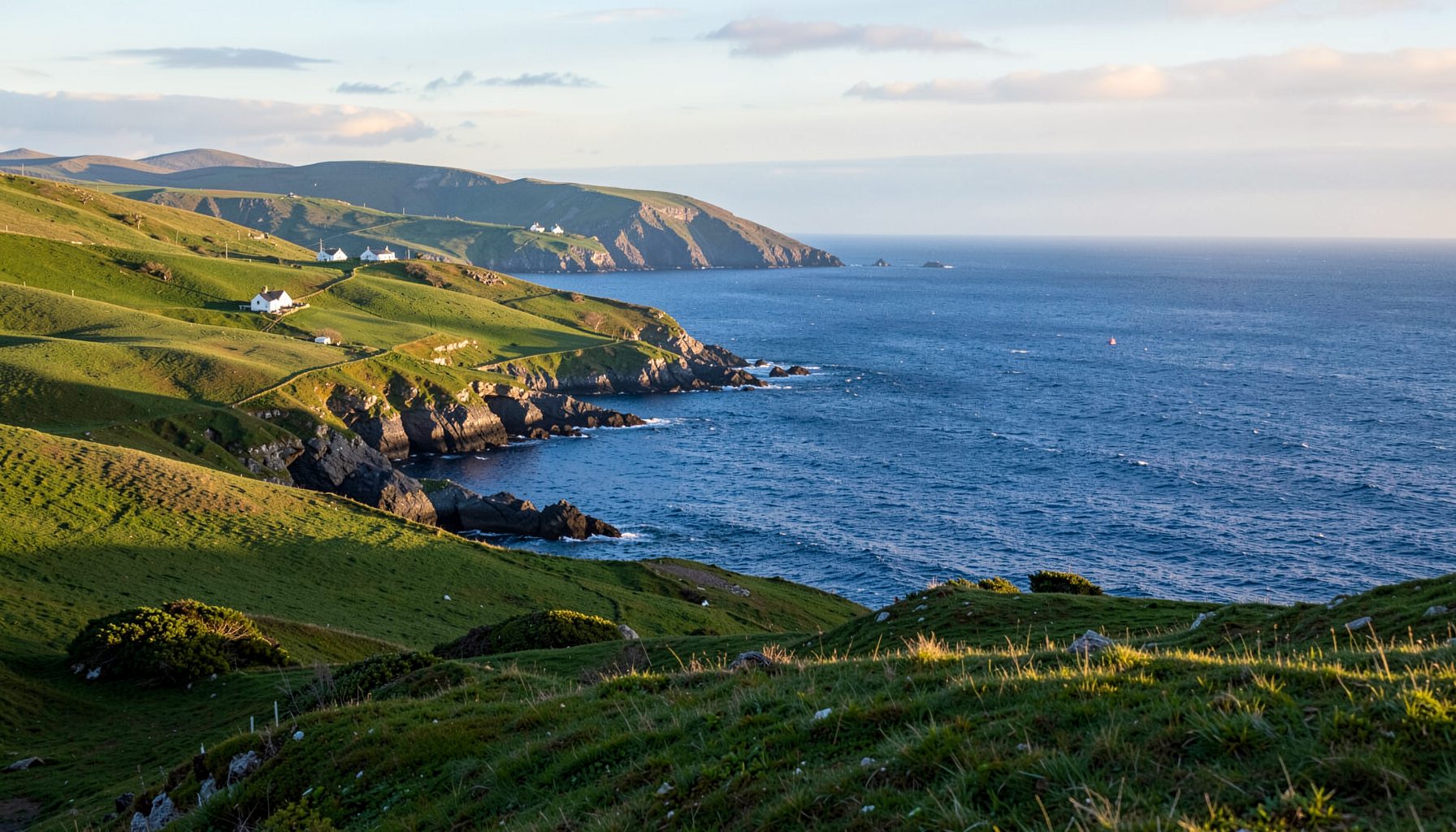
hunting on the Flaggy Rocks of the Skellig Coast
The Skellig Coast on Ireland's Iveragh Peninsula is better known for its monastic island and dramatic cliffs, yet along its shoreline lie stretches of weathered stone that quietly preserve evidence of a much older Ireland. The Flaggy Rocks, tucked between Kells and Castlecove, expose bands of Old Red Sandstone that have been shaped by Atlantic waves for hundreds of millions of years. Walking there at low tide reveals a surface that looks almost sculpted, with curved patterns and shell-like shapes that turn out to be far more than decoration.
For Australian travellers used to fossil-rich terrains such as the Ediacara Hills of South Australia or the Devonian reefs exposed along Victoria's coast, the Flaggy Rocks offer a familiar thrill in unfamiliar surroundings. The appeal is straightforward: a stretch of coastline where you can spend a few hours searching for traces of ancient marine life while seabirds wheel above and the Atlantic mist rolls in. This guide walks through what you can expect to find, how the rocks came to hold these fossils, and how to explore them responsibly.
The geological story behind Flaggy Rocks
The bedrock along this part of Kerry dates to the Devonian period, roughly 400 million years ago, when Ireland sat south of the equator on a continent geologists call Laurussia. The sandstones, siltstones, and mudstones that make up the Flaggy Rocks were laid down in river systems, shallow seas, and coastal flats that teemed with early plant and animal life. Over millions of years, sediments buried organic remains, mineral-rich groundwater replaced their tissue, and pressure cemented the surrounding grains into stone. Erosion by the Atlantic has since planed those beds into broad, sloping pavements.
The colour palette is part of what makes the site approachable. Iron oxides stain the rock in shades of rust, ochre, and pale grey, and bedding planes sometimes split into thin sheets that lift cleanly from the outcrop. Australian visitors familiar with the red Devonian sandstones exposed in the Kimberley or along parts of the New South Wales coast will recognise the layering. Where the Flaggy Rocks differ is in the marine influence: the lower beds include intervals that were deposited under brackish or saltwater conditions, which is why so many of the fossils preserved here are marine rather than terrestrial.
Fossils you might find
Most of the fossils visible on the Flaggy Rocks are invertebrates. Brachiopods are common, often appearing as curved, ribbed shells the size of a thumbnail to a coin, sometimes clustered in dense bands. Bivalves turn up too, usually as paired moulds where the original shell has dissolved away, leaving only the impression. Less obvious are crinoid fragments, tiny discs and stems that come from sea lilies related to modern starfish. On calmer bedding planes, trace fossils such as burrows and trails can be seen weaving through the sediment.
Plant remains appear in the upper, more terrestrial beds. Thin, carbonised streaks sometimes resolve into stem fragments or early vascular plant tissue, reminiscent of the sorts of fossils found in the Silurian-Devonian rocks of the Australian Alps or the Yea area of Victoria. Occasionally, a lucky collector spots a piece of armour from an early fish, a rare find that makes the site scientifically significant. Most days, however, the joy is in spotting the patterns: a row of shells lined up the way they fell, a bed crowded with hundreds of individuals, or a slab that, once split, shows two mirrored halves of the same ancient community.
Planning a low-tide visit
Tide is everything on the Flaggy Rocks. The foreshore only reveals its best surfaces for a few hours either side of low water, and incoming swell can turn the return route into a scramble. Checking the local tide tables before leaving Cahersiveen or Caherdaniel is essential, and it is wise to arrive an hour before the published low tide to get the most out of the exposure. Wind direction matters as well: a westerly can push spray over the lower rocks, while a calm morning usually offers the clearest views of bedding planes and fossil outlines.
Australian travellers will find the climate milder than expected. Even in summer, the Skellig Coast rarely climbs above twenty degrees, so a light waterproof jacket is more useful than sunscreen. Sturdy boots with good grip are important, since wet sandstone can be slippery and the surfaces are uneven. A small backpack with a hand lens, a notebook, a camera, and a few bags for any specimens you are allowed to collect will keep you comfortable for a long morning on the rocks. Many visitors combine the trip with a walk along the Kerry Way or a visit to nearby Valentia Island, where the tetrapod tracks at Dohilla offer a related window into ancient life.
A short kit list covers most needs:
- Check tide tables the evening before and aim to be on the rocks an hour before low water.
- Wear sturdy boots with good grip; wet sandstone is unforgiving under smooth soles.
- Bring a hand lens, a small chisel or blunt knife, and a notebook for sketches and grid references.
- Photograph specimens in place before considering any removal, and avoid hammering large slabs.
- Carry a light waterproof jacket, water, and a snack, as the Skellig Coast weather can shift quickly.
- Respect any signs marking protected zones, and leave the foreshore as you found it.
How Australian heritage laws shape the hobby
Australians thinking about bringing specimens home should be aware of how heritage rules work on both sides of the trip. In Ireland, fossils and rocks on the foreshore are generally treated as part of the natural heritage, and removing material from protected sites, including any within designated Special Areas of Conservation, can breach national heritage legislation. Local guides and the National Monuments Service can clarify what is permissible at a specific location. New South Wales, Victoria, South Australia, and Western Australia each have their own rules, and several require permits before fossils can be exported, even for personal collections. The Australian Museum in Sydney and Museums Victoria in Melbourne can advise on what paperwork may be needed for any finds of scientific interest.
Practical etiquette also matters. Hammering large sections of rock is rarely necessary on the Flaggy Rocks, since the fossils weather out naturally and can often be lifted without force. Photographs and sketches are encouraged, and detailed records help researchers if a significant find is later identified. Collectors who spot anything unusual, such as a dense fossil bed or a possible vertebrate fragment, are asked to report the location to a local geologist or the Kerry UNESCO Global Geopark, which coordinates citizen-science contributions across the region.
Where to learn more before you go
For anyone wanting context before travelling, several resources make the geology easier to appreciate. The geological survey memoirs for Iveragh describe the local stratigraphy in detail, while regional walking guides often include short sections on the fossils you can see at roadside stops. Australian readers may find it useful to revisit familiar ground first: the Devonian marine fossils of the Buchan area in Victoria or the older Ediacaran assemblages of the Flinders Ranges provide a useful comparison for the kinds of life preserved at Flaggy Rocks.
Joining a guided walk is the simplest way to get the most out of a first visit. Local geologists and heritage interpreters occasionally run low-tide forays along this stretch, and they can point out features that a casual visitor would walk past. Even without a guide, spending a slow morning on the rocks with a hand lens, a tide table, and a sense of curiosity tends to be rewarding. The Flaggy Rocks are not a flashy destination, and that is part of their charm: a quiet shoreline where the deep history of the Iveragh Peninsula lies open to anyone willing to look down.
Step out onto the Skellig Coast with a simple plan: map a route from Kells to Castlecove, check the tide times, and pack a hand lens and a notebook. The fossils have waited four hundred million years to be found, and a single low tide is often enough to begin a lifelong interest.