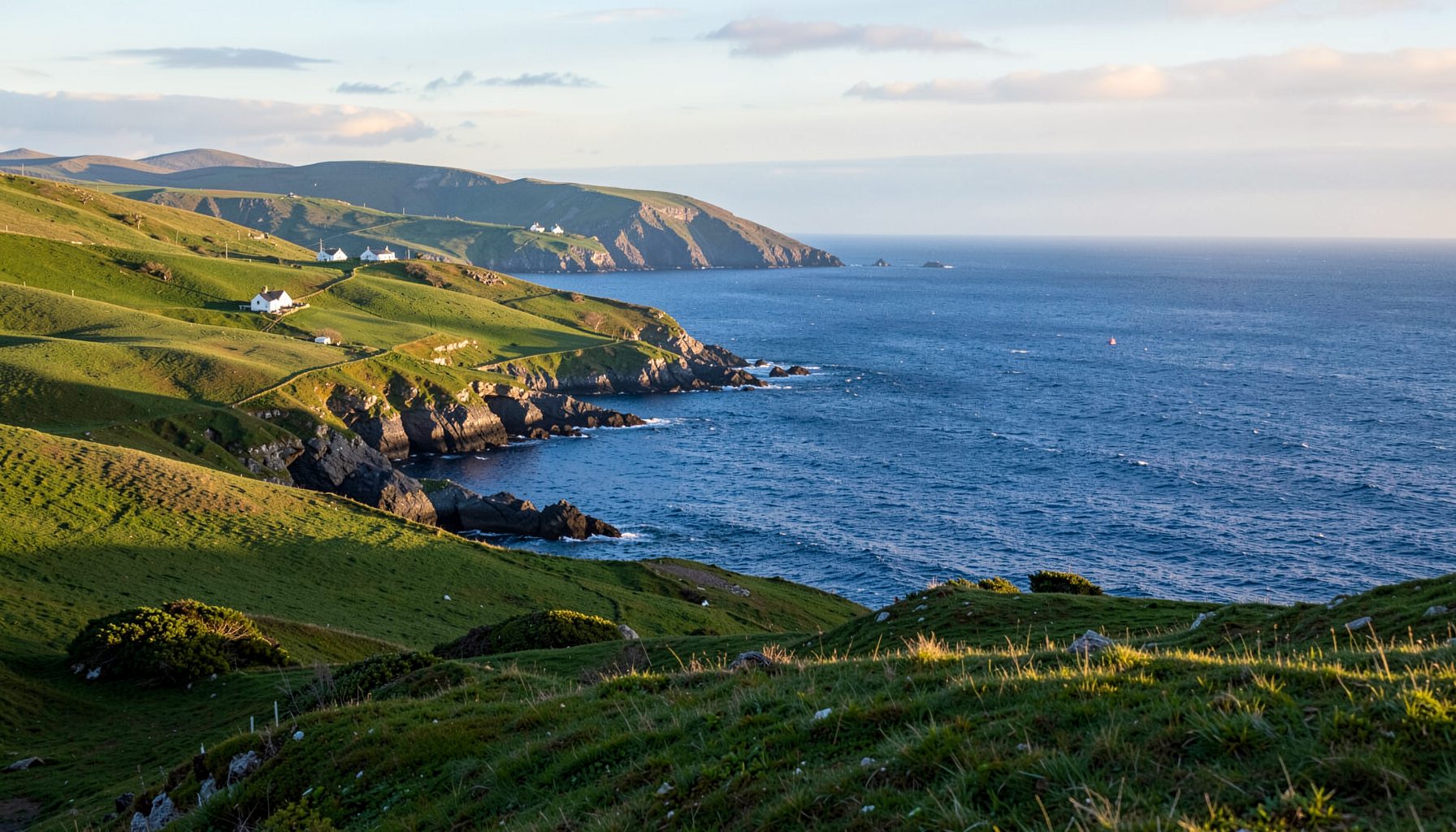
The Townlands of the Iveragh Peninsula: A Genealogy Guide
Tracing family history on the Iveragh Peninsula often begins with a surname and a broad location such as “County Kerry.” That starting point is useful, but it is rarely precise enough to identify the right family. The decisive clue is frequently a townland: a small historic area whose name may appear in civil registers, parish records, leases, headstones, maps, and family stories.
Iveragh stretches across a landscape of coastal villages, mountain valleys, islands, farms, and scattered homes. Townland boundaries do not always match modern town or parish boundaries, and the same place-name can appear in several spellings. A successful search therefore combines online records with local knowledge, historical maps, and a careful understanding of how the peninsula was organised.
This guide explains how to move from a broad family tradition to a documented Iveragh connection. It covers townland names, civil and church records, land sources, surname research, and the value of speaking with local heritage and community groups.
Understanding Townlands In Iveragh
A townland is a historic territorial division used throughout Ireland. It may contain a village, a group of farms, a mountain area, or a stretch of open ground. The word does not necessarily mean an urban settlement. On the Iveragh Peninsula, a townland can be closely associated with a nearby village while remaining legally and historically distinct from it.
This distinction matters because older records often identify people by townland rather than by a postal address. A baptism might record a family in one townland, a marriage in the parish church, and a burial in a cemetery several kilometres away. Later documents may use a village name, electoral division, or civil parish instead.
Place-name spelling is another complication. English-language records frequently altered Irish names according to the hearing or habits of the official making the entry. A single townland may therefore appear with different vowels, consonants, or spacing. Keep every version you find, including forms on gravestones and estate maps.
Establishing The Correct Place
Begin with the most recent reliable document in your family collection. Birth certificates, marriage certificates, death registrations, obituaries, memorial cards, military records, and school documents may offer a townland, parish, or town. Write the information down exactly as it appears before attempting to standardise it.
Next, locate the place on an authoritative map. The Placenames Database of Ireland, historic Ordnance Survey maps, townland indexes, and local studies can help distinguish similar names. Search nearby townlands as well as the apparent location, because families often moved short distances between farms, villages, and neighbouring parishes.
It is also important to separate a townland from a civil parish and a Catholic parish. These units may overlap without sharing the same boundaries. A record described by a researcher as “from Cahersiveen” could relate to a much wider rural area, while a church register may cover several townlands around the town.
Using Civil And Church Records
Civil registration provides a strong framework for nineteenth- and twentieth-century research. Births, marriages, and deaths were registered nationally, with civil records for non-Catholic marriages beginning earlier than general registration of births, marriages, and deaths. Later certificates may provide occupations, addresses, fathers’ names, and witnesses who help connect one generation to the next.
For Catholic families, parish registers are essential. Baptismal and marriage entries may reveal parents, sponsors, townlands, and the names of witnesses. Coverage varies by parish, and handwriting can be difficult, particularly in older registers. Search a reasonable range of years rather than relying on an exact date supplied by family memory.
Church of Ireland and other denominations require separate research paths. Their registers may be held by local churches, diocesan repositories, national archives, or heritage institutions. Burial grounds can also include families whose baptisms and marriages took place elsewhere. Photograph every legible inscription and record the position of each grave, as neighbouring stones may reveal relatives.
| Record type | Details it may provide | Useful research caution |
|---|---|---|
| Birth or baptism | Child, parents, residence, sponsors | A baptismal place may differ from the civil address |
| Marriage | Bride, groom, fathers, witnesses, residence | Witnesses may be close relatives |
| Death or burial | Age, occupation, residence, informant | Ages are often approximate |
| Griffith’s Valuation | Occupier, landlord, property, townland | It is a snapshot, not a complete family census |
| Tithe records | Occupiers liable for tithes | Mainly concerns agricultural land and earlier periods |
| Census returns | Household members, ages, language, occupation | Surviving national returns are strongest for 1901 and 1911 |
| Headstones and memorials | Names, dates, relationships, townland clues | Inscriptions may be weathered or incomplete |
The 1901 and 1911 census returns are particularly valuable for connecting individuals to households. Compare ages, occupations, Irish-language ability, literacy, and relationships rather than matching names alone. A common surname in a small community can produce several plausible families.
Following Land And Property
Land records often provide the bridge between generations when parish registers become ambiguous. Griffith’s Valuation, published in the mid-nineteenth century, lists occupiers and landlords and identifies the property’s townland. It can show whether a surname was established in a particular area at that time, although it does not list every member of a household.
Earlier tithe applotment books may identify farmers liable for agricultural tithes. Estate rentals, lease books, landlord papers, and maps can add details about changing tenancy. These sources are especially helpful on a peninsula where families sometimes remained on the same holding for decades while different generations appeared in church or civil records.
When reading a valuation, note the property number, neighbouring occupiers, and the landlord’s name. Families often lived beside cousins or in-laws, and that local pattern can help distinguish one branch from another. A map reference is more reliable than an assumption based solely on a surname.
Reading Surnames And Family Networks
Surnames on Iveragh may appear in both English and Irish forms. The same family can be recorded with an anglicised surname in civil documents and a different spelling in oral tradition or Irish-language material. Do not treat spelling variation as proof of a separate family until dates, occupations, addresses, and relationships have been compared.
Given names can be equally misleading. Naming customs sometimes repeated the names of grandparents, while Catholic records may use Latin forms or abbreviated entries. A man known as Jeremiah in one record may appear under a variant in another. Women are usually recorded under their birth surnames in marriage or baptismal contexts, but later documents may identify them only by a husband’s name.
Build a family group for every candidate household. Include children who died young, witnesses, sponsors, neighbours, and people who emigrated. A witness at a Portmagee or Waterville marriage may be a sibling from a nearby townland, while a sponsor at a baptism may reveal a maternal connection that a census entry does not make obvious.
Oral history can supply the missing links, particularly when a family remembers a nickname, a former farm name, or a migration route. Local traditions are evidence to test rather than facts to copy unchanged. Community life remains a useful setting for discovering such clues; accounts of Portmagee music sessions reflect the continuing importance of shared places and conversations in preserving local memory.
Working With Maps, Archives, And Local Knowledge
Historic maps can reveal roads, lanes, schools, churches, wells, burial grounds, and property divisions that no longer appear in the modern landscape. Compare several editions because boundaries and names changed. A house may have disappeared while its field name survives in local speech.
Libraries, heritage centres, parish offices, graveyard projects, and local historical societies may hold material that has not been digitised. School registers, handwritten family trees, estate papers, and photographs can contain precise townland references. Contact institutions with a focused request that includes names, dates, denominations, and known locations.
When visiting Iveragh, plan research around geography. A short distance on a map can involve steep roads, coastal detours, or a mountain route. Record the modern name, historic name, parish, and approximate coordinates for every location. If you photograph documents or graves, retain the original image and note where and when it was taken.
A useful research log should include the source, archive or website, date accessed, image or page reference, and your interpretation. Mark uncertain information clearly. This prevents attractive but unverified family stories from becoming fixed as fact.
A Practical Research Sequence
A disciplined sequence keeps the investigation manageable. Work from known people to earlier generations, documenting each relationship before moving backwards. Avoid attaching an ancestor to a townland simply because the surname is associated with it today.
Use the following checklist when beginning or restarting a family-history project:
- Collect certificates, obituaries, letters, photographs, memorial cards, and family Bible entries.
- Write down every place-name spelling, nickname, parish reference, and approximate date.
- Search civil registers, Catholic or denominational records, census returns, valuations, and graveyard sources.
- Compare neighbouring households, witnesses, sponsors, occupations, and land records.
- Confirm the townland on a historic map before treating it as an established family location.
Once a likely townland has been identified, create a map-based timeline. Add births, marriages, deaths, leases, emigration, and changes of occupation. This can reveal whether the family stayed in one district, moved towards a coastal village, or followed work between several parts of the peninsula.
Preserving The Story For Future Researchers
Genealogy becomes more valuable when the evidence is preserved in a form that another person can follow. Keep digital copies in more than one location and use consistent file names containing the person, record type, date, and townland. Transcribe difficult documents, but retain the original image beside the transcription.
Record the reasoning behind every identification. If two men share a name, explain why one has been accepted and the other rejected. Cite the source for each date and relationship, including information supplied by relatives. This makes later corrections easier and protects the research from becoming a collection of unsupported assumptions.
The townlands of the Iveragh Peninsula are more than labels on a map. They connect families to farms, churches, schools, roads, coastlines, and patterns of community life. By combining formal records with local geography and carefully gathered memories, researchers can turn a broad county connection into a detailed and credible family history.
Begin with one known person, one document, and one place-name. Follow each clue through the records, compare it with the landscape, and preserve the evidence as you go. Explore the communities and heritage resources of the Skellig Coast to place your family’s townland story within the wider history of Iveragh.