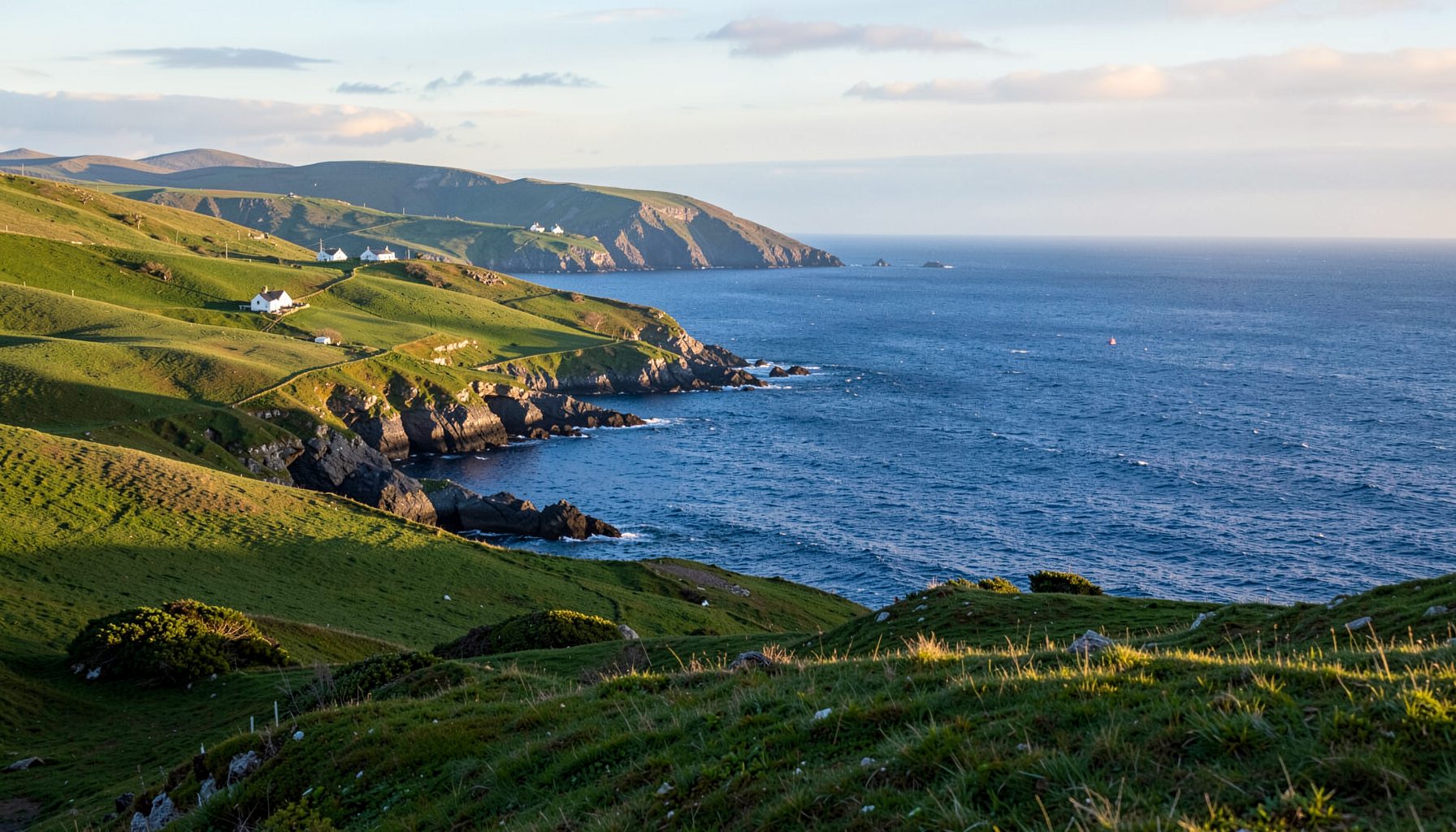
The story of the Great Blasket Island evacuations
The Great Blasket Island lies off the western tip of the Dingle Peninsula, separated from the mainland by the waters of Blasket Sound. Its last permanent residents left in 1953, bringing an end to a distinctive island society shaped by fishing, farming, storytelling and the Irish language. The evacuation was a major moment in modern Irish social history, but it was also a deeply personal upheaval for families whose lives were rooted in the island.
The island community is remembered through oral tradition, photographs, buildings and a remarkable body of Irish-language writing. Books by Peig Sayers, Tomás Ó Criomhthain and Muiris Ó Súilleabháin carried the voice of the Blasket people far beyond the Atlantic shore. Their work offers insight into daily life, family relationships, hardship, faith and the strong attachment residents felt towards their island home.
The evacuation did not happen because of a single disaster. It followed decades of population decline, economic pressure and growing concern about the safety and welfare of those who remained. Understanding that gradual process helps explain why leaving became, for some families, an unwanted necessity rather than a simple choice.
An island community shaped by the Atlantic
For centuries, the Great Blasket community lived with the rhythms of the sea. Men fished from small boats and hunted for mackerel, pollock and other seasonal catches, while families cultivated potatoes, oats and vegetables in limited strips of land. Sheep and cattle were also kept, although the island’s exposed terrain made agriculture demanding.
The island was remote, yet it was not isolated from the wider world. Boats connected residents with Dún Chaoin on the mainland, particularly when weather allowed safe passage. Islanders traded fish, turf and farm goods, attended to religious and family links, and maintained a strong awareness of the communities across the water. The sea was a source of food and income, but it could also prevent access to doctors, markets, schools and supplies.
Blasket life was deeply communal. Neighbours helped with births, funerals, fishing and seasonal work, while storytelling provided entertainment and preserved local knowledge. The Irish spoken on the island attracted scholars and writers because it retained rich vocabulary, traditional expressions and forms of speech that were becoming less common elsewhere.
Why the population began to fall
The Great Blasket population reached more than 150 people in the early twentieth century, but numbers declined steadily in the following decades. Younger islanders increasingly moved to the mainland or emigrated in search of employment and education. The island offered limited economic opportunities, and families understood that modern services were more accessible elsewhere.
The community’s vulnerability became especially clear during winter storms. A dangerous sea crossing could make medical treatment impossible to obtain quickly. Boats might be damaged, supplies delayed and communication interrupted. For older residents, the physical demands of island life became increasingly difficult, while younger families faced the prospect of raising children without reliable access to schooling and healthcare.
This decline was part of a wider pattern affecting many small Irish islands. Mechanisation, emigration, changing employment patterns and improved mainland transport altered the reasons people remained in remote places. On the Great Blasket, however, the consequences were particularly stark because the island depended so heavily on boats and because its entire permanent population was small enough to disappear within a single generation.
The decision to leave in 1953
By the early 1950s, the remaining residents were concerned about their future. The community had become older and smaller, and the practical difficulties of sustaining life on the island were becoming more serious. Residents approached the authorities about resettlement, seeking secure homes and better access to essential services on the mainland.
The 1953 evacuation is therefore best understood as a negotiated relocation shaped by pressure and necessity. It was not a sudden removal following a military order. Islanders had strong emotional and cultural reasons to stay, but they also knew that the community could not easily continue without younger families, dependable transport and public services.
In November 1953, the remaining inhabitants were brought from the Great Blasket to homes in the Dún Chaoin area. Accounts commonly place the final departure on 17 November. The move marked the end of permanent settlement, although former residents and their descendants continued to visit, remember and care for the island.
The state-assisted resettlement offered greater physical security, but it could not replace the social world that had existed offshore. Families who had shared the same small landscape were dispersed into mainland houses and communities. The move solved immediate problems while creating a lasting sense of loss.
A timeline of the island’s final decades
| Period | Development | Significance |
|---|---|---|
| Early 1900s | The island population exceeds 150 | The community is large enough to sustain fishing, farming and social institutions |
| 1920s–1930s | Blasket autobiographies attract attention | Island life and spoken Irish reach a national and international readership |
| 1940s | Emigration and mainland relocation accelerate | The resident population becomes older and more vulnerable |
| Early 1950s | Islanders seek assistance with resettlement | Access to healthcare, schooling and transport becomes a central concern |
| November 1953 | The remaining residents leave the Great Blasket | Permanent settlement on the island comes to an end |
| After 1953 | Buildings fall into disrepair while memories endure | The island becomes a powerful site of cultural and historical remembrance |
Voices preserved in Irish-language writing
The literary legacy of the Great Blasket is central to how the evacuation is understood today. Tomás Ó Criomhthain’s An tOileánach, translated as The Islandman, describes work, family life, natural hazards and the changing fortunes of the island community. His writing is valued for its detail and for the way it records a world that was already under pressure during his lifetime.
Peig Sayers became one of the best-known voices associated with the island. Her autobiography, Peig, recounts hardship, bereavement, domestic life and religious belief. For many years, the book was widely encountered by students in Ireland, sometimes through a narrow and gloomy interpretation. Read in its fuller context, Sayers’s work offers a complex account of resilience, memory and the demands placed on women within a remote community.
Muiris Ó Súilleabháin’s Twenty Years A-Growing provides another perspective, tracing childhood and youth in an island society rich in language and custom. Together, these books show that the Great Blasket was not simply a place of poverty or isolation. It was a living culture with humour, intelligence, artistic expression and a sophisticated understanding of the natural world.
Visitors exploring the wider region can place this history alongside other local stories through Skellig Coast resources, which connect communities, heritage sites and cultural initiatives across the Iveragh Peninsula and the Ring of Kerry. Although the Great Blasket lies farther west on the Dingle Peninsula, its experience belongs to the broader history of Ireland’s Atlantic communities.
What remains on the Great Blasket
After the evacuation, the island’s houses were gradually exposed to Atlantic weather. Roofs collapsed, walls deteriorated and paths became overgrown. The abandoned village now appears as a striking collection of stone ruins, with the arrangement of homes and fields still visible across the landscape. These remains help visitors imagine the scale of the former settlement without turning it into a reconstructed museum village.
The island is uninhabited, and access depends on sea conditions. Boat trips generally depart from the mainland near Dún Chaoin and may include time to walk among the ruins, observe wildlife and experience the exposed landscape. Weather can change quickly, so the sea crossing should always be treated as part of the visit rather than a guaranteed routine.
A visitor centre on the mainland interprets the history of the Blasket Islands and the people who lived there. It provides context that the ruins alone cannot supply, including information about language, family life, emigration and the final resettlement. The centre and island together make it possible to understand both the physical place and the human story.
Remembering an evacuation with care
The phrase “evacuation” can suggest a brief emergency, but the Great Blasket departure was the result of long-term change. It involved ageing, emigration, inadequate services and difficult decisions made by families who loved their home. Some residents welcomed the security of mainland housing, while others mourned the loss of the island way of life. These feelings could exist together.
The island’s heritage should therefore be approached with respect. Its ruins are not merely scenic remnants, and its literature should not be reduced to a picturesque account of hardship. The community had its own internal differences, aspirations and ordinary routines. Preserving its memory means recognising both the beauty of its culture and the limitations imposed by geography and poverty.
For anyone visiting the Blasket landscape, a thoughtful approach includes:
- Learn about the island’s Irish-language writers before arriving.
- Check sea conditions and boat arrangements well in advance.
- Treat the ruined houses, graveyards and landscape as fragile heritage.
- Visit the mainland interpretive centre to understand the wider context.
- Allow time to reflect on the difference between a day visit and permanent island life.
The Great Blasket Island evacuations changed the community forever, but they did not erase its influence. The island continues to shape Irish literature, language studies, local identity and public discussions about rural depopulation. Its story also raises questions about what is gained when people move to safer, better-served places and what can never be carried across the water.
Today, the empty village, the surviving books and the memories held by descendants form a link between the island’s past and the living communities of Kerry and west Cork. Explore the heritage of Ireland’s Atlantic coast through local archives, responsible visits and community-led cultural projects, and help keep the voices of the Blasket Islanders part of the region’s future.