Valentia Island And The Atlantic Telegraph Revolution
Before the age of radio, satellites, and instant messaging, news between Europe and North America travelled no faster than a ship. A letter could take weeks to cross the Atlantic, while financial reports, political updates, and personal messages were already outdated when they arrived. In the nineteenth century, engineers and investors began searching for a way to carry electrical signals beneath the ocean.
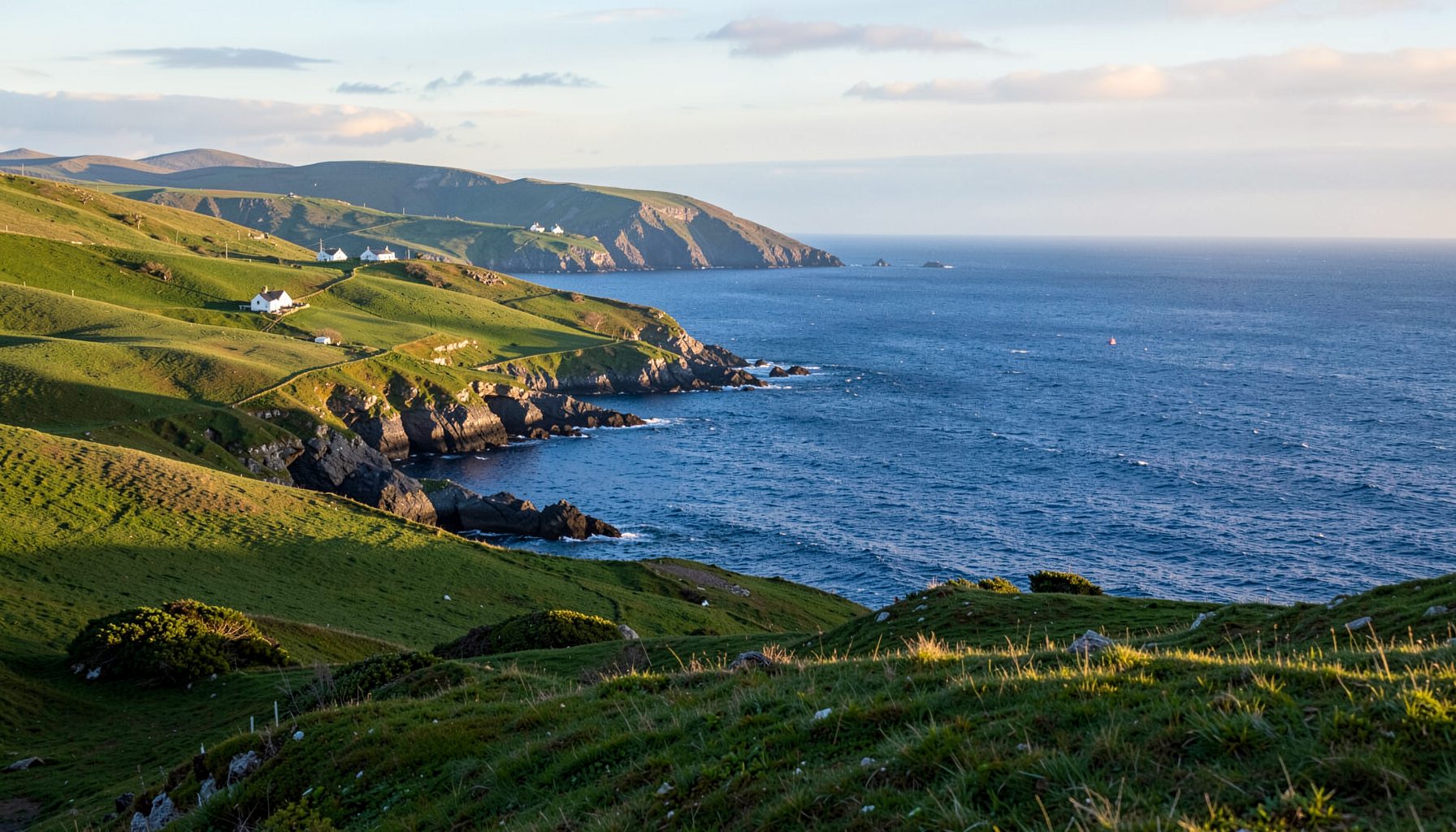
Valentia Island became central to that effort. Its position on Ireland’s south-western edge placed it close to the shortest practical route between Europe and Newfoundland. The island’s sheltered coastline, especially Foilhommerum Bay, offered a natural landing place for submarine cable. What began as an ambitious experiment transformed the communities of Valentia, Knightstown, and the wider Iveragh Peninsula.
The Atlantic telegraph was a technological project, but it was also a local story. It required landing sites, roads, buildings, workers, ships, signal equipment, and reliable links to the Irish telegraph network. Its influence remains visible in the island’s industrial heritage and in the history of global communications.
Why Valentia Was Chosen
The first transatlantic cable planners needed two points that were as close together as possible. Valentia Island stood at the western end of Europe, while Trinity Bay in Newfoundland provided a suitable location on the North American side. The distance was still vast, but this route was considerably shorter than many alternatives.
The geography of Valentia created additional advantages. Foilhommerum Bay had a useful natural landing area, and the island could be connected by landline to the telegraph system on the Irish mainland. Knightstown, the island’s principal settlement, could support the station workers, engineers, and visiting officials involved in the undertaking.
The project also depended on advances in cable manufacture. Submarine telegraph cable needed a copper conductor protected by layers of insulating gutta-percha and strong iron wire. It had to survive pressure, movement, salt water, and the strain of being lowered from a ship into deep ocean. The cable was both delicate electrical equipment and heavy marine engineering.
The First Atlantic Experiment
The Atlantic Telegraph Company, associated with American businessman Cyrus West Field, organised the first major attempt to connect Ireland and Newfoundland. In 1857, the expedition set out with the USS Niagara and HMS Agamemnon, but the cable broke during the operation. A second attempt in 1858 succeeded in joining the two continents.
The cable reached the Valentia shore at Foilhommerum Bay in early August 1858. Signals were tested across the new connection, and on 16 August the system carried a formal exchange between Queen Victoria and United States President James Buchanan. Newspapers celebrated the achievement as a triumph that had made the Atlantic almost vanish.
The equipment at Valentia connected the undersea line with the land telegraph network. Messages could then travel onward through Ireland and Britain. The event attracted international attention, and the island became briefly associated with one of the most remarkable technological achievements of the nineteenth century.
A Triumph That Could Not Last
The first cable’s success was short-lived. Its electrical performance deteriorated rapidly, and the connection failed within a few weeks. The reasons included weaknesses in the cable’s design, manufacturing problems, and attempts to send signals using electrical conditions that damaged the insulation. The slow transmission speed also exposed the limitations of the system.
The failure did not make the project irrelevant. It demonstrated that a submarine cable could carry a message across the Atlantic, which was the essential proof that investors and engineers needed. The next stage involved stronger cable construction, improved testing, better electrical instruments, and greater care during laying operations.
The episode also showed how experimental technology could be misunderstood by the public. Many people regarded the first message as evidence that instant communication had arrived permanently. In reality, transatlantic telegraphy was still an unfinished engineering challenge.
| Date | Development | Importance for Valentia |
|---|---|---|
| 1857 | First cable-laying attempt fails | Revealed the practical dangers of deep-sea cable work |
| August 1858 | Cable reaches Foilhommerum Bay | Valentia becomes a landing point for the first transatlantic connection |
| 16 August 1858 | Formal messages cross the Atlantic | Marked the first celebrated exchange between Europe and North America |
| 1866 | A durable cable reaches Newfoundland | Provided the foundation for regular transatlantic communication |
| 1868 | Valentia cable station develops as a permanent operation | Connected the island to an international communications network |
| Twentieth century | Telegraph and cable services continue to evolve | Preserved Valentia’s role in communications heritage |
The Permanent Connection
A more reliable transatlantic link was established in 1866. The Great Eastern, the largest ship of its time, successfully laid a new cable from Ireland’s Atlantic communications route to Heart’s Content in Newfoundland. This cable operated successfully, and a second cable was recovered and completed after an earlier failure.
The 1866 achievement changed the commercial value of the project. Messages could now travel between Europe and North America in minutes rather than weeks. Telegraph offices handled government instructions, shipping information, financial news, and private correspondence. The cable became part of an international communications system rather than a single celebrated experiment.
Valentia’s importance continued through the development of a permanent cable station. The station handled signals arriving from the Atlantic and passed them into the wider European network. Its work required technical expertise, disciplined operating procedures, and constant attention to instruments that translated electrical pulses into written messages.
Work And Community Around The Station
The cable station brought a distinctive type of employment to Valentia Island. Telegraph operators, engineers, maintenance workers, clerks, and support staff formed part of a specialised workforce. Their duties could be demanding, especially when faults occurred at sea or when a cable needed testing and repair.
The station also connected the island to global events. A short message received in Valentia could concern a ship’s movement, a market change in New York, a diplomatic development in London, or a family matter thousands of miles away. Although the technology was advanced, the system depended on local routines: accurately recording messages, maintaining equipment, and moving information between the station and its recipients.
Knightstown and nearby communities adapted to the presence of the cable industry. Visitors, officials, and technical specialists arrived on the island, while local people encountered new forms of work and new links to the wider world. The transatlantic cable therefore affected the social and economic history of Valentia as well as its technological history.
Reading The Cable Landscape Today
Foilhommerum Bay is the most important physical landmark associated with the first cable landing. The landscape helps explain the practical character of the project: the cable had to come ashore safely, be protected from waves and rocks, and continue overland towards the station and telegraph network.
The Transatlantic Cable Station in Knightstown preserves the story through exhibits and interpretation. Its collections help visitors understand cable manufacture, telegraph instruments, the operators’ work, and the international consequences of the connection. The site places Valentia’s history within the broader story of Victorian engineering and globalisation.
The cable heritage also complements the island’s natural and cultural attractions. Geology, maritime history, local settlement, and Atlantic scenery all shaped the project. Exploring the story alongside Valentia’s villages, coastal routes, and heritage sites offers a fuller understanding of why this remote island became a communications centre.
Practical Ways To Explore The Story
A visit to the cable heritage sites is most rewarding when the technology is considered alongside the landscape and the people who operated it. The following approaches can help connect the surviving places with the wider history:
- Begin at the cable station heritage centre in Knightstown to understand the equipment, operators, and international network.
- Visit the Foilhommerum Bay landing area and consider the engineering challenge of bringing a cable safely ashore.
- Look for local interpretation about Valentia’s maritime, geological, and community history.
- Allow time to explore the island beyond the cable story, including its villages, coastal scenery, and links with the wider Iveragh Peninsula.
- Treat exposed coastal heritage with care and follow local access guidance, since weather and ground conditions can change quickly.
Valentia’s transatlantic cable history is a reminder that globalisation was built through specific places. Signals crossed the ocean, but they began with workers on an island shore, instruments in a station, and a community supporting an extraordinary experiment. The story links local heritage with the beginnings of modern international communication.
Explore the cable station, Foilhommerum Bay, and the wider heritage of Valentia Island through Skellig Coast, then share the island’s story with visitors who want to understand how the Atlantic world became connected.