The history of the Valentia Island telegraph cable
Before radio, satellites and the internet, information travelled no faster than a ship unless an electrical telegraph could carry it. The successful connection between Valentia Island and Newfoundland changed that reality. News that once took weeks to cross the Atlantic could eventually be transmitted in minutes, linking Europe and North America through a cable on the seabed.
Valentia became central to this technological breakthrough because of its position on Ireland’s south-western Atlantic edge. The island offered a practical departure point for a submarine cable, while the nearby waters provided a route towards Newfoundland. The project brought engineers, investors, sailors and telegraph operators to a remote part of the Iveragh Peninsula, creating a lasting connection between local history and global communications.
The first attempt in 1858 was celebrated around the world but failed within weeks. A later effort in 1866 created a dependable transatlantic link, and further cables followed. The story is preserved today at the Valentia Cable Station and at the cable landing area at Foilhommerum Bay, where the landscape still reveals the scale of an enterprise that helped shape the modern world.
Why Valentia became a telegraph gateway
The Atlantic crossing was the central obstacle facing nineteenth-century telegraph engineers. Land-based telegraph networks had already spread across Europe and North America, but messages stopped at the ocean. A submarine cable offered a way to join these systems, provided it could withstand great pressure, currents, difficult weather and the strain of being lowered across thousands of kilometres.
Valentia’s western location made it one of the closest practical points in Europe to Newfoundland. The island also had a sheltered landing place at Foilhommerum Bay, where the cable could come ashore before continuing to a purpose-built station. From there, messages could be connected to Ireland’s developing telegraph network and sent onwards to London and other centres.
The project was led by the Atlantic Telegraph Company, associated with American businessman Cyrus West Field and a group of British and North American investors. Engineers including Charles Tilston Bright and William Thomson, later Lord Kelvin, contributed to the design and operation of the system. Their work combined maritime surveying, cable manufacture and electrical experimentation on a scale never attempted before.
The first Atlantic crossing in 1858
The first cable was manufactured in sections and carried across the Atlantic aboard the USS Niagara and HMS Agamemnon. The two ships met in mid-ocean, joined the cable and attempted to lay it in both directions. After the first effort failed, a second expedition began in July 1858. The ships successfully reached Newfoundland, and the cable was connected across the ocean.
Messages began passing between Valentia and Newfoundland in August. On 16 August 1858, Queen Victoria sent a message to United States President James Buchanan. The exchange was a major international event. It symbolised improved relations between Britain and the United States and demonstrated that electrical communication could cross the Atlantic.
The triumph was short-lived. The cable’s signals weakened, and the system became increasingly unreliable. The transmission speed was very slow by modern standards, with messages taking many hours. An attempt to increase the electrical power damaged the delicate insulation and the cable stopped working in September. Even so, the 1858 crossing proved that a submarine telegraph route was technically possible.
From failure to a lasting connection
The next major expedition used the Great Eastern, the largest ship in the world at the time. Its immense size allowed it to carry thousands of miles of cable and provided a more stable platform for laying it. In 1865, the cable broke before reaching Newfoundland, leaving engineers to recover the failure and rethink their methods.
A new cable was manufactured with improvements to its copper conductor and gutta-percha insulation. In July 1866, the Great Eastern completed the journey from Valentia to Heart’s Content in Newfoundland. This cable worked reliably, and a second cable was later recovered from the 1865 attempt and brought ashore successfully.
The 1866 success transformed the economics and speed of international communication. Messages could cross the Atlantic in minutes rather than travelling by steamship. Financial information, diplomatic instructions, shipping reports and newspaper dispatches could circulate with unprecedented speed. The transatlantic cable did not make communication instant in the modern sense, but it created the first practical information bridge between continents.
The achievement also confirmed Valentia’s continuing role. The island was no longer simply a remote Atlantic settlement. It had become the European terminus of a network that connected Ireland with Newfoundland, Britain, North America and the wider world.
Life around the cable station
The telegraph station brought specialised work to the island. Cable operators monitored electrical signals, received and transmitted coded messages, recorded traffic and maintained equipment. Engineers and maintenance crews dealt with faults both on land and offshore. The station needed reliable buildings, power, instruments and links to the broader Irish telegraph system.
Telegraphy changed local employment and connected Valentia more closely with international commerce. Operators had to work with precision, often interpreting faint signals through early instruments. A short message might contain information of considerable financial or political importance, so accuracy was essential.
The cable also influenced the community’s identity. Valentia’s name began appearing in newspapers and technical reports around the world. The landing station became a symbol of confidence in engineering and international cooperation, while the surrounding island remained a working landscape of farms, piers, roads and maritime activity.
The cable route required continuing care. Submarine cables could be damaged by anchors, fishing gear, storms or gradual deterioration. Repair ships and specialist crews were part of the developing cable industry. Each new cable reduced the risk of total interruption and increased the capacity of the Atlantic communications network.
The technology behind the Atlantic link
A telegraph cable carried coded electrical pulses rather than spoken sound. Operators used a system based on the Morse code, converting letters and numbers into combinations of short and long signals. At the receiving station, the pulses were interpreted and written down for delivery.
The cable itself had to balance several competing demands. Its copper core needed to conduct electricity efficiently, while its insulation prevented current from leaking into the surrounding seawater. Protective iron wires formed an outer armour, giving the cable strength during laying and helping shield it from damage.
Early engineers initially underestimated the effects of electrical resistance and capacitance in a very long cable. Signals became spread out and distorted as they travelled. William Thomson’s mathematical work helped explain these problems and encouraged the use of more sensitive receiving instruments, including the mirror galvanometer.
| Milestone | Date | Importance |
|---|---|---|
| First transatlantic cable expedition | 1857 | Established the route and tested the practical difficulties of laying a cable |
| First successful Valentia–Newfoundland connection | August 1858 | Proved that electrical messages could cross the Atlantic |
| First royal and presidential exchange | 16 August 1858 | Made the new communication system an international public event |
| Failure of the first cable | September 1858 | Revealed weaknesses in insulation, transmission and operating methods |
| Great Eastern expedition | 1865 | Attempted a stronger and more carefully managed crossing, but the cable broke |
| Reliable transatlantic cable | July 1866 | Created a lasting high-speed link between Valentia and Newfoundland |
| Expansion of the cable network | Late nineteenth century | Increased capacity, reliability and competition between cable companies |
A global revolution with local roots
The telegraph cable altered the rhythm of international life. Before its arrival, a government, business or newspaper might wait for a ship to bring news from across the ocean. After 1866, decisions could be made on the basis of information received almost immediately.
Markets were among the first areas to feel the effect. Commodity prices, stock quotations and shipping news could be exchanged rapidly. Newspapers gained access to international reports while events were still current. Governments could communicate with overseas representatives without relying entirely on mail ships.
The cable also changed public perceptions of distance. The Atlantic remained physically vast, but it no longer imposed the same delay on information. This shift helped create the interconnected commercial and political world associated with the late nineteenth century.
The benefits were uneven. Cable messages were expensive, so access was initially concentrated among governments, companies, newspapers and wealthy individuals. The system also depended on complex infrastructure and private investment. Yet its wider influence was substantial: later telephone cables, wireless communication and digital networks all developed within a world that the first telegraph cables had helped connect.
Remembering the cable on Valentia Island
The cable story remains visible at the Valentia Cable Station, where exhibitions interpret the island’s place in communications history. Displays explore the people, ships, instruments and engineering decisions behind the Atlantic crossings. The station provides a useful connection between a local building and events that affected diplomacy, commerce and journalism across the world.
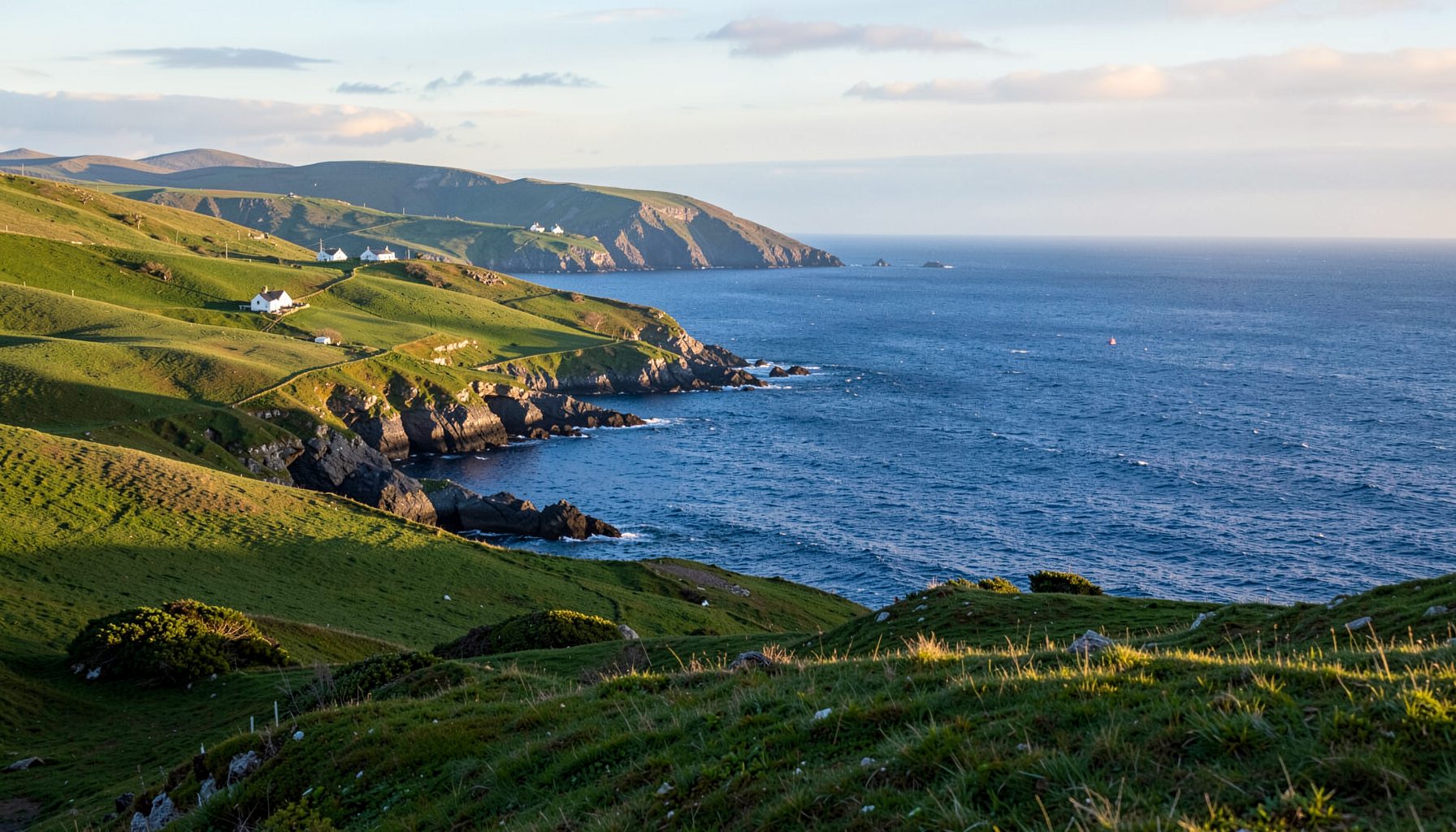
Foilhommerum Bay is equally important. The cable landing site places the history in its physical setting: a rugged Atlantic shoreline where the cable emerged from the sea and entered the communications network. The surrounding landscape helps visitors understand why Valentia was chosen and how demanding the marine crossing must have been.
The story belongs within the wider heritage of the Skellig Coast. Valentia’s cable enterprise sits alongside maritime traditions, island communities, archaeology and the broader history of the Iveragh Peninsula. It shows that regional heritage is not confined to ancient monuments. It can also include industrial sites, scientific achievements and the local consequences of global change.
Visitors can deepen their understanding by:
- Visiting the Valentia Cable Station to explore original equipment, documents and interpretation
- Travelling to Foilhommerum Bay and respecting coastal access, roads and private land
- Learning about the Great Eastern, Cyrus Field and Lord Kelvin before visiting
- Connecting the cable story with Valentia’s maritime, geological and island heritage
- Supporting local museums, community projects and heritage initiatives that preserve the island’s past
The transatlantic cable began as an ambitious experiment and became a foundation of modern communication. Its first message from Valentia was slow, fragile and temporary, yet the knowledge gained from failure led to the reliable 1866 connection. Today, the old landing place and cable station preserve the memory of an era when a remote Irish island stood at the centre of a revolution in global information.
Explore Valentia Island’s cable heritage alongside its coastal scenery, maritime history and living community, and discover how the Skellig Coast helped connect two continents.