The History of the Ballinskelligs Priory and Its Monks
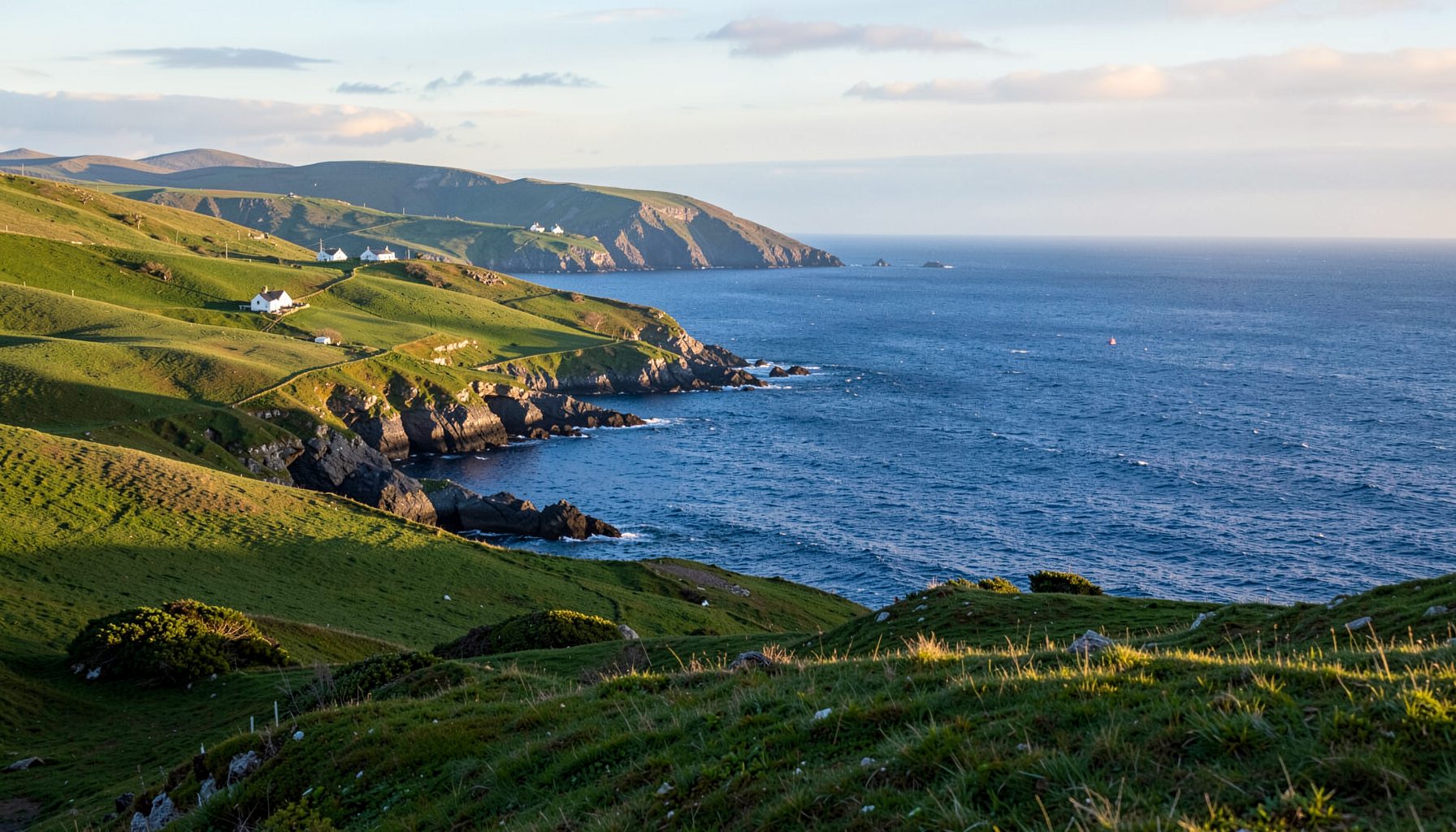
On the western edge of the Iveragh Peninsula, where the Atlantic meets broad sands and low green hills, the ruins of Ballinskelligs Priory preserve a long story of faith, migration and adaptation. The site is often called Ballinskelligs Abbey, although its religious community belonged to the Augustinian tradition and was formally a priory.
Its history is closely linked with Skellig Michael, the offshore monastery whose stone beehive huts and dramatic location have made it one of Ireland’s best-known heritage sites. Ballinskelligs offered a more practical mainland setting for religious life, giving the monks access to farmland, freshwater and communication routes while keeping them within sight of the Skelligs.
The surviving walls are incomplete, but they remain expressive. Pointed arches, weathered masonry and traces of domestic buildings show how a medieval religious house functioned as a place of prayer, work, hospitality and administration. Understanding the priory means looking beyond the ruins to the changing communities around them.
From Skellig Michael to the mainland
The early monastic settlement on Skellig Michael was established in a remote maritime landscape, probably between the sixth and eighth centuries. Its monks chose isolation as a way of pursuing prayer, discipline and a life separated from ordinary settlement. The island’s steep slopes and exposed position made it a remarkable spiritual retreat, but they also imposed severe practical limits.
By the central Middle Ages, religious organisation in Ireland was changing. Reform movements encouraged monasteries to follow more structured rules and to connect with wider ecclesiastical networks. The mainland settlement at Ballinskelligs is generally understood as part of this transition. It may have served as a successor or companion foundation to the older island monastery, allowing religious life associated with the Skelligs to continue in a more sustainable location.
The move should not be imagined as a single dramatic evacuation. Island and mainland traditions could coexist, and the relationship between them probably changed over time. Ballinskelligs became the community’s practical base, while Skellig Michael retained its importance as a place of memory, pilgrimage and spiritual identity.
The Augustinian community
Ballinskelligs Priory was founded around the early thirteenth century, commonly dated to about 1210. Its monks were Augustinian canons regular, members of a community that combined religious vows with pastoral and administrative duties. Calling them simply “monks” is understandable, but “canons” more accurately reflects their role within the medieval Church.
The Augustinian rule placed value on communal worship, disciplined living and service to local society. A priory such as Ballinskelligs would have required a church, cloister or communal centre, living quarters, storage areas and working spaces. The canons needed food, fuel, clothing and books, so religious devotion was supported by farming, estate management and contact with neighbouring families.
Their work may also have included hospitality and pastoral care. Medieval religious houses were places where travellers could seek shelter, tenants could conduct business and local people could encounter clerical authority. The priory was therefore part of the social and economic fabric of the district rather than an isolated collection of buildings.
A landscape shaped by faith and work
The priory’s position near the coast was significant. Ballinskelligs Bay connected the settlement to maritime routes around the Iveragh Peninsula, while nearby land provided opportunities for cultivation and grazing. The coast could be generous, supplying fish and shellfish, but it was also unpredictable. Storms, salt exposure and poor soils demanded careful planning.
The canons’ daily routine would have followed the rhythm of the canonical hours, with prayers and services structured throughout the day. Between religious observances, members of the community would have supervised land, repaired buildings, prepared food, copied or cared for manuscripts and dealt with visitors. Their life was contemplative, but it was also intensely practical.
The surrounding place-names, roads and field patterns offer clues to the wider world that supported the priory. Local tenants, landholders, craftsmen and seafarers all had connections with the institution. Even when the buildings appear quiet today, the site represents a network of relationships extending across the parish and towards the offshore Skelligs.
Key stages in the priory’s story
| Period | Development | Historical significance |
|---|---|---|
| Early medieval era | Monastic life becomes established on Skellig Michael | Creates the spiritual tradition later associated with the mainland |
| Around 1210 | Augustinian priory founded at Ballinskelligs | Provides a more accessible and sustainable religious base |
| Later medieval period | Community manages worship, land and local relationships | Shows the priory’s role in both religious and everyday life |
| Sixteenth century | Royal religious reforms affect the institution | Brings the medieval priory system to an end |
| After suppression | Buildings and lands pass into secular ownership | The ruins become part of the area’s historic landscape |
| Modern period | Conservation and heritage interpretation continue | Connects local memory with regional and international interest |
Medieval architecture in the ruins
What survives at Ballinskelligs is best read as a fragment of a larger complex. The church remains the most immediately recognisable element, with medieval stonework that reflects the architectural language of the period. Pointed openings, thick walls and carefully shaped masonry reveal the skill required to build a permanent religious centre in a remote coastal district.
The priory’s design would have separated sacred and domestic functions while keeping them connected. The church formed the spiritual heart of the complex. Nearby spaces supported communal meals, sleeping arrangements, storage and work. Some structures have disappeared through collapse, weathering or later reuse, leaving archaeologists and visitors to reconstruct the original layout from foundations and surviving wall lines.
Carved details are especially valuable because they give the ruins a human dimension. Stone heads, mouldings and fragments of decoration show that the priory was not designed as a purely utilitarian settlement. Beauty, symbolism and craftsmanship mattered. Even worn carvings can suggest how medieval worshippers experienced the building through light, texture, sound and movement.
Suppression and the end of medieval religious life
The priory’s medieval story changed during the sixteenth-century Reformation. Across Ireland, religious houses were dissolved or placed under pressure as the English Crown expanded control over church property. Ballinskelligs, like many other monasteries and priories, lost its institutional independence during this period.
The process of suppression did not erase the site overnight. Buildings could remain standing after a community had departed, and former religious lands might be granted, leased or transferred to secular owners. Some parts of the complex may have been reused for practical purposes, while stone from abandoned structures could be incorporated into later walls.
The end of the priory also changed the social landscape. A house that had once organised prayer, landholding and hospitality no longer served the same communal function. Yet its memory persisted through local tradition and through the visible presence of the ruins. The story of religious change is therefore also a story of continuity: people continued to live, farm and travel around the site long after the canons were gone.
Ballinskelligs in the wider Skellig Coast
The priory forms one part of a heritage corridor that includes the villages, beaches, archaeological sites and maritime traditions of the Skellig Coast. Its connection with Skellig Michael gives it particular significance, but the mainland setting deserves attention in its own right. Ballinskelligs shows how religious communities negotiated the boundary between retreat and engagement.
The site also belongs to a living region. Visitors encounter working landscapes, local festivals, community projects and businesses alongside ancient monuments. Food traditions are part of that contemporary cultural setting; those exploring the wider peninsula can also find regional dining through this guide to seafood restaurants in Cahersiveen, linking today’s coastal economy with the area’s enduring relationship with the sea.
The nearby coastline helps explain why the priory mattered. The Atlantic was a route, a source of food and a force that shaped settlement. Looking from Ballinskelligs towards the Skelligs makes the historical connection tangible, while walking through the ruins reveals the discipline and labour required to maintain a religious house in such an exposed environment.
Reading the site with care
A visit is most rewarding when the ruins are approached as evidence rather than as a complete story. The remaining church walls cannot show every stage of construction, and some details of the priory’s foundation and later use remain uncertain. Good interpretation distinguishes between documented facts, archaeological evidence and informed historical reconstruction.
The site can also be understood through several overlapping timescales. The earliest layer is the island monastic tradition; the medieval layer is represented by the Augustinian priory; the post-Reformation layer concerns landownership and reuse; and the modern layer involves conservation, tourism and local identity. Each period adds meaning without replacing the others.
Useful ways to explore the ruins include:
- Examine the surviving masonry for changes in stonework, repair and construction technique.
- Consider how the priory’s position connected prayer, farming, travel and the sea.
- Compare the mainland site with the monastic landscape of Skellig Michael.
- Read local heritage information before visiting so that uncertain claims are kept distinct from established evidence.
- Treat the ruins as part of a living community, with care for the site and respect for nearby land and residents.
The priory is also a reminder that heritage is larger than a single monument. Its story includes the canons who lived there, the families who supported or encountered them, the craftsmen who shaped the stone and the later generations who preserved the remains. Those connections make Ballinskelligs relevant to anyone interested in medieval Ireland, local history or the cultural landscape of the Ring of Kerry.
Visit Ballinskelligs Priory with time to look closely, then follow the coast towards the Skelligs and the communities that continue to give this landscape its character. By engaging with the ruins respectfully and sharing their history accurately, visitors help keep the memory of the Augustinian canons and their remarkable coastal home alive.