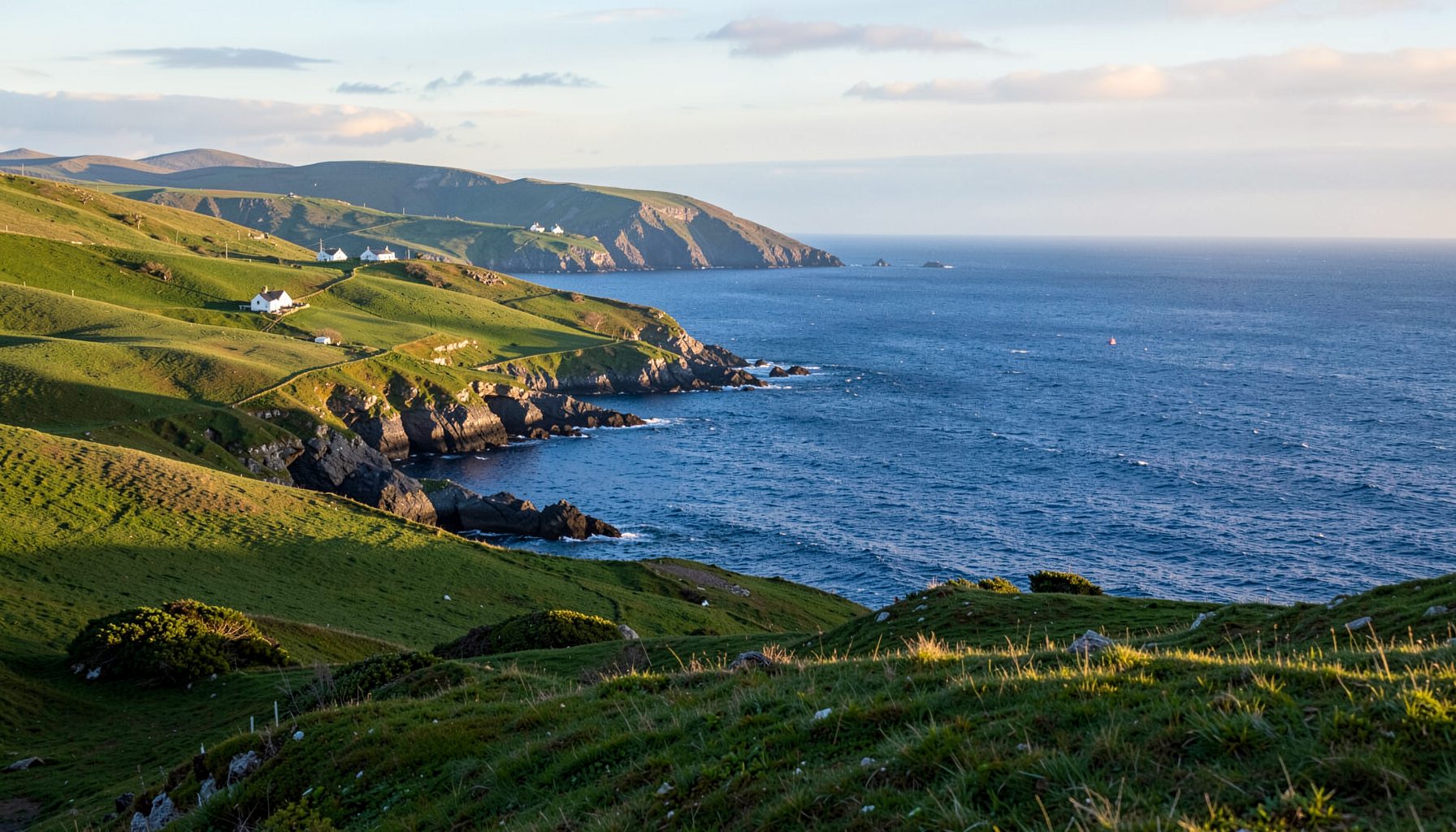
The Geology Of The Skellig Islands: Sandstone And Sea Stacks
Far out from the Iveragh Peninsula, the Skellig Islands rise from the Atlantic as steep, dark silhouettes. Their cliffs, ledges and pinnacles are often first associated with monastic history, seabirds or the filming of Star Wars. Yet the character of Skellig Michael and Little Skellig begins much deeper in time, within the rocks shaped by ancient rivers, mountain-building forces, ice and powerful Atlantic waves.
The islands are built largely from Devonian sandstone, a rock formed roughly 385 to devonian 350 million years ago. Layer by layer, sand and gravel were deposited in a terrestrial basin before becoming compressed and cemented into solid rock. Later geological movements tilted and fractured those layers, giving the Skelligs their dramatic angles and helping create the cliffs seen today.
This rocky landscape is part of the wider geology of the Skellig Coast, linking the islands with the mountains, headlands and offshore reefs around the Iveragh Peninsula. Understanding that connection adds another dimension to local heritage and explains why the islands appear so distinctive from the mainland.
Ancient Sandstone Beneath The Atlantic
The principal bedrock of the Skellig Islands belongs to the Old Red Sandstone tradition found across much of southwest Ireland. The name describes a broad group of reddish and brown sedimentary rocks deposited during the Devonian Period, when Ireland lay within a large continental landmass rather than in its present ocean setting.
Streams and seasonal rivers carried sediment from eroding uplands into inland basins. Coarse gravel settled close to active channels, while finer sand spread across floodplains. Over immense periods, these deposits were buried, compacted and bound together by mineral cements. The resulting sandstone preserves the memory of a dry, river-dominated environment very different from the wet Atlantic setting seen today.
The colour of the rock can vary from grey and brown to warm red or purple, depending on mineral content, weathering and exposure. Individual beds may differ in grain size and strength. These variations matter because softer layers erode more quickly, while more resistant bands can remain as projecting ledges or ribs.
Folding Faults And Tilted Rock Layers
The Skelligs are not made from neatly horizontal beds. Their strata were later affected by tectonic forces associated with the formation and rearrangement of ancient mountain belts. Compression folded and fractured the sandstone, while faults displaced sections of the rock. On Skellig Michael, the sloping surfaces and repeated bands of stone reflect this disturbed geological structure.
Inclined bedding creates natural lines of weakness that guide weathering. Rainwater can enter joints and fractures, salt crystals can grow in tiny openings, and repeated heating and cooling can gradually loosen blocks. Once a fragment breaks away, gravity and wave action carry the process forward.
The steep stairways and terraces used by monastic communities follow the shape of the mountain rather than cutting through uniform rock. The island’s famous beehive cells stand within this rugged setting, where carefully placed stonework contrasts with naturally tilted sandstone beds. Cultural history is therefore closely connected to the physical structure of the island.
How Sea Stacks Were Carved
Sea stacks begin as sections of a rocky coastline that are progressively weakened by marine erosion. Waves strike cracks and faults, enlarging them into narrow inlets or caves. Continued erosion may form an arch, and the roof of that arch can eventually collapse. The remaining pillar becomes an isolated stack, separated from the main cliff by the sea.
The Skellig Islands display this process at a grand scale. Their cliffs are exposed to Atlantic swell arriving across a wide stretch of ocean, giving waves considerable energy. Storms can remove loose blocks, undercut cliff faces and transport broken sandstone along the shoreline. Wind, rain and salt spray work above the waterline, while wave impact attacks the base.
Not every sea stack develops in the same way. Rock strength, fracture direction, bedding angle and local water depth all influence the final shape. A resistant ridge may survive as a pointed pinnacle, while adjacent weaker material disappears. Over time, stacks can become lower, narrower and more isolated before collapsing into reefs and boulder fields.
Skellig Michael And Little Skellig Compared
| Feature | Skellig Michael | Little Skellig |
|---|---|---|
| Main character | Large, steep island with terraces, cliffs and a summit ridge | Smaller, sharply rocky sea stack and island |
| Geological appearance | Inclined sandstone beds, ledges, gullies and deeply weathered slopes | Exposed rock faces, pinnacles and narrow landing areas |
| Cultural importance | Early medieval monastic settlement and UNESCO World Heritage Site | Primarily known for its wildlife and dramatic natural form |
| Wildlife setting | Cliffs and ledges used by seabirds, with vegetation in sheltered places | Major seabird colony, especially gannets |
| Forces shaping the coast | Weathering, rockfall, rainfall and Atlantic wave erosion | Wave attack, salt weathering, storm exposure and collapse |
Skellig Michael is the larger and more varied of the two islands. Its summit rises to about 218 metres, and its slopes contain natural shelves that were adapted by monastic builders. The island’s profile combines broad tilted surfaces with sheer cliff sections, producing a landscape that seems both ordered and precarious.
Little Skellig is lower in human associations but no less remarkable geologically. Its jagged outline is strongly influenced by erosion, and its exposed rock provides nesting space for one of the most important gannet colonies in Ireland. The white birds, guano-streaked ledges and dark sandstone create a vivid contrast that has become one of the defining sights of the Skellig Coast.
Weathering On A Living Coastline
Geology is often imagined as something fixed, but the Skellig Islands are still changing. Every storm removes material from some part of the cliffs. Rainwater enters cracks, vegetation widens small openings, and frost can prise apart blocks during colder periods. Salt carried in sea spray is particularly effective at weakening exposed surfaces.
Rockfalls are an important part of this natural cycle. A cliff may appear unchanged for years before a section suddenly gives way. The fallen debris then becomes part of the shore, where waves break it into smaller pieces and redistribute it. This process helps maintain the rough, broken character of the islands.
Lichens and small plants also contribute to the weathering environment. Their roots and growth patterns exploit tiny spaces in the sandstone, while organic acids can affect mineral surfaces. At the same time, vegetation stabilises some sheltered slopes by holding soil in place. The island landscape is shaped by a constant interaction between rock, climate, water and living organisms.
Reading The Rocks Along The Skellig Coast
The offshore islands belong to a broader geological story visible from Kells to Castlecove. Headlands, coves and upland valleys around the Iveragh Peninsula reveal related sandstone formations, altered by folding, faulting and long-term erosion. Inland ridges and coastal cliffs are connected through the same deep history, even where vegetation or human settlement hides the bedrock.
Look closely at exposed coastal outcrops and several details become meaningful. Parallel stripes may represent bedding planes. Sharp breaks can mark joints or faults. Rounded blocks may have been weathered in place before falling, while angular boulders often indicate more recent fracture and collapse. The direction of a cliff face also affects its exposure to prevailing winds and incoming swell.
The geological setting supports more than scenic value. It influences soil depth, drainage, grazing patterns, nesting locations and the routes taken by footpaths. It also helps explain why some places are suitable for buildings or fields while others remain bare cliff, reef or boggy ground. Local communities have always inhabited a landscape whose opportunities and limits were partly established by bedrock.
Responsible Ways To Discover The Geology
The Skellig Islands are protected places with sensitive wildlife, historic structures and unstable cliff edges. Geological observation should therefore be combined with careful behaviour. Visitors should follow official access arrangements, remain within permitted areas and avoid touching masonry or collecting rocks. A small fragment removed from a cliff or shore may seem insignificant, but repeated disturbance can damage fragile sites.
Useful observations can also be made from the mainland, where the island profiles are visible in changing light and weather. Local heritage centres, walking programmes, schools and community learning hubs may provide talks or guided activities that connect physical geography with archaeology, ecology and maritime history.
- Compare the steep profile of Skellig Michael with the sharper outline of Little Skellig
- Look for tilted sandstone layers and fracture lines on accessible mainland outcrops
- Notice how wave exposure changes the shape of coves, headlands and offshore rocks
- Learn about seabird protection before planning any boat trip or coastal visit
- Record observations through sketches or photographs rather than removing geological material
Explore The Coast Through Its Rocks
The sandstone and sea stacks of the Skellig Islands show how landscapes can carry several histories at once. Ancient river deposits became rock, tectonic forces tilted and fractured them, and the Atlantic carved those structures into cliffs and pinnacles. Human communities later built paths, walls and monastic cells within the spaces geology made possible, while seabirds continue to occupy the ledges created by erosion.
Explore the Skellig Coast through its villages, heritage resources, learning initiatives and outdoor programmes, and take time to read the rocks alongside the stories of the people and wildlife connected to them.