How the Skellig Coast Shaped Paudig O’Sullivan’s Poetry
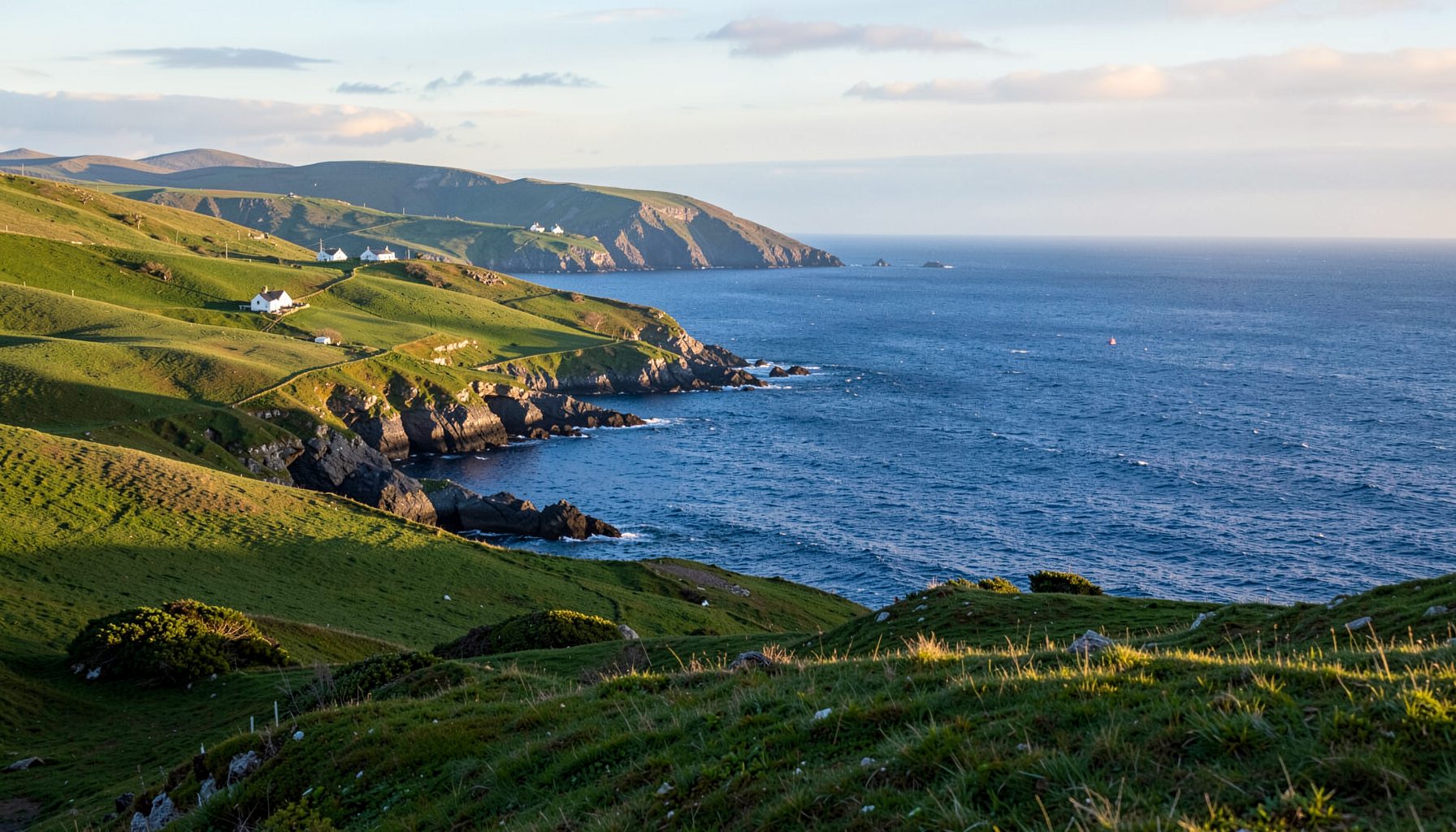
The Skellig Coast is a place where landscape carries memory. Along the road from Kells to Castlecove, mountains, islands, coves and townlands form more than a scenic backdrop. They preserve stories of work, faith, migration, hardship and belonging. For Paudig O’Sullivan, this living landscape offered a rich source of images and emotions for poetry.
His poems can be read as a response to the distinctive character of the Iveragh Peninsula. The Atlantic is powerful but unpredictable, the coastline is beautiful but demanding, and every village holds traces of earlier generations. These contrasts helped shape a body of local verse attentive to place, people and the passing of time.
O’Sullivan’s connection with the Skellig Coast is best understood through recurring themes rather than through a single landmark or event. His poetry reflects the way local life is rooted in the land, while also reaching towards spiritual, historical and emotional questions that have meaning far beyond the peninsula.
The Landscape as a Speaking Presence
In O’Sullivan’s work, the landscape appears active rather than passive. Headlands seem to watch over the sea, roads carry the memory of those who travelled them, and islands become symbols of distance, endurance and mystery. The coast gives his poems a strong visual language, but it also supplies their emotional movement.
The Skelligs are especially powerful in this context. Rising sharply from the Atlantic, Skellig Michael represents isolation and devotion, while Little Skellig evokes the wild energy of the natural world. Their presence can suggest a conversation between human ambition and forces that remain beyond human control. The islands are visible from parts of the mainland, yet their distance gives them an almost dreamlike quality.
This tension between nearness and remoteness is central to the poetic imagination of the region. A familiar view can suddenly become strange in changing weather, and an ordinary shoreline can recall voyages, shipwrecks, prayer or departure. Such shifts allow O’Sullivan to move naturally from physical description into reflection.
Shorelines, Townlands and Belonging
The poet’s sense of place is also grounded in smaller details. A townland name, a bend in the road, a ruined cottage or a field wall can hold as much significance as a dramatic mountain or island. These features connect personal experience with community history, giving local poetry its sense of intimacy.
The Skellig Coast is made up of distinct communities, each with its own character and memories. Kells, Caherdaniel, Waterville, Cahersiveen, Portmagee, Ballinskelligs and Castlecove are connected by geography, yet each has developed particular traditions and stories. In poems shaped by this environment, belonging is rarely abstract. It is experienced through speech, landscape and shared recognition.
A place becomes meaningful because people return to it in memory. O’Sullivan’s verse can therefore be read as an act of attention: a way of noticing what might otherwise be overlooked. The small scale of a local image does not limit its importance. A gate, a harbour or a familiar hill may stand for home itself.
| Element of the Skellig Coast | Poetic association | Emotional effect |
|---|---|---|
| Atlantic shore | Change, danger and freedom | Restlessness and awe |
| Skellig islands | Solitude, faith and mystery | Wonder and reflection |
| Mountain roads | Travel, memory and separation | Longing and endurance |
| Village life | Belonging and shared history | Warmth and recognition |
| Ruins and old fields | Loss, survival and continuity | Sadness balanced by resilience |
The Music of Local Speech
The sound of a poem matters deeply in a region where oral storytelling and conversation remain important parts of cultural life. The cadence of local speech, the rhythm of Irish place names and the directness of rural expression can influence how a poem feels when read aloud. O’Sullivan’s work belongs to this wider tradition of language shaped by voice.
The use of local names can preserve meanings that a translation cannot fully carry. A name may refer to a physical feature, a saint, an old occupation or an event remembered by generations. Including such names in poetry anchors the work in its setting and gives the reader a sense that the poem has grown from the ground beneath it.
This attention to language also creates a bridge between Irish and English. Even when a poem is written mainly in English, Irish words and rhythms may remain present in its structure and imagery. The result is a form of writing that reflects the linguistic history of the Iveragh Peninsula rather than treating the landscape as culturally empty.
Sea, Faith and the Inner Life
The sea in O’Sullivan’s poetry can carry several meanings at once. It is a source of food and employment, a route out of the community, a threat to those who work upon it and a constant presence in daily life. Its changing moods provide a natural vocabulary for fear, hope, grief and renewal.
The religious history of the Skellig Coast adds another layer. Early Christian associations, holy wells, graveyards, Mass rocks and pilgrimage routes remain part of the region’s cultural landscape. Skellig Michael is internationally recognised for its monastic settlement, but the wider coast also contains many quieter signs of devotion. These places help explain why spiritual imagery can appear naturally in local poetry.
O’Sullivan’s treatment of faith need not be read as simple religious certainty. The Atlantic horizon and the isolation of the islands may instead create a mood of questioning. The poems can hold reverence and doubt together, allowing the natural world to become a setting for thoughts about mortality, endurance and the limits of human knowledge.
History Beneath the Everyday
The Skellig Coast contains a layered history of famine, emigration, conflict, disease and economic change. Historic events are not confined to museums or written archives; they remain present in abandoned settlements, family stories and the shape of the landscape. This connection between the ordinary and the historical gives regional poetry much of its depth.
A poem about a quiet village may therefore carry the memory of population loss. A description of a harbour may recall generations who left by sea. A reference to illness can point towards the vulnerability of communities before modern medicine. The cholera wave folklore associated with the 1832 epidemic shows how local catastrophe survives through story, place and collective memory.
Such history does not have to dominate a poem to influence it. Sometimes it appears through an image of an empty house, a neglected field or a name spoken by an older person. O’Sullivan’s sensitivity to these details allows the past to remain present without turning the poetry into a formal history lesson.
The emotional force comes from the relationship between loss and continuity. Communities have endured change, but endurance does not erase grief. The poems can honour those who remained, those who departed and those whose lives are known only through fragments passed down over time.
A Poetry Rooted in Community
Although the Skellig Coast is often presented to visitors through spectacular scenery, its character depends on people who live, work and create there. Schools, heritage groups, libraries, arts projects and local gatherings keep the region’s cultural life active. Poetry belongs within this network because it turns local experience into something that can be shared.
O’Sullivan’s work gains much of its meaning from this communal setting. A poem may begin with an individual memory, yet its references invite recognition from others. Readers familiar with the roads, weather and place names may find their own experiences reflected in the lines. Those from outside the region can encounter the coast through an emotional rather than purely geographic map.
Local poetry also resists the idea that rural places are silent or unchanging. The Skellig Coast has always been shaped by movement: seasonal work, fishing, migration, pilgrimage, tourism and education. O’Sullivan’s poems show how a strong attachment to home can exist alongside curiosity about the wider world.
Ways to Read O’Sullivan’s Work
- Notice how natural features create mood rather than serving as simple scenery.
- Read place names as fragments of history, language and community identity.
- Listen for rhythms that suggest spoken storytelling or local conversation.
- Consider how the sea represents both connection and separation.
- Look for moments where private memory opens into shared regional experience.
Reading the poems in this way makes the Skellig Coast more than a setting. It becomes a participant in the work, shaping its vocabulary and emotional direction. The mountains provide permanence, the sea introduces uncertainty, and the villages supply the human scale through which history can be understood.
The Coast as an Ongoing Source
The inspiration behind Paudig O’Sullivan’s poetry is not limited to one period or one view. The Skellig Coast continues to change, while retaining landmarks and traditions that connect the present with earlier generations. New community initiatives, cultural events and local research add fresh layers to an already complex sense of place.
That continuing change is important. A living landscape cannot be reduced to nostalgia. The coast includes working communities, contemporary artists, young people, visitors and families whose experiences differ from those of the past. Poetry remains relevant because it can hold these layers together, preserving memory while responding to the present.
O’Sullivan’s poems encourage readers to look closely at the relationship between people and place. They show how an island on the horizon, a familiar road or a remembered voice can become a source of imaginative power. Through that attention, the Skellig Coast emerges as both a physical region and an inner landscape.
Explore the stories, heritage and communities of the Skellig Coast through local perspectives, and read Paudig O’Sullivan’s poetry with the coastline in mind. Visit the villages, learn the place names, listen to the memories and discover how the landscape continues to inspire creative life along Ireland’s Iveragh Peninsula.