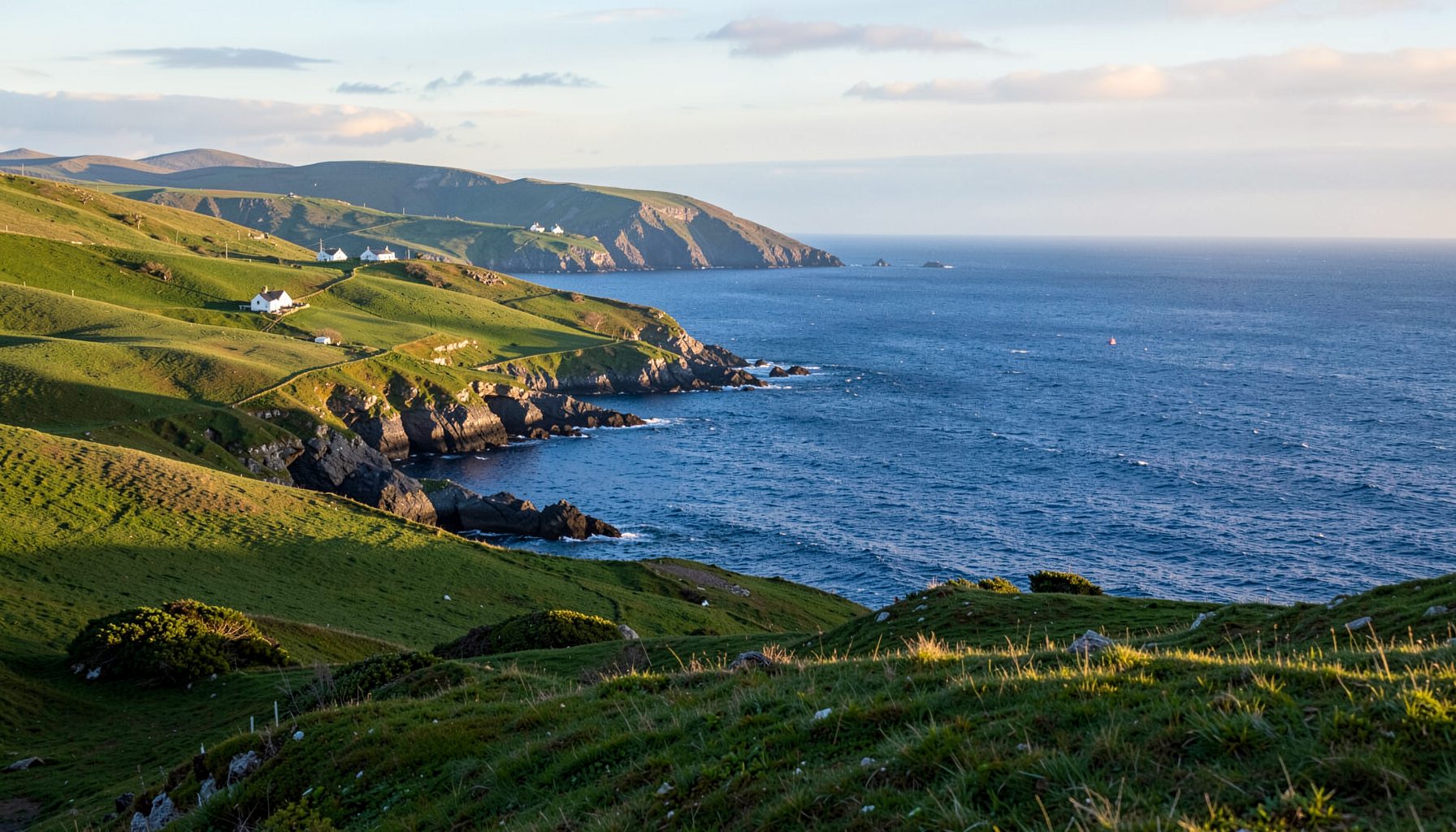
How the Skellig Coast Became a Star Wars Filming Location
The Skellig Coast’s connection with Star Wars began with a landscape that seemed to belong to another world. Rising sharply from the Atlantic, Skellig Michael combines dark rock, white surf, steep stone steps and an early medieval monastery. Its isolation gives the island a powerful sense of place, far removed from ordinary roads, buildings and modern life.
That quality made the island a natural choice for Ahch-To, the remote planet where Rey finds Luke Skywalker at the end of The Force Awakens. The location returned in The Last Jedi, becoming closely associated with Luke’s exile, Rey’s training and the film series’ exploration of Jedi history.
The production brought worldwide attention to a corner of County Kerry already valued for its archaeology, wildlife and living communities. It also created a new relationship between filmmaking, heritage protection and tourism from Portmagee and Valentia to Ballinskelligs, Waterville and the wider Iveragh Peninsula.
A Landscape That Already Looked Like Another World
Skellig Michael stands around 11 kilometres west of the Iveragh Peninsula. The island’s cliffs rise from the Atlantic in dramatic layers, while its summit is reached by hundreds of narrow, uneven steps. At the top are the remains of a monastic settlement, including beehive-shaped stone huts built by monks between roughly the sixth and eighth centuries.
The island’s appearance suited the imagined world of Ahch-To without requiring extensive visual alteration. Its exposed position, changing weather and severe approach communicate isolation immediately. In the Star Wars story, that isolation reflects Luke Skywalker’s withdrawal from the galaxy and Rey’s arrival at a place connected with the earliest Jedi traditions.
The Skelligs also offered visual contrasts that helped the filmmakers. Calm light can reveal green slopes, lichen-covered stone and distant mainland views, while Atlantic mist can make the island appear almost suspended in space. This combination of archaeological detail and wild scenery gave the fictional planet a recognisable identity.
Why Skellig Michael Matched The Story
The choice was based on more than scenic beauty. The filmmakers needed a location that could suggest an ancient spiritual centre, a difficult pilgrimage and a place untouched by modern development. Skellig Michael’s monastic settlement already carried associations with retreat, discipline and faith.
The island’s physical structure supported the storytelling. The long climb from the landing place to the monastery creates a natural sense of effort and discovery. Paths turn around cliffs, views open suddenly across the ocean, and the settlement appears only after a demanding ascent. These qualities helped make Rey’s journey to Luke feel like a genuine passage into an older world.
The island was used to represent Ahch-To rather than to stand in for every part of the fictional planet. Film sets, digital effects and other locations expanded the environment beyond what could be captured on Skellig Michael. Even so, the real island supplied the visual foundation that audiences remember: Luke on the high ridge, Rey crossing the stone landscape and the ancient structures overlooking the Atlantic.
From Irish Heritage Site To Global Screen Location
Skellig Michael had international importance long before cameras arrived. UNESCO added the island to its World Heritage List in 1996, recognising the monastic settlement as an exceptional example of early Christian architecture and a remarkable survival in an extreme setting. Its significance also includes maritime history, geology and its role as a breeding ground for seabirds.
The island’s protected status shaped the filming process. A production could not treat the site like an empty outdoor set. Movement, equipment, timing and crew numbers had to be managed around fragile archaeology and wildlife. The steep steps and narrow ledges created practical risks, while Atlantic weather could make landing and working conditions unpredictable.
The decision to film there reflected careful negotiation between creative ambitions and conservation responsibilities. The result was a short but memorable use of the island rather than a transformation of it. Skellig Michael remained an historic monument and protected natural site after filming ended.
| Feature | Importance To The Film | Importance To The Skellig Coast |
|---|---|---|
| Skellig Michael monastery | Provided the ancient setting for Ahch-To and the Jedi refuge | Preserves an early medieval monastic settlement |
| Atlantic cliffs and sea views | Created the remote, otherworldly appearance of Luke’s island | Define the landscape and maritime character of the region |
| Stone steps and paths | Supported scenes of arrival, ascent and discovery | Form part of a fragile archaeological visitor route |
| Portmagee and nearby mainland communities | Helped connect the production with local transport and services | Act as gateways to the Skelligs and wider coastal heritage |
| Wildlife and protected habitats | Limited how and when filming could take place | Support seabird colonies and require responsible tourism |
The Filming Of The Force Awakens
Principal photography for Star Wars: The Force Awakens brought the production to Skellig Michael in 2014. The island appears most prominently near the end of the film, when Rey travels across the rocky summit and presents Luke with his lightsaber. The sequence ends with a silent exchange that became one of the film’s defining images.
The scene worked because the landscape was allowed to remain visible and recognisable. The ocean, cliffs and monastery gave the moment scale, while the lack of dialogue placed attention on movement, gesture and atmosphere. The location became part of the emotional meaning of the scene rather than a decorative background.
The film’s release introduced millions of viewers to an island many had never encountered before. Audiences began searching for the real-world setting behind Ahch-To, linking the fictional Jedi story with the Skellig Coast’s archaeological and maritime identity.
Returning For The Last Jedi
Skellig Michael appeared again in The Last Jedi, released in 2017. The sequel developed the island’s role as a place of training and memory, showing Rey’s attempts to understand Luke, the Force and the history he believed had failed. The film’s production returned to the location in 2015, with additional work taking place elsewhere to build the complete Ahch-To environment.
The second film made the connection more substantial. Rather than serving as a final reveal, the island became part of the narrative’s central setting. Viewers saw more of its paths, stone structures and surrounding sea, although filmmaking techniques extended and reshaped the real landscape.
This return also highlighted the limits of the location. Skellig Michael is difficult to access, exposed to weather and unsuitable for large-scale production activity. The island could provide distinctive images, but practical work had to be restricted. Digital effects and constructed sets allowed the story to continue without placing constant pressure on the protected site.
A New Chapter For Local Communities
The films’ popularity strengthened the profile of the wider Skellig Coast. Portmagee became widely recognised as a mainland gateway for journeys towards the Skellig Islands, while nearby villages and towns gained a larger place in conversations about film tourism, heritage and the Wild Atlantic Way.
The effect reached beyond visitors interested in Star Wars. People arriving because of the films could discover the region’s other stories: the Skellig monastic tradition, Valentia Island’s communications history, local Gaelic culture, coastal geology, traditional music and the communities along the Ring of Kerry. Screen recognition acted as a starting point for broader exploration.
Film tourism can bring attention, income and new opportunities for interpretation, yet it also requires balance. Skellig Michael has limited capacity and dangerous terrain, and landing depends on sea conditions and conservation rules. A visit to the filming location therefore needs to be understood as access to a protected heritage site, not a theme park attraction.
Visiting The Star Wars Landscape Responsibly
The strongest way to experience the connection is to treat the film location and the real landscape as inseparable. The drama of Ahch-To comes from the same qualities that make Skellig Michael culturally and environmentally important. Respect for those qualities helps protect the place for residents, researchers, wildlife and future visitors.
Practical access varies by season and weather. Boat trips may pass close to the islands without landing, while authorised landing trips operate under specific conditions and are subject to restrictions. The island’s steps are steep, there are no conventional visitor facilities at the summit, and the Atlantic crossing can be rough.
- Check official access information and conservation guidance before travelling.
- Consider a boat trip or mainland viewpoint if landing trips are unavailable.
- Allow time for Portmagee, Valentia Island, Ballinskelligs and other nearby communities.
- Learn about the monastery and seabird habitats rather than focusing only on the film scenes.
- Follow local instructions, avoid touching stonework and take all belongings away from the island.
The mainland offers many ways to understand the setting without putting pressure on Skellig Michael. Local museums, heritage projects, walking routes, cultural events and community information hubs can add context to the cinematic images. They show how the coast’s identity existed long before Hollywood arrived and continues to develop after the cameras left.
The story of the Skellig Coast’s journey to the Star Wars screen is therefore a story of recognition rather than reinvention. A real place, shaped by monks, weather, wildlife and coastal communities, became the visual home of an ancient fictional tradition. Its appearance in the films opened a global window onto County Kerry while leaving the responsibility of caring for the landscape firmly in the real world.
Explore the Skellig Coast through its villages, heritage sites, local initiatives and coastal viewpoints, and let the Star Wars connection lead you towards the deeper history of the Iveragh Peninsula.