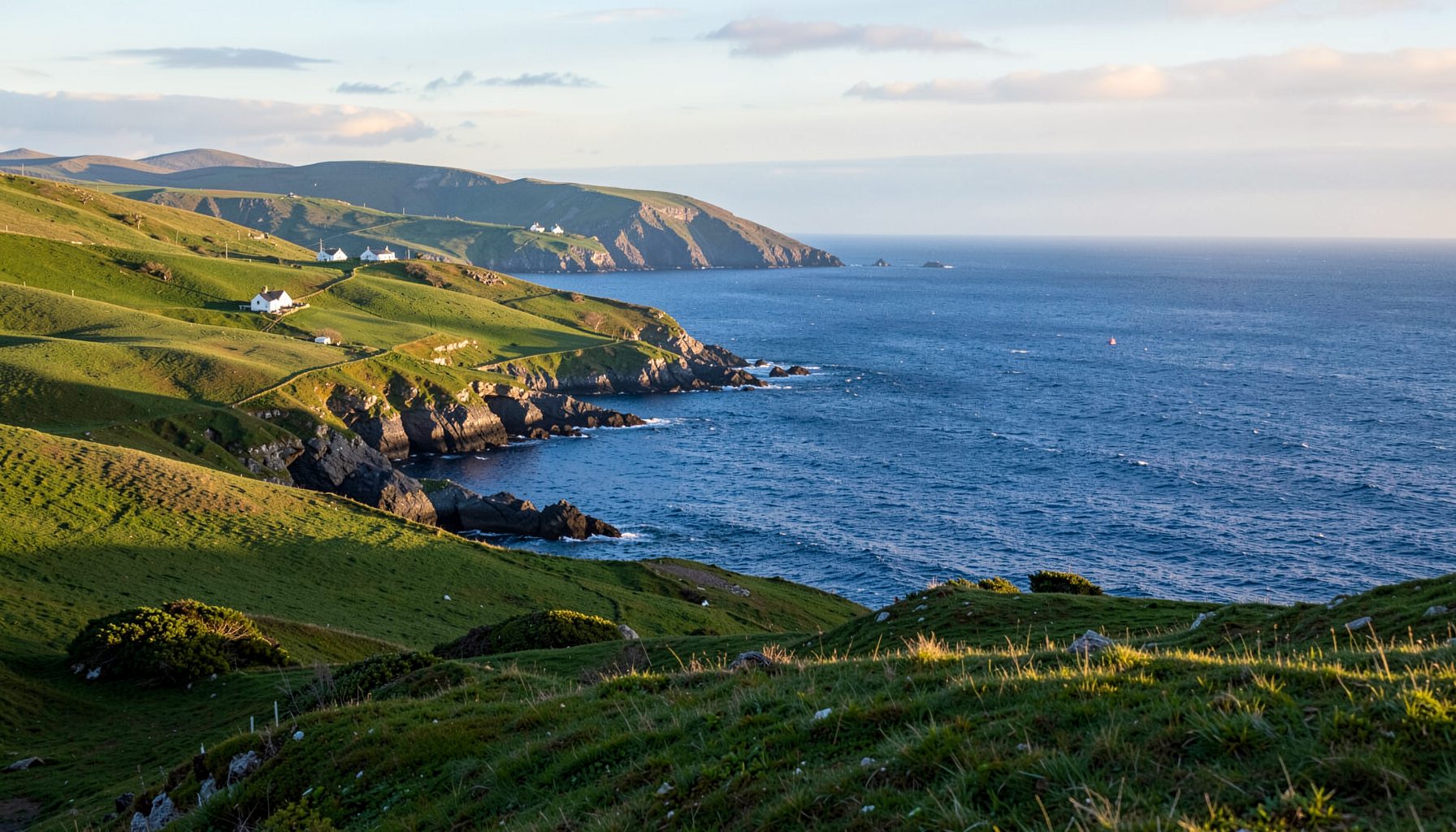
Exploring the ruins of Ballycarbery Castle
Ballycarbery Castle stands on a grassy rise above the shoreline near Cahersiveen, where the broad waters of Valentia Harbour meet the rugged landscape of the Iveragh Peninsula. Its broken walls, ivy-covered stonework and dramatic coastal setting make it one of the most recognisable historic sites along the Skellig Coast.
The castle is often pictured against the mountains and sea, yet its appeal reaches beyond scenery. Ballycarbery reflects the political history of Gaelic Ireland, the changing fortunes of local families and the upheavals that reshaped County Kerry during the seventeenth century. Even in ruin, it gives a strong sense of the landscape’s past.
A visit works best when combined with nearby heritage sites, including the stone forts of Cahergall and Leacanabuaile, as well as Cahersiveen’s museums, churches and harbour. Visitors can also check local updates for community events, seasonal information and activities taking place across the wider region.
The setting beside Valentia Harbour
Ballycarbery Castle is located a short distance west of Cahersiveen, close to the coast and within view of Valentia Island. The surrounding fields slope gently towards the water, while the Skellig region’s hills rise behind the town and create a powerful backdrop. This combination of sea, pasture and mountain gives the ruins much of their visual character.
The castle does not stand in an isolated wilderness. It belongs to a lived-in rural landscape of roads, farms and working fields, so the approach should be treated with care and respect. Some viewpoints are available from the public road, while access close to the structure may be restricted. The ruin itself is unsafe to enter, with unstable masonry, uneven ground and exposed sections of wall.
Weather can change quickly on the Iveragh Peninsula. Rain may make grass and paths slippery, and strong coastal winds can make the open site feel colder than expected. Sturdy footwear and a little extra time for viewing the castle from safe positions will make the experience more comfortable.
A castle shaped by Gaelic power
Ballycarbery is generally associated with the MacCarthy family, a powerful Gaelic dynasty whose influence extended across much of south-west Ireland. The castle is thought to date mainly from the sixteenth century, although it may have replaced an earlier fortified residence on the same site. Like many Irish tower houses and fortified homes, it combined domestic living space with defensive features.
The surviving structure includes substantial stone walls, tall gables and traces of multiple levels. Its original appearance would have been more complete, with floors, roofs, internal partitions and functioning fireplaces transforming the building from a shell into a residence. The height and thickness of the walls still suggest the importance of the people who occupied it.
A castle such as Ballycarbery was more than a military stronghold. It was a household centre, a symbol of authority and a place where local relationships were managed. The surrounding land supported the household, while the elevated position offered visibility across approaches by land and sea.
The marks left by conflict
The seventeenth century brought severe disruption to Gaelic families throughout Ireland. The Confederate Wars, the campaigns of Oliver Cromwell and later changes in land ownership weakened the old political order. Ballycarbery is traditionally linked with damage caused during the Cromwellian period, although the exact sequence of events and the extent of deliberate destruction are difficult to establish from surviving evidence.
Historic ruins can encourage simple stories about a single battle or attack, but their decline was often gradual. Abandonment, weather, vegetation, removal of stone and the loss of regular maintenance all contributed to the condition seen today. The castle’s broken walls therefore represent several layers of change rather than one clearly documented moment.
This uncertainty adds value to a visit. Looking closely at blocked openings, wall thickness, projecting stonework and surviving architectural details can prompt questions about how the building was used. The ruin invites interpretation, but it also reminds visitors that local history is built from documents, archaeology, oral tradition and careful comparison with similar sites.
What to notice at the ruin
The most striking feature is the castle’s scale. Even without its roof and floors, the remaining walls rise prominently above the surrounding landscape. The tall gables provide a recognisable outline, while sections of rough stonework show how the building has weathered over centuries.
Look for the relationship between the castle and its surroundings rather than focusing only on individual stones. The elevated ground offers views towards Valentia Harbour, and the position would have connected the residence visually with important routes across the peninsula. The site also demonstrates how historic buildings were placed within working landscapes rather than separated from everyday life.
Photography is especially rewarding in changing light. Morning mist can soften the mountains, while late afternoon light may bring out the texture of the masonry. A respectful distance usually produces better images than attempting to approach unstable walls. Avoid climbing, leaning against the structure or disturbing vegetation and stone.
The following nearby features can help place Ballycarbery within the wider heritage of the area:
| Feature | What it adds to a visit | Approximate relationship |
|---|---|---|
| Cahergall stone fort | A remarkably preserved circular ringfort with strong dry-stone walls | Near Cahersiveen |
| Leacanabuaile fort | A second early medieval settlement site with a different character | Close to Cahergall |
| Cahersiveen | Local history, services, harbour views and access to regional attractions | Short drive from Ballycarbery |
| Valentia Island | Maritime history, coastal scenery and links across the harbour | Visible from the castle area |
| Skellig Michael | A major monastic and cultural landmark offshore | Further along the coast, subject to boat access |
Pairing the castle with nearby heritage
Ballycarbery Castle is best understood as part of a compact group of historic places around Cahersiveen. Cahergall and Leacanabuaile are particularly important companions because they represent an earlier period of settlement. Their circular stone walls and enclosed spaces offer a contrast with Ballycarbery’s later tower-house architecture.
Cahergall is known for its impressive dry-stone construction and carefully shaped interior terraces. Leacanabuaile provides another perspective on fortified domestic life in the early medieval period. Visiting both forts before or after the castle creates a clearer sense of how settlement, defence and family life changed across the centuries.
Cahersiveen itself provides a useful base for exploring the area. The town connects local heritage with modern community life, and visitors can find places to pause, learn more about the region and continue towards the Skellig Coast. Further west, the route leads towards coastal viewpoints, island crossings and the wider heritage landscape associated with Skellig Michael.
A respectful and practical visit
Because Ballycarbery is a ruin rather than a maintained visitor attraction, expectations should be set accordingly. There may be no interpretation panels, staffed entrance or formal facilities at the site. Check local conditions before travelling, remain on permitted routes and avoid entering the castle or crossing private land.
The location is rewarding for visitors interested in photography, architecture, archaeology and landscape history. It may be less suitable for anyone expecting a restored interior or a clearly marked tour. Children should be supervised closely around drops, rough ground and loose masonry, while dogs should remain under control and away from livestock.
A few simple habits protect the site for the future:
- View the castle from safe, permitted areas and never climb the walls.
- Keep gates closed and respect signs, boundaries and working farmland.
- Take litter home and avoid removing stones, plants or historic material.
- Wear weatherproof clothing and shoes with good grip.
- Combine the visit with Cahergall, Leacanabuaile or Cahersiveen rather than treating the ruin as an isolated stop.
These measures support both conservation and good relations with the people who live and work around the castle. Historic places remain part of their communities, and considerate behaviour helps preserve access to the wider landscape.
Reading the landscape around Ballycarbery
The castle’s position offers more than a scenic view; it reveals how geography influenced settlement on the Iveragh Peninsula. The sheltered waters near Cahersiveen supported movement, communication and trade, while the surrounding hills shaped travel routes and provided natural landmarks. Valentia Harbour connected the area to the coast and to island communities.
From the castle grounds or nearby viewpoints, the landscape can be read as a sequence of relationships: pasture around the ruin, the harbour beyond, Valentia Island across the water and mountain country inland. On clear days, the combination explains why this part of Kerry has attracted settlers, seafarers, pilgrims, artists and visitors for generations.
The wider Skellig Coast also contains layers from prehistoric, early Christian, medieval and modern history. A ruined castle, a ringfort and an island monastery belong to different eras, yet they occupy the same connected environment. Exploring them together turns a short visit into a more meaningful study of how people adapted to this remote Atlantic edge.
Making the castle part of a Kerry day
Allow enough time to slow down at Ballycarbery rather than treating it as a quick photograph from a car window. Notice the masonry, listen to the wind across the fields and compare the castle’s architecture with the stone forts nearby. The experience is quiet and atmospheric, especially outside the busiest periods.
A heritage-focused day might begin in Cahersiveen, continue to the nearby forts and then move towards the castle and harbour viewpoints. Local opening conditions, road access and weather should guide the order of the visit. Those travelling farther along the coast can connect the stop with other villages, cultural sites and outdoor activities across the peninsula.
Ballycarbery Castle has survived as a fragment, but the fragment is eloquent. Its walls preserve the outline of a former residence, its setting reveals the importance of the coast, and its relationship with nearby monuments places it within a much older story. Include the ruin in your Skellig Coast itinerary, explore it carefully, and give yourself time to encounter the history written across the surrounding landscape.